
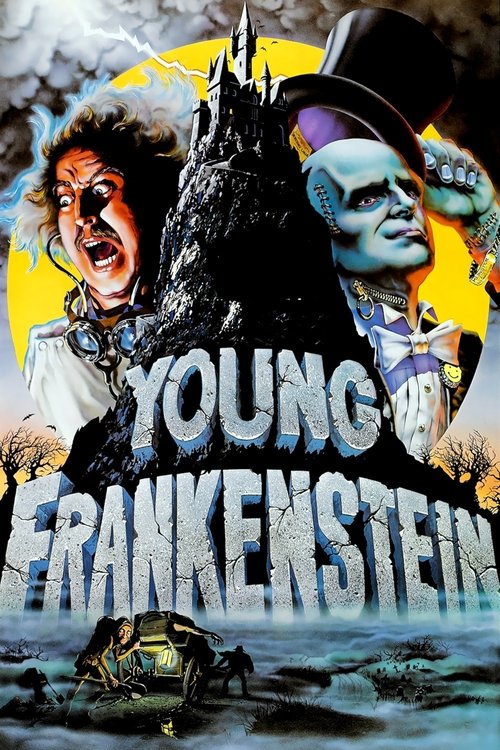
"The scariest comedy of all time!"
Young Frankenstein - Symbolism & Philosophy
Symbols & Motifs
The Abnormal Brain
The "Abby Normal" brain symbolizes the flaw in purely scientific ambition and the unpredictability of creation. Frederick plans meticulously, seeking the brain of a "scientist and saint," but Igor's mistake introduces chaos and humanity into the experiment. It suggests that perfection is unattainable and that the most interesting outcomes arise from imperfection.
Igor is sent to steal the brain of Hans Delbrück but drops it. He grabs another jar, which is labeled "Abnormal." This mistake is the direct cause of the Monster's initial violent and frightened behavior, forcing Frederick to use compassion rather than just science to solve the problem.
Igor's Moving Hump
Igor's migrating hump is a running gag that symbolizes the film's playful and self-aware absurdity. It constantly breaks the fourth wall of cinematic realism, reminding the audience that they are watching a comedy that gleefully defies logic for the sake of a laugh. It represents the film's irreverent spirit and its refusal to take itself, or its source material, too seriously.
Throughout the film, the hump on Igor's back appears on his left side, his right side, or in the middle, with no explanation. When Frederick offers to help him with it, Igor famously replies, "What hump?" This gag was improvised by actor Marty Feldman.
Violin Music
The violin music serves as a symbol of connection, soothing the savage beast and representing the legacy of the Frankenstein family. It is the key to calming the Monster, showing that art and emotion can tame what brute force cannot. It is also revealed that Frau Blücher uses it to communicate with and control the Monster, and that it was a passion she shared with Frederick's grandfather, linking the past to the present.
Frederick first discovers the secret laboratory by following the sound of violin music. Later, he uses the violin to soothe the enraged Monster, leading to a touching moment of understanding between creator and creation. Frau Blücher also reveals she would play the violin for Victor Frankenstein, her former lover.
Lightning
Lightning symbolizes the spark of life, divine power, and the chaotic forces of nature being harnessed by science. It is the essential element that animates the Monster, directly referencing the iconic creation scenes of the 1931 classic. It represents the moment of hubris where man plays God, bridging the gap between life and death.
During a thunderstorm, Frederick hoists the body of his creation to the roof of the castle. A massive bolt of lightning strikes the equipment, coursing through the body and bringing the Monster to life, leading to Frederick's triumphant scream, "It's alive!"
Philosophical Questions
What is the true nature of a 'monster'?
The film explores whether monstrosity is innate or created by societal reaction. Peter Boyle's Monster is initially violent due to an "abnormal" brain, but he is also frequently a victim of circumstance, reacting with fear to fire and the angry mob. His gentle moments with the blind hermit and the little girl, though comically disastrous, hint at a desire for connection. The film ultimately argues that a "monster" can be redeemed through compassion, education, and acceptance, as Frederick's guidance transforms him into a sophisticated gentleman.
Can one escape their family's legacy?
"Young Frankenstein" directly tackles the theme of nature versus nurture through Frederick's struggle with his identity. His initial, forceful rejection of his name and heritage proves futile. The narrative suggests that destiny and lineage are powerful forces. However, it also posits that one is not doomed to repeat the mistakes of the past. Frederick follows in his grandfather's footsteps but succeeds where he failed because he adds a crucial element: love. He doesn't just create life; he nurtures it, thus redeeming the Frankenstein name.
Where is the line between genius and madness?
The film humorously blurs this line. Frederick begins as a respected, rational scientist who views his grandfather as insane. Yet, as he delves into the reanimation experiments, he adopts the classic tropes of the "mad scientist"—the wild hair, the maniacal laughter, the passionate shouting. The film satirizes the idea that any pursuit of knowledge beyond conventional boundaries can be seen as madness by society. Frederick's success suggests that genius often requires a touch of what others perceive as insanity.
Core Meaning
The core meaning of "Young Frankenstein" revolves around the themes of heritage and acceptance. Director Mel Brooks, along with co-writer Gene Wilder, explores the idea that one cannot escape their roots, but can redefine them. Frederick Frankenstein begins the film by vehemently rejecting his lineage, but ultimately finds fulfillment and success only after he embraces his identity with the cry, "My name is Frankenstein!" The film suggests that true genius lies not in denying the past, but in learning from it and improving upon it. Frederick doesn't just replicate his grandfather's work; he nurtures his creation with kindness and understanding, ultimately succeeding where his ancestor failed by giving the Monster not just life, but a soul and a place in the world.