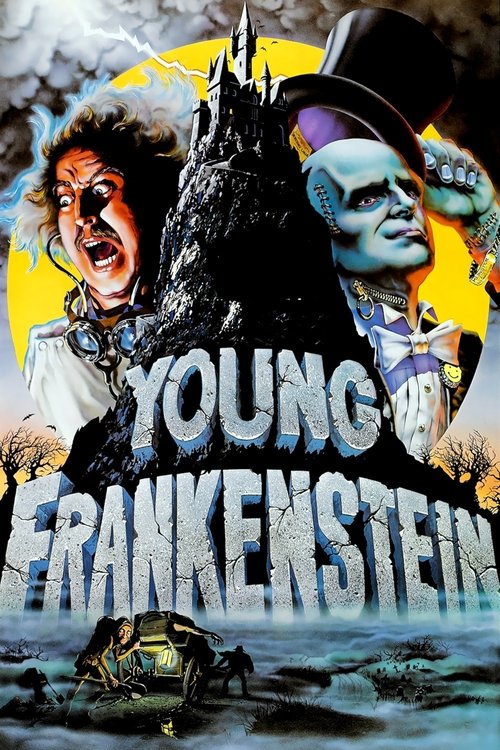
Young Frankenstein
A raucous, black-and-white love letter to 1930s horror, this comedy crackles with manic energy, offering a visually stunning and hilariously irreverent resurrection of a classic legend.
Young Frankenstein

Young Frankenstein

"The scariest comedy of all time!"

15 December 1974 United States of America 106 min ⭐ 7.9 (3,278)
Director: Mel Brooks
Cast: Gene Wilder, Peter Boyle, Marty Feldman, Madeline Kahn, Cloris Leachman
Comedy
Parody and Homage The Nature of Creation and Responsibility Science vs. Superstition Destiny and Identity
Budget: $2,800,000
Box Office: $86,273,333

Overview

"Young Frankenstein" follows Dr. Frederick Frankenstein (Gene Wilder), a brilliant American neurosurgeon who is deeply ashamed of his family's infamous legacy. He insists his name is pronounced "Fronkensteen" to distance himself from his grandfather, Victor Frankenstein, the notorious mad scientist. Upon inheriting the family estate in Transylvania, Frederick travels to Europe, intending only to settle his affairs. However, he is soon drawn into his grandfather's world by his quirky new assistants: the bug-eyed, hunchbacked Igor (Marty Feldman), whose hump seems to move on its own, and the lovely Inga (Teri Garr).

After discovering his grandfather's secret laboratory and a book titled "How I Did It," Frederick's scientific curiosity overtakes his skepticism. He decides to replicate the infamous experiments, successfully reanimating a massive corpse (Peter Boyle). Unfortunately, Igor has mistakenly supplied an "abnormal" brain, leading to chaotic and hilarious results. The film chronicles Frederick's frantic attempts to accept his heritage, control his creation, and prove to the skeptical and fearful townspeople—led by the rigid Inspector Kemp (Kenneth Mars)—that his monster is not a menace but a misunderstood being, culminating in an unforgettable song-and-dance number.
Core Meaning

The core meaning of "Young Frankenstein" revolves around the themes of heritage and acceptance. Director Mel Brooks, along with co-writer Gene Wilder, explores the idea that one cannot escape their roots, but can redefine them. Frederick Frankenstein begins the film by vehemently rejecting his lineage, but ultimately finds fulfillment and success only after he embraces his identity with the cry, "My name is Frankenstein!" The film suggests that true genius lies not in denying the past, but in learning from it and improving upon it. Frederick doesn't just replicate his grandfather's work; he nurtures his creation with kindness and understanding, ultimately succeeding where his ancestor failed by giving the Monster not just life, but a soul and a place in the world.

Thematic DNA

Parody and Homage 35%
The Nature of Creation and Responsibility 30%
Science vs. Superstition 20%
Destiny and Identity 15%

Parody and Homage

The film is a masterful blend of parody and heartfelt homage to the Universal horror films of the 1930s, particularly James Whale's Frankenstein (1931) and Bride of Frankenstein (1935). Mel Brooks meticulously recreated the aesthetic of these classics by shooting in black and white, using 1930s-style scene transitions, and even employing the original laboratory props designed by Kenneth Strickfaden. This loving recreation provides a genuine atmosphere that makes the slapstick, wordplay, and anachronistic gags even funnier by contrast.

The Nature of Creation and Responsibility

While played for laughs, the film echoes Mary Shelley's original theme of a creator's responsibility to his creation. Unlike his grandfather, who abandoned the Monster, Frederick initially reacts with fear but soon develops a paternal affection. He teaches the Monster, calms his fears, and ultimately risks his own life in a "transference" procedure to grant the Monster intelligence and speech. This relationship suggests that a creation is shaped by the love and guidance it receives, transforming a potential monster into a civilized being.

Science vs. Superstition

The film plays with the classic conflict between enlightened science and the fear-driven superstition of the villagers and Inspector Kemp. Frederick initially represents pure, detached science, dismissing his grandfather's work as nonsense. However, he soon finds himself swept up in the "mad science" he once scorned. The film satirizes both the arrogance of the scientific mind and the ignorance of the mob, suggesting a middle ground where intellect and emotion must coexist.

Destiny and Identity

A central struggle for the protagonist is his battle against his perceived destiny. Frederick's insistence on being called "Fronkensteen" is a futile attempt to escape his family's shadow. His journey is one of reluctant acceptance, culminating in a powerful moment where he screams, "My name is Frankenstein!" This embrace of his true identity is what allows him to finally succeed and find happiness, suggesting that one's true potential is unlocked by accepting all parts of oneself.

Character Analysis

Dr. Frederick Frankenstein

Gene Wilder

Archetype: The Reluctant Hero
Key Trait: Neurotic Brilliance

Motivation

Initially, his motivation is to distance himself from his family name and be respected as a serious man of science. This later shifts to an obsessive desire to prove that his grandfather's theories were correct and that re-animation is possible. Finally, his motivation becomes the protection and betterment of his creation.

Character Arc

Frederick begins as a man of logic, ashamed of his family's legacy and desperately trying to forge his own respectable identity. Upon arriving in Transylvania, his scientific curiosity is piqued, leading him down his grandfather's path. His arc is a journey from denial to acceptance. Initially terrified of his creation, he develops empathy and a sense of responsibility, ultimately embracing his name and heritage to save the Monster and the town. He transforms from a repressed scientist into a passionate, "mad" genius who integrates his intellect with his heart.

The Monster

Peter Boyle

Archetype: The Misunderstood Outcast
Key Trait: Childlike Innocence

Motivation

The Monster's initial motivation is simple survival and escape from frightening stimuli like fire. He seeks connection, as seen in his encounters with the little girl and the blind hermit, but his appearance and lack of communication skills cause terror. His ultimate motivation, after the transference, is to be loved and accepted.

Character Arc

The Monster begins as a violent, grunting creature, a result of the "abnormal" brain. He is driven by instinct and fear, lashing out at a world he doesn't understand. Through Frederick's patient teachings and kindness, the Monster begins to develop. His arc is a transformation from a frightening beast into a gentle and sophisticated being. This is symbolized by the famous "Puttin' on the Ritz" performance. In the end, after a brain transference, he becomes a highly intelligent and articulate individual capable of love.

Igor

Marty Feldman

Archetype: The Jester / Loyal Sidekick
Key Trait: Gleeful Absurdity

Motivation

Igor's primary motivation is to see the Frankenstein family business revived. He takes great pride in his lineage of serving Frankensteins and enthusiastically encourages Frederick to embrace his destiny. He is a loyal and (mostly) helpful assistant, driven by a love for the macabre and chaotic work of his master.

Character Arc

Igor does not have a significant character arc; he remains a constant source of comedic chaos and loyal support throughout the film. He is overjoyed at the prospect of Frederick continuing his grandfather's work and eagerly serves his new master. His pronouncements of his name ("Eye-gore") and his ever-shifting hump define his role as a meta-comedic character who exists to subvert expectations and deliver punchlines.

Elizabeth

Madeline Kahn

Archetype: The Spoiled Fiancée / The Damsel in Distress (subverted)
Key Trait: Dramatic Self-Absorption

Motivation

Elizabeth's initial motivation is maintaining her social standing and her carefully constructed, passionless relationship with Frederick. After her encounter with the Monster, her motivation shifts entirely to fulfilling her newfound desires, leading her to enthusiastically embrace her role as the Monster's partner.

Character Arc

Elizabeth starts as Frederick's cold, narcissistic, and comically chaste fiancée, whose affections are strictly hands-off. Her arc is one of surprising sexual awakening. When she is kidnapped by the Monster, she is initially terrified, but discovers he possesses qualities (and physical attributes) she has been missing. She transforms from a repressed socialite into a passionate woman who falls in love with the Monster, complete with a Bride of Frankenstein-inspired hairstyle.

Symbols & Motifs

The Abnormal Brain

Meaning:

The "Abby Normal" brain symbolizes the flaw in purely scientific ambition and the unpredictability of creation. Frederick plans meticulously, seeking the brain of a "scientist and saint," but Igor's mistake introduces chaos and humanity into the experiment. It suggests that perfection is unattainable and that the most interesting outcomes arise from imperfection.

Context:

Igor is sent to steal the brain of Hans Delbrück but drops it. He grabs another jar, which is labeled "Abnormal." This mistake is the direct cause of the Monster's initial violent and frightened behavior, forcing Frederick to use compassion rather than just science to solve the problem.

Igor's Moving Hump

Meaning:

Igor's migrating hump is a running gag that symbolizes the film's playful and self-aware absurdity. It constantly breaks the fourth wall of cinematic realism, reminding the audience that they are watching a comedy that gleefully defies logic for the sake of a laugh. It represents the film's irreverent spirit and its refusal to take itself, or its source material, too seriously.

Context:

Throughout the film, the hump on Igor's back appears on his left side, his right side, or in the middle, with no explanation. When Frederick offers to help him with it, Igor famously replies, "What hump?" This gag was improvised by actor Marty Feldman.

Violin Music

Meaning:

The violin music serves as a symbol of connection, soothing the savage beast and representing the legacy of the Frankenstein family. It is the key to calming the Monster, showing that art and emotion can tame what brute force cannot. It is also revealed that Frau Blücher uses it to communicate with and control the Monster, and that it was a passion she shared with Frederick's grandfather, linking the past to the present.

Context:

Frederick first discovers the secret laboratory by following the sound of violin music. Later, he uses the violin to soothe the enraged Monster, leading to a touching moment of understanding between creator and creation. Frau Blücher also reveals she would play the violin for Victor Frankenstein, her former lover.

Lightning

Meaning:

Lightning symbolizes the spark of life, divine power, and the chaotic forces of nature being harnessed by science. It is the essential element that animates the Monster, directly referencing the iconic creation scenes of the 1931 classic. It represents the moment of hubris where man plays God, bridging the gap between life and death.

Context:

During a thunderstorm, Frederick hoists the body of his creation to the roof of the castle. A massive bolt of lightning strikes the equipment, coursing through the body and bringing the Monster to life, leading to Frederick's triumphant scream, "It's alive!"

Memorable Quotes

It's pronounced 'Fronkensteen.'

— Dr. Frederick Frankenstein

Context:

Spoken early in the film during his medical lecture, when a student questions him about his notorious grandfather, Victor Frankenstein.

Meaning:

This line immediately establishes Frederick's central conflict: his shame and denial of his infamous family heritage. It's a recurring gag that highlights his desperate attempt to separate himself from the madness he perceives in his lineage.

What hump?

— Igor

Context:

Frederick, a brilliant surgeon, has just met Igor at the Transylvania train station and offers to help him with his prominent hump, to which Igor innocently replies, "What hump?"

Meaning:

This is a classic example of the film's absurd and fourth-wall-breaking humor. The joke lies in the obviousness of the hump, which Marty Feldman would secretly move between takes, and Igor's complete denial of its existence. It perfectly encapsulates the character's quirky and illogical nature.

Abby Normal.

— Igor

Context:

After the Monster is brought to life and proves dangerously volatile, Frederick confronts Igor about which brain he stole. Igor confesses he didn't get the brain of Hans Delbrück, but that of "Abby... Normal."

Meaning:

This is a pivotal pun that explains the Monster's violent behavior. Igor's innocent misreading of the label "Abnormal Brain" as a name, "Abby Normal," is a perfect blend of slapstick error and clever wordplay that drives the central conflict of the plot.

Puttin' on the Ritz!

— Dr. Frederick Frankenstein and The Monster

Context:

During a presentation to a skeptical scientific community, Frederick and the top-hat-and-tails-clad Monster perform a musical number to prove the creature's docility and intelligence.

Meaning:

This quote represents the peak of Frederick's attempt to present his creation as civilized and sophisticated. The song-and-dance number is a moment of pure, brilliant absurdity, showcasing the film's ability to blend classic horror tropes with vaudevillian comedy. It symbolizes Frederick's pride in his work and his affection for the Monster.

He vas my BOYFRIEND!

— Frau Blücher

Context:

Frederick confronts Frau Blücher, realizing she has been deliberately manipulating events to get him to continue his grandfather's work. As he connects the dots, she finally admits her romantic relationship with the late Victor Frankenstein.

Meaning:

This climactic confession from the stern, imposing housekeeper reveals her deep, personal connection to the Frankenstein legacy and explains her mysterious behavior throughout the film. It's a hilarious and unexpected punchline that adds a layer of absurd romance to the backstory.

Philosophical Questions

What is the true nature of a 'monster'?

The film explores whether monstrosity is innate or created by societal reaction. Peter Boyle's Monster is initially violent due to an "abnormal" brain, but he is also frequently a victim of circumstance, reacting with fear to fire and the angry mob. His gentle moments with the blind hermit and the little girl, though comically disastrous, hint at a desire for connection. The film ultimately argues that a "monster" can be redeemed through compassion, education, and acceptance, as Frederick's guidance transforms him into a sophisticated gentleman.

Can one escape their family's legacy?

"Young Frankenstein" directly tackles the theme of nature versus nurture through Frederick's struggle with his identity. His initial, forceful rejection of his name and heritage proves futile. The narrative suggests that destiny and lineage are powerful forces. However, it also posits that one is not doomed to repeat the mistakes of the past. Frederick follows in his grandfather's footsteps but succeeds where he failed because he adds a crucial element: love. He doesn't just create life; he nurtures it, thus redeeming the Frankenstein name.

Where is the line between genius and madness?

The film humorously blurs this line. Frederick begins as a respected, rational scientist who views his grandfather as insane. Yet, as he delves into the reanimation experiments, he adopts the classic tropes of the "mad scientist"—the wild hair, the maniacal laughter, the passionate shouting. The film satirizes the idea that any pursuit of knowledge beyond conventional boundaries can be seen as madness by society. Frederick's success suggests that genius often requires a touch of what others perceive as insanity.

Alternative Interpretations

While primarily a straightforward parody, some critical analysis offers alternative readings. One interpretation views the film as a metaphor for artistic creation. Frederick, representing a filmmaker or artist, struggles with the legacy of past masters (his grandfather). He attempts to create something new but is inevitably drawn to the old formulas. His eventual success comes from embracing and personalizing the past, not rejecting it. The "Puttin' on the Ritz" scene can be seen as the ultimate artistic presentation, where the creator and creation work in perfect, harmonious tandem.

Another interpretation views the film through a psychoanalytic lens. Frederick's journey to Transylvania is a journey into his own subconscious. He must confront his repressed "monstrous" heritage—the chaotic, primal urges represented by his grandfather's work—and integrate it with his controlled, scientific ego. The brain transference at the end symbolizes this integration, where Frederick gives some of his intellect to the Monster (his id) and in return, receives some of its potent life force (and, as implied, sexual prowess for his relationship with Inga). The ending, where both Frederick and the Monster find loving partners, represents a complete and healthy psyche.

Cultural Impact

"Young Frankenstein" was released in 1974 to both critical acclaim and massive commercial success, grossing over $86 million on a small budget. It arrived at a time when the classic horror genre was being overshadowed by more graphic films, and its success demonstrated a public appetite for affectionate, intelligent parody. Critics praised it as Mel Brooks' most disciplined and stylish film, a perfect marriage of his chaotic humor with a strong narrative and visual style.

The film had a profound influence on the genre of parody, proving that a spoof could be both hilarious and a loving tribute. Its success paved the way for future genre parodies like "Airplane!" and "The Naked Gun" which, like "Young Frankenstein," based their humor on a deep understanding and respect for the genres they were satirizing. The film's quotable lines, such as "Walk this way," "What hump?," and "Abby Normal," have become ingrained in pop culture.

In 2003, "Young Frankenstein" was selected for preservation in the United States National Film Registry by the Library of Congress as being "culturally, historically, or aesthetically significant," cementing its status as an enduring classic. In 2007, Brooks adapted the film into a successful Broadway musical, introducing the story to a new generation. Fifty years after its release, it remains a benchmark for comedy, celebrated for its brilliant script, iconic performances, and timeless humor.

Audience Reception

Upon its release, "Young Frankenstein" was met with widespread acclaim from both audiences and critics, becoming a significant box office success. Audiences embraced its clever blend of slapstick, witty wordplay, and affectionate homage to classic horror. On review aggregator Rotten Tomatoes, the film holds a 95% "Certified Fresh" rating, with a consensus stating, "Made with obvious affection for the original, Young Frankenstein is a riotously silly spoof featuring a fantastic performance by Gene Wilder." Viewers consistently praise the brilliant comedic performances of the entire cast, particularly Wilder's manic energy, Marty Feldman's absurd antics, and Peter Boyle's surprisingly touching portrayal of the Monster. The "Puttin' on the Ritz" sequence is universally cited as a highlight. While some minor criticism has pointed to occasional pacing issues or gags that don't land as well as others, the overwhelming verdict is that it is one of the funniest and most well-crafted comedies ever made. Its enduring popularity has solidified its status as a beloved cult classic.

Interesting Facts

  • The idea for the film originated with Gene Wilder, who wrote the initial premise. He was hesitant to show it to Mel Brooks, but eventually did during a break on the set of "Blazing Saddles".
  • Much of the laboratory equipment used in the film was the original set of props created by Kenneth Strickfaden for the 1931 "Frankenstein". Mel Brooks discovered Strickfaden was still alive and rented the equipment from him, giving him the screen credit he had been denied on the original film.
  • Mel Brooks insisted on filming in black and white to perfectly emulate the style of the 1930s Universal horror films. Columbia Pictures refused, so Brooks took the project to 20th Century Fox, which agreed to his condition.
  • Gene Hackman's cameo as the Blind Hermit was uncredited. Hackman was a friend of Gene Wilder's and wanted to try comedy. He improvised the line, "I was gonna make espresso," which caused the crew to burst out laughing.
  • Marty Feldman secretly moved Igor's hump from shoulder to shoulder as a prank. Mel Brooks found it so funny that he incorporated it into the film as a running gag.
  • The gag where Frederick and Igor use the phrase "Walk this way" inspired the Aerosmith song of the same name. The band saw the film and decided to write a song around the line.
  • Cloris Leachman's character name, Frau Blücher, is a running gag; every time her name is spoken, horses are heard neighing in terror. The reason for this is never explained.
  • Gene Wilder insisted that Mel Brooks not appear in the film, believing it would break the illusion and nostalgic feel of the movie. Brooks agreed, though his voice can be heard as a howling wolf and a screeching cat.

Easter Eggs

The character name "Hans Delbrück," whose brain Frederick initially wants, is a reference to a real German military historian and a nod to the intellectual, "saintly" brain Frederick desired for his creation.

This is an inside joke for history buffs, adding a layer of subtle, intellectual humor to the film. It contrasts sharply with the "Abby Normal" brain that Igor ultimately provides, heightening the comedy of the error.

The film directly recreates several specific scenes from the 1931 "Frankenstein" and its 1935 sequel "Bride of Frankenstein."

These scenes are not just parodies but shot-for-shot homages. Key examples include the Monster's encounter with the little girl by the lake and his meeting with the blind hermit (played by Gene Hackman). For viewers familiar with the original films, these moments serve as loving easter eggs that demonstrate the filmmakers' deep affection for their source material.

At the train station, Frederick asks a boy, "Pardon me, boy, is this the Transylvania Station?"

This is a direct, witty reference to the 1941 song "Chattanooga Choo Choo," which contains the lyric, "Pardon me, boy, is that the Chattanooga Choo Choo?" This anachronistic nod to a popular American song highlights the film's playful blending of old-world gothic horror with modern American comedy.

⚠️ Spoiler Analysis

Click to reveal detailed analysis with spoilers

Frequently Asked Questions

Explore More About This Movie

Dive deeper into specific aspects of the movie with our detailed analysis pages

Comments (0)

Leave a comment

No comments yet. Be the first to share your thoughts!