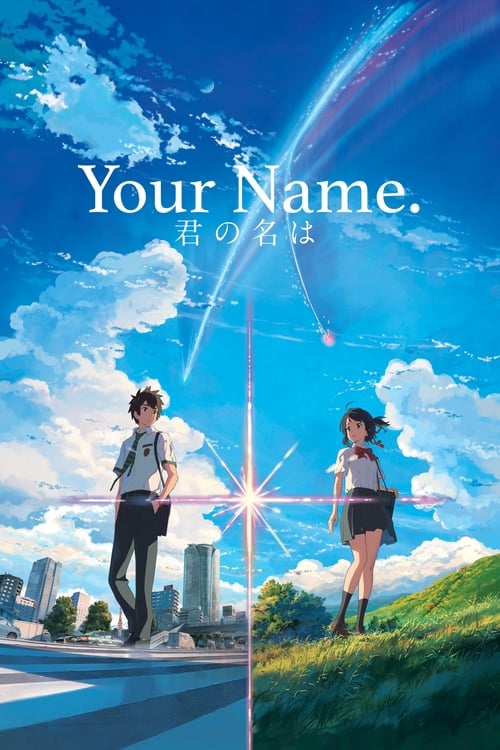
Your Name.
A visually stunning and emotionally resonant animated masterpiece where fleeting dreams and enduring connections paint a celestial romance against the backdrop of impending cosmic fate.
Your Name.
Your Name.

君の名は。

"Separated by distance, connected by fate."

26 August 2016 Japan 106 min ⭐ 8.5 (12,019)
Director: Makoto Shinkai
Cast: Ryunosuke Kamiki, Mone Kamishiraishi, Ryo Narita, Aoi Yuuki, Nobunaga Shimazaki
Drama Animation Romance
Connection and Fate Memory and Loss Tradition vs. Modernity Disaster and Hope
Box Office: $358,000,000

Your Name. - Ending Explained

⚠️ Spoiler Analysis

The central twist of "Your Name." is the revelation that Taki and Mitsuha are not living in the same time. There is a three-year gap between their timelines: when Taki is experiencing the body-swap in 2016, Mitsuha is living in 2013. This becomes devastatingly clear when Taki, after the swapping stops, embarks on a journey to find Mitsuha, only to discover that her entire town of Itomori was destroyed by a fragment of the Comet Tiamat three years prior, and she was among the 500 casualties.

This discovery transforms the film from a romantic comedy into a desperate race against time. Taki realizes his connection with Mitsuha is his only chance to change the past. He travels to the Miyamizu shrine's sacred place and drinks the 'kuchikamizake' that Mitsuha made. This ritualistic act allows him to connect with her one last time, initiating a final body-swap into her past self on the morning of the disaster.

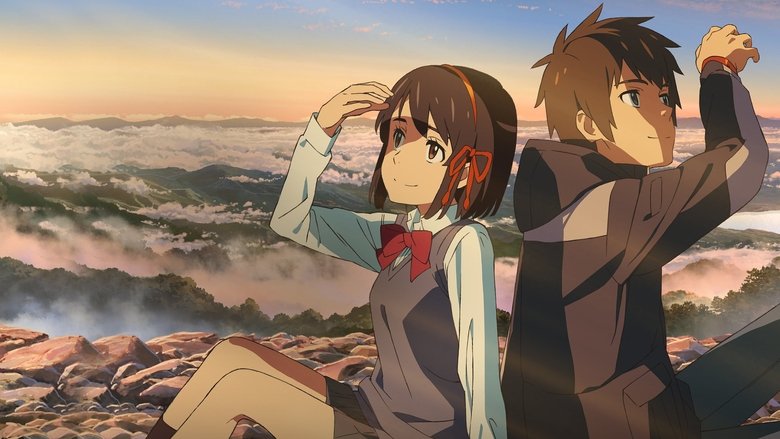
As Mitsuha, Taki enlists her friends Tessie and Sayaka in a plan to evacuate the town by creating a blackout and hijacking the town's broadcast system. The plan is complicated by Mitsuha's estranged father, the mayor, who refuses to believe the danger. The climax occurs at 'kataware-doki' (twilight) on the mountain. For a brief moment, the timelines converge, and Taki and Mitsuha meet in their own bodies. Taki returns her red braided cord and they try to write their names on each other's hands so they won't forget, but Mitsuha disappears before she can finish. When she looks at her hand, she finds Taki wrote "I love you" instead of his name. This emotional fuel gives her the resolve to convince her father and save the town.

The ending takes place five years after the successful evacuation of Itomori. Taki and Mitsuha have survived but have no clear memories of each other, only a persistent feeling of longing for a person they can't name. After several near-misses in Tokyo, they finally spot each other from parallel trains. They disembark and search for one another, finally meeting on a staircase. In the film's poignant final lines, they simultaneously ask, "Kimi no na wa?" ("Your name?"), signifying not an end, but the true beginning of their story.

Alternative Interpretations

While "Your Name." is widely seen as a romance, some interpretations delve deeper into its philosophical and metaphorical layers. One perspective is that the body-swapping is a metaphor for empathy and understanding. By literally walking in each other's shoes, Taki and Mitsuha transcend their personal and cultural differences (city vs. country, male vs. female) to form a profound connection based on shared experience. Their love is not just about romantic attraction, but about truly knowing and understanding another person from the inside out.

Another interpretation views the film as a commentary on memory and identity in the digital age. Taki and Mitsuha's primary mode of communication is through their phones, leaving digital diaries for each other. When their memories of each other fade, it's the digital and written records that initially serve as proof of their connection. However, the film ultimately emphasizes that true connection transcends these records, existing as a persistent feeling or a longing in the soul. This suggests that identity is not just the sum of our recorded memories but is also shaped by profound, emotionally resonant experiences that persist even when the details are lost.

Finally, the ending can be interpreted in a more bittersweet light. While they find each other, they are essentially strangers with a powerful, inexplicable sense of déja vu. Their journey to rebuild their relationship and memories is just beginning. This reading emphasizes the cyclical nature of their bond, suggesting that their reunion is not an end but a new beginning, another turn in the continuous thread of 'musubi'.