Your Name.
君の名は。
"Separated by distance, connected by fate."
Overview
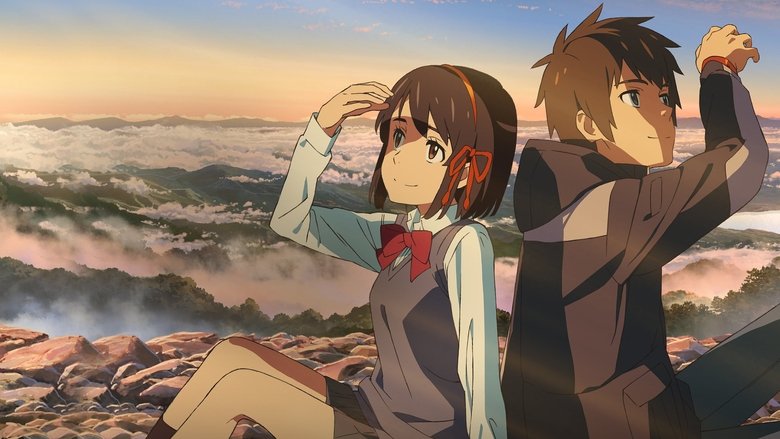
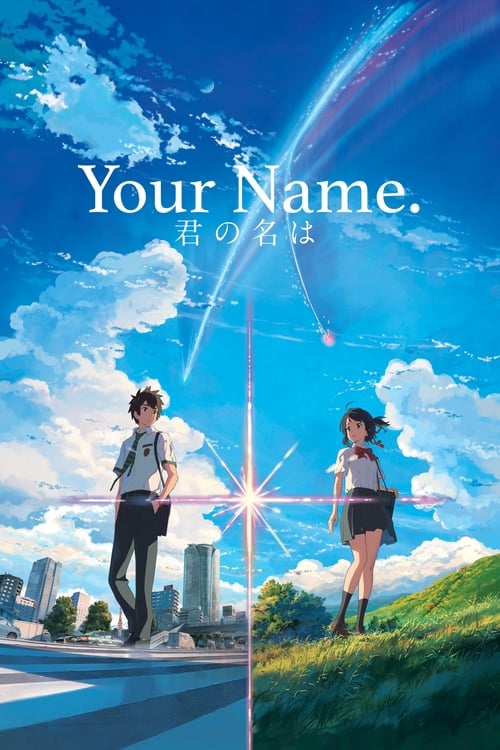
"Your Name." follows the intertwined destinies of two high school students: Mitsuha Miyamizu, a girl living in the rural town of Itomori, and Taki Tachibana, a boy from the bustling city of Tokyo. Bored with her quiet life, Mitsuha wishes to be a handsome Tokyo boy in her next life. Her wish seemingly comes true when she and Taki begin to inexplicably swap bodies on random days. Communicating through notes left on paper, their phones, and even their skin, they navigate each other's lives, forging a unique and profound bond despite never having met.
Mitsuha, in Taki's body, helps him get closer to his crush, while Taki, as Mitsuha, helps her become more popular. However, the body-swapping phenomenon abruptly ceases, leaving Taki with a lingering sense of loss and a determination to find Mitsuha. His journey to find her, guided only by his memories and sketches of her town's landscape, leads him to a startling revelation that redefines their connection and sets him on a desperate mission against time and fate.
Core Meaning
At its heart, "Your Name." explores the profound and often invisible connections that bind people together across time and distance. Director Makoto Shinkai delves into the themes of memory, loss, and the enduring power of relationships. The film suggests that even when memories fade, the emotional impact of a connection remains, leaving an indelible mark on one's soul. Furthermore, the narrative serves as a poignant reflection on the 2011 Great East Japan Earthquake, expressing a collective desire to rewrite history and prevent such tragedies. Shinkai himself stated that the disaster influenced his desire for a happy ending, reflecting a wish that such events could be undone. The film also touches upon the tension between tradition and modernity in Japanese society, as seen through Mitsuha's life in a traditional shrine family and her yearning for the contemporary world of Tokyo.
Thematic DNA
Connection and Fate
The central theme revolves around the invisible threads that connect individuals, often referred to as 'musubi'. This concept, explained by Mitsuha's grandmother, encompasses the intertwining of time, relationships, and destiny. The red braided cord that Mitsuha wears and later gives to Taki is a powerful symbol of this fated connection, linking them across a three-year time gap and ultimately guiding them back to each other. Their body-swapping experience, initially a bizarre phenomenon, becomes the very medium through which their destined bond is realized and strengthened.
Memory and Loss
The film intricately explores the transient nature of memory. As Taki and Mitsuha's connection deepens, their memories of each other begin to fade after the comet's impact, much like waking from a dream. This loss creates a profound sense of longing and a desperate search for something or someone they can't quite remember. The film beautifully illustrates that while specific recollections may disappear, the feelings and emotional imprints of a significant connection persist, driving the characters to find what they have lost.
Tradition vs. Modernity
"Your Name." presents a thoughtful contrast between the traditional, rural life of Mitsuha in Itomori and the fast-paced, modern existence of Taki in Tokyo. Mitsuha's duties as a shrine maiden and her participation in ancient rituals, such as creating 'kuchikamizake', are juxtaposed with her fascination for city life. This theme is not presented as a simple dichotomy but rather as a negotiation of identity for modern Japanese youth, who navigate the space between their cultural heritage and the influences of globalization.
Disaster and Hope
Inspired by real-life natural disasters in Japan, the film uses the fictional comet strike as a catalyst for its dramatic conflict. The impending doom and the subsequent effort to save the town of Itomori reflect a collective wish to avert tragedy and protect what is precious. It is a story of hope and resilience, suggesting that even in the face of catastrophic events, human connection and determination can lead to miraculous outcomes. Director Makoto Shinkai has mentioned that the 2011 earthquake influenced his decision to give the film a happy ending.
Character Analysis
Taki Tachibana
Ryunosuke Kamiki
Motivation
Initially, his motivation is to understand and cope with the body-swapping. Later, it becomes a desperate and heartfelt desire to find Mitsuha and, upon learning of her fate, to save her and her town from the comet disaster. In the end, his motivation is to reconnect with the person who left an indelible, albeit forgotten, mark on his soul.
Character Arc
Taki begins as an impulsive but well-meaning high school student in Tokyo, working part-time and aspiring to be an architect. Through his connection with Mitsuha, he becomes more empathetic and considerate. After her disappearance from his life, he embarks on a determined quest to find her, transforming from a passive participant in a strange phenomenon into an active hero fighting against fate to save the person he has come to love.
Mitsuha Miyamizu
Mone Kamishiraishi
Motivation
Her initial motivation is a deep yearning to escape her rural life and experience the excitement of Tokyo. As the story progresses, her motivation shifts to understanding her connection with Taki. Ultimately, her primary drive becomes the survival of her friends, family, and entire town, fueled by Taki's warning from the future.
Character Arc
Mitsuha starts as a kind-hearted but insecure girl, feeling stifled by her small town and her family's traditions. Her experience in Taki's body gives her a newfound confidence and a broader perspective on life. This growth is crucial as she is ultimately the one who must take decisive action to convince her estranged father and save her community. Her journey is one of self-discovery and empowerment, moving from a passive dreamer to a proactive savior.
Miki Okudera
Masami Nagasawa
Motivation
Her motivation is to support Taki, whom she cares for as a friend. She is intrigued by the changes in his personality and is instrumental in accompanying him on his trip to search for Itomori, providing a grounding and mature presence.
Character Arc
Okudera is Taki's stylish and mature coworker on whom he has a crush. Initially, she is an object of Taki's affection, but she develops a friendship with him (and by extension, Mitsuha in his body). She acts as a supportive and perceptive figure, noticing the changes in Taki and encouraging him on his journey to find Mitsuha, even though she doesn't understand the full story. Her arc is one of a supportive friend who helps the protagonist on his quest.
Hitoha Miyamizu
Etsuko Ichihara
Motivation
Her motivation is to preserve and pass down the traditions of the Miyamizu shrine to her granddaughters. She acts as a source of wisdom and provides the key philosophical framework for the story's events.
Character Arc
Mitsuha's grandmother is the head of the family shrine and the keeper of local traditions and lore. She doesn't have a significant personal arc but serves as a crucial figure who provides the spiritual and thematic context for the film's supernatural events. She explains the concept of 'musubi', which is central to understanding the film's philosophy. She reveals that both she and Mitsuha's mother experienced similar dream-like connections in their youth, hinting at a mystical family lineage.
Symbols & Motifs
The Red Braided Cord (Musubi)
The red cord symbolizes the concept of 'musubi' – the interconnectedness of all things, including time, fate, and human relationships. It represents the unbreakable bond and the red string of fate that connects Taki and Mitsuha across time and space.
Mitsuha wears the red cord in her hair and later gives it to Taki three years in her past (and his present). He wears it on his wrist as a good luck charm. The cord acts as a physical manifestation of their connection, and Taki's eventual return of it to Mitsuha during their twilight meeting signifies a crucial point in their intertwined destinies.
The Comet Tiamat
The comet represents both breathtaking beauty and devastating destruction. It is a celestial event that is both awe-inspiring and a harbinger of doom. It also serves as a powerful metaphor for the uncontrollable forces of nature and the fragility of life.
The comet is a central element of the plot, visible in the sky throughout the film. Its fragmentation is what leads to the destruction of Itomori in Mitsuha's timeline. Taki's foreknowledge of this event, gained through their body-swapping, drives the film's second half as he attempts to save her and the town.
Twilight (Kataware-doki)
Twilight, or 'kataware-doki', is depicted as a magical time when the boundaries between different worlds or dimensions blur. It is a moment when the supernatural can occur, a liminal space between day and night, reality and dream.
This is the time when Taki and Mitsuha are finally able to meet in person, in their own bodies, on the mountain near the shrine. Their brief, emotional encounter happens during this magical hour, allowing them to bridge the three-year gap that separates them before they are pulled back into their respective timelines.
Kuchikamizake (Ritual Sake)
The 'kuchikamizake', a traditional form of sake made by Mitsuha as part of a shrine ritual, symbolizes a deep connection to tradition, the town's history, and Mitsuha's spiritual lineage. It is described as containing a part of the maker's soul.
Taki drinks the kuchikamizake that Mitsuha made at the Miyamizu shrine's 'goshintai' (sacred body). This act allows him to reconnect with Mitsuha across time and space after their body-swapping has stopped, triggering a vision of her life and enabling him to enter her body one last time to try and save the town.
Memorable Quotes
Once in a while when I wake up, I find myself crying.
— Taki Tachibana & Mitsuha Miyamizu
Context:
The quote appears at the very beginning of the film, overlaid with stunning visuals of the comet, immediately setting a tone of poignant melancholy and foreshadowing the journey of memory and connection that is to come.
Meaning:
This opening line, recited by both protagonists, establishes the film's central mystery and emotional core. It signifies the lingering, subconscious feeling of loss and longing that both Taki and Mitsuha experience, even without concrete memories of each other. It's the emotional echo of a connection that their conscious minds can't grasp.
Musubi is the old way of calling the local guardian god. This word has profound meaning. Tying threads is Musubi. Connecting people is Musubi. The flow of time is Musubi. These are all the god's power.
— Hitoha Miyamizu
Context:
Mitsuha's grandmother explains the meaning of 'musubi' to Mitsuha and her sister Yotsuha while they are making traditional braided cords. This scene is crucial for the audience to understand the deeper significance of the film's events and symbols, particularly the red cord.
Meaning:
This quote explains the film's central philosophy. 'Musubi' is the force that connects everything – people, time, and fate. It provides the spiritual framework for the body-swapping phenomenon and Taki and Mitsuha's bond, suggesting their connection is part of a larger, sacred design.
I'm always searching for something, for someone.
— Taki Tachibana
Context:
This is part of Taki's internal monologue in the film's epilogue, set five years after he saved Itomori. He is a university graduate searching for a job, but more importantly, he is searching for the source of his persistent sense of loss, leading him to unconsciously look for Mitsuha.
Meaning:
This line encapsulates the feeling of inexplicable longing that haunts Taki for years after the events of the comet. It speaks to the idea that a profound connection leaves a permanent void when it's forgotten, a feeling that something essential is missing without knowing what it is. It's a universal sentiment of searching for a purpose or a person to feel whole.
I wanted to tell you that… wherever you may end up in this world, I will be searching for you.
— Taki Tachibana
Context:
Taki says this to Mitsuha during their brief meeting at twilight on the mountain. It is one of the most emotionally charged moments of the film, as they finally see each other for the first time in their own bodies before being separated again by time.
Meaning:
This is a powerful declaration of love and commitment that transcends time and space. It solidifies the depth of Taki's feelings for Mitsuha and his determination to find her, no matter the obstacles. It's a promise that their bond cannot be broken by distance or fading memories.
Philosophical Questions
What is the nature of memory and its relationship to identity?
The film poses this question by having Taki and Mitsuha forget each other's names and their shared experiences. Despite this amnesia, a deep sense of longing and the feeling that they are missing someone important remains. This suggests that our identity is not solely constructed by our explicit memories but also by the emotional imprints left by profound connections. The feeling of knowing someone can be more powerful than the memory of them.
Can love and connection transcend the boundaries of time and space?
"Your Name." explores this question through its central premise. Taki and Mitsuha are separated by a three-year time gap, yet they form an intimate bond through the body-swapping phenomenon. The film uses the Shinto concept of 'musubi' (the interconnectedness of all things) to suggest that a powerful enough connection is not bound by physical laws, but is a force of fate that can weave together different timelines and destinies.
To what extent are our lives governed by fate versus free will?
The film presents a world where fate, symbolized by the red braided cord, plays a significant role in bringing Taki and Mitsuha together. However, their story is not one of passive acceptance. Taki actively chooses to defy Mitsuha's fate by using his knowledge of the future to intervene. Mitsuha, in turn, must use her free will and courage to convince her town to evacuate. The film suggests that while fate may connect people, it is their choices and actions that ultimately shape their destinies.
Alternative Interpretations
While "Your Name." is widely seen as a romance, some interpretations delve deeper into its philosophical and metaphorical layers. One perspective is that the body-swapping is a metaphor for empathy and understanding. By literally walking in each other's shoes, Taki and Mitsuha transcend their personal and cultural differences (city vs. country, male vs. female) to form a profound connection based on shared experience. Their love is not just about romantic attraction, but about truly knowing and understanding another person from the inside out.
Another interpretation views the film as a commentary on memory and identity in the digital age. Taki and Mitsuha's primary mode of communication is through their phones, leaving digital diaries for each other. When their memories of each other fade, it's the digital and written records that initially serve as proof of their connection. However, the film ultimately emphasizes that true connection transcends these records, existing as a persistent feeling or a longing in the soul. This suggests that identity is not just the sum of our recorded memories but is also shaped by profound, emotionally resonant experiences that persist even when the details are lost.
Finally, the ending can be interpreted in a more bittersweet light. While they find each other, they are essentially strangers with a powerful, inexplicable sense of déja vu. Their journey to rebuild their relationship and memories is just beginning. This reading emphasizes the cyclical nature of their bond, suggesting that their reunion is not an end but a new beginning, another turn in the continuous thread of 'musubi'.
Cultural Impact
"Your Name." was a cultural phenomenon upon its 2016 release, achieving unprecedented commercial and critical success. It shattered box office records in Japan, becoming the highest-grossing domestic film for a time and the highest-grossing anime film worldwide, surpassing the long-held record of Studio Ghibli's "Spirited Away". This success propelled director Makoto Shinkai to international stardom, with many critics dubbing him the "new Hayao Miyazaki", although Shinkai himself has humbly downplayed such comparisons.
The film's impact resonated deeply within Japan, partly due to its underlying themes of disaster and recovery, which struck a chord with a nation that had experienced the 2011 Great East Japan Earthquake. The story's wish-fulfillment narrative of averting a catastrophe offered a form of collective catharsis. Its stunningly realistic depiction of locations in Tokyo and Hida, Gifu Prefecture, led to a surge in "anime tourism," with fans making pilgrimages to the real-life spots featured in the film.
Internationally, "Your Name." was praised for its breathtaking animation, emotional depth, and intricate storytelling, introducing a new generation of viewers to anime beyond the works of Studio Ghibli. It demonstrated that non-Ghibli anime films could achieve massive mainstream success globally. The film's blend of modern romance, sci-fi elements, and traditional Shinto beliefs about connection and fate created a narrative that was both uniquely Japanese and universally appealing. Its success has also sparked a live-action American remake currently in development by Paramount Pictures and Bad Robot.
Audience Reception
Audience reception for "Your Name." was overwhelmingly positive, with viewers around the world praising its stunning visual artistry, compelling emotional narrative, and beautiful musical score by Radwimps. Many viewers were deeply moved by the love story between Taki and Mitsuha, finding their journey to be both heartwarming and heart-wrenching. The film's unique blend of genres—rom-com, sci-fi, and disaster drama—was frequently highlighted as a major strength, keeping audiences engaged with its unpredictable plot twists. The breathtakingly detailed animation, a signature of Makoto Shinkai, was universally acclaimed.
Criticism of the film, though minor, sometimes pointed to the complexity of the plot, particularly the rules of its time-travel and body-swapping mechanics, which some found slightly confusing on a first watch. A few critics felt the film's tone shifted somewhat abruptly from lighthearted comedy to high-stakes drama. However, the vast majority of audiences found the emotional core of the story to be so powerful that it overshadowed any minor plot ambiguities. The film's ending was a major point of discussion, with most viewers expressing immense satisfaction and relief at the hopeful and poignant reunion of the two protagonists.
Interesting Facts
- The animation director, Masashi Ando, has an extensive resume that includes working on acclaimed Studio Ghibli films like "Spirited Away" and Satoshi Kon's "Paprika".
- Director Makoto Shinkai also wrote the novelization of "Your Name.", which was published one month before the film's premiere. The novel is written from a first-person perspective, alternating between Taki and Mitsuha.
- The fictional town of Itomori was inspired by the real-life city of Hida in Gifu Prefecture and the area around Lake Suwa in Nagano Prefecture, which is Shinkai's home region.
- The names of the female characters in the Miyamizu family are thematically linked. The grandmother, Hitoha, means 'one leaf'; the mother, Futaba, means 'two leaves'; Mitsuha means 'three leaves'; and the younger sister, Yotsuha, means 'four leaves'.
- The comet in the film, Tiamat, is named after a primordial goddess in Mesopotamian mythology who is often associated with the ocean and creation, but also chaos. In the myth, her body is torn in half to create the heavens and the earth, mirroring how the comet splits in the film.
- The rock band Radwimps was involved in the film's production from the early stages, composing not only the soundtrack but also several vocal tracks that are integral to the film's narrative and emotional pacing.
- The film became the highest-grossing anime film of all time worldwide, surpassing Studio Ghibli's "Spirited Away", a title it held until it was overtaken by "Demon Slayer: Mugen Train" in 2020.
- The desire for a happy ending was heavily influenced by the 2011 Tōhoku earthquake and tsunami. Director Makoto Shinkai expressed that the catastrophic event made him want to create a story where such a tragedy could be averted.
Easter Eggs
Mitsuha's literature teacher at her high school is Yukari Yukino, the female protagonist from Makoto Shinkai's 2013 film, "The Garden of Words".
This is a direct and poignant cameo that connects the two films within a shared universe. For viewers of "The Garden of Words", it provides a glimpse into Yukino's life after the events of that film, showing that she returned to her hometown as she had planned.
The restaurant where Taki works part-time is named "Il Giardino Delle Parole".
This is the Italian translation for "The Garden of Words", another clear reference to Makoto Shinkai's earlier work. This Easter egg further solidifies the connection between his films.
Takao Akizuki, the male protagonist from "The Garden of Words", makes a very brief, silent cameo.
This is a much more subtle Easter egg than Yukari's appearance. He can be seen in the crowd on a bridge during one of the final scenes in Tokyo as Taki and Mitsuha are searching for each other. This detail was confirmed by director Makoto Shinkai.
The protagonists of "Your Name.", Taki and Mitsuha, both make brief cameo appearances in Shinkai's subsequent film, "Weathering with You" (2019).
This continues the tradition of creating a shared universe among Shinkai's works. It provides a satisfying glimpse for fans, showing Taki and Mitsuha in their lives after the events of their own film.
⚠️ Spoiler Analysis
Click to reveal detailed analysis with spoilers
Frequently Asked Questions
Explore More About This Movie
Dive deeper into specific aspects of the movie with our detailed analysis pages
Comments (0)
No comments yet. Be the first to share your thoughts!