At its heart, "Your Name." explores the profound and often invisible connections that bind people together across time and distance. Director Makoto Shinkai delves into the themes of memory, loss, and the enduring power of relationships. The film suggests that even when memories fade, the emotional impact of a connection remains, leaving an indelible mark on one's soul. Furthermore, the narrative serves as a poignant reflection on the 2011 Great East Japan Earthquake, expressing a collective desire to rewrite history and prevent such tragedies. Shinkai himself stated that the disaster influenced his desire for a happy ending, reflecting a wish that such events could be undone. The film also touches upon the tension between tradition and modernity in Japanese society, as seen through Mitsuha's life in a traditional shrine family and her yearning for the contemporary world of Tokyo.
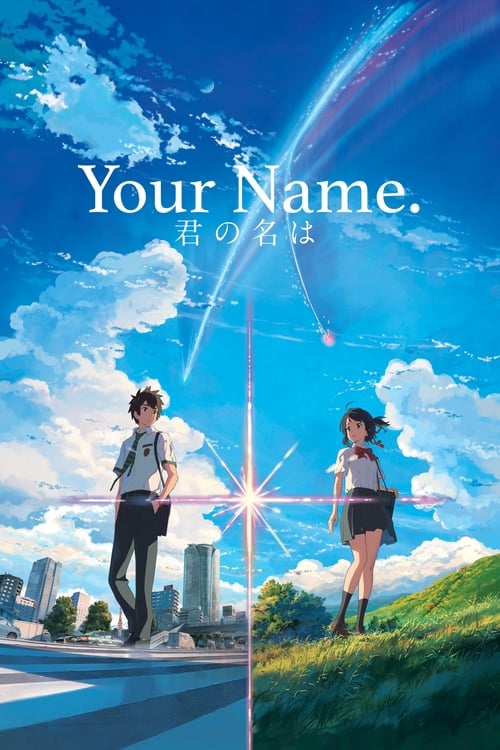
君の名は。
"Separated by distance, connected by fate."
Director: Makoto Shinkai
Cast: Ryunosuke Kamiki, Mone Kamishiraishi, Ryo Narita, Aoi Yuuki, Nobunaga Shimazaki
Your Name. — Symbolism & Philosophy
Symbols & Motifs
The Red Braided Cord (Musubi)
The red cord symbolizes the concept of 'musubi' – the interconnectedness of all things, including time, fate, and human relationships. It represents the unbreakable bond and the red string of fate that connects Taki and Mitsuha across time and space.
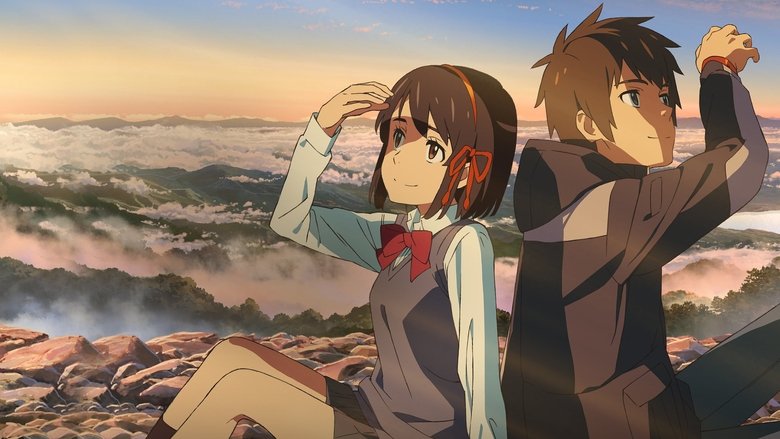
Mitsuha wears the red cord in her hair and later gives it to Taki three years in her past (and his present). He wears it on his wrist as a good luck charm. The cord acts as a physical manifestation of their connection, and Taki's eventual return of it to Mitsuha during their twilight meeting signifies a crucial point in their intertwined destinies.
The Comet Tiamat
The comet represents both breathtaking beauty and devastating destruction. It is a celestial event that is both awe-inspiring and a harbinger of doom. It also serves as a powerful metaphor for the uncontrollable forces of nature and the fragility of life.
The comet is a central element of the plot, visible in the sky throughout the film. Its fragmentation is what leads to the destruction of Itomori in Mitsuha's timeline. Taki's foreknowledge of this event, gained through their body-swapping, drives the film's second half as he attempts to save her and the town.
Twilight (Kataware-doki)
Twilight, or 'kataware-doki', is depicted as a magical time when the boundaries between different worlds or dimensions blur. It is a moment when the supernatural can occur, a liminal space between day and night, reality and dream.
This is the time when Taki and Mitsuha are finally able to meet in person, in their own bodies, on the mountain near the shrine. Their brief, emotional encounter happens during this magical hour, allowing them to bridge the three-year gap that separates them before they are pulled back into their respective timelines.
Kuchikamizake (Ritual Sake)
The 'kuchikamizake', a traditional form of sake made by Mitsuha as part of a shrine ritual, symbolizes a deep connection to tradition, the town's history, and Mitsuha's spiritual lineage. It is described as containing a part of the maker's soul.
Taki drinks the kuchikamizake that Mitsuha made at the Miyamizu shrine's 'goshintai' (sacred body). This act allows him to reconnect with Mitsuha across time and space after their body-swapping has stopped, triggering a vision of her life and enabling him to enter her body one last time to try and save the town.
Philosophical Questions
What is the nature of memory and its relationship to identity?
The film poses this question by having Taki and Mitsuha forget each other's names and their shared experiences. Despite this amnesia, a deep sense of longing and the feeling that they are missing someone important remains. This suggests that our identity is not solely constructed by our explicit memories but also by the emotional imprints left by profound connections. The feeling of knowing someone can be more powerful than the memory of them.
Can love and connection transcend the boundaries of time and space?
"Your Name." explores this question through its central premise. Taki and Mitsuha are separated by a three-year time gap, yet they form an intimate bond through the body-swapping phenomenon. The film uses the Shinto concept of 'musubi' (the interconnectedness of all things) to suggest that a powerful enough connection is not bound by physical laws, but is a force of fate that can weave together different timelines and destinies.
To what extent are our lives governed by fate versus free will?
The film presents a world where fate, symbolized by the red braided cord, plays a significant role in bringing Taki and Mitsuha together. However, their story is not one of passive acceptance. Taki actively chooses to defy Mitsuha's fate by using his knowledge of the future to intervene. Mitsuha, in turn, must use her free will and courage to convince her town to evacuate. The film suggests that while fate may connect people, it is their choices and actions that ultimately shape their destinies.
Core Meaning
Explore More About This Movie
Dive deeper into specific aspects of the movie with our detailed analysis pages