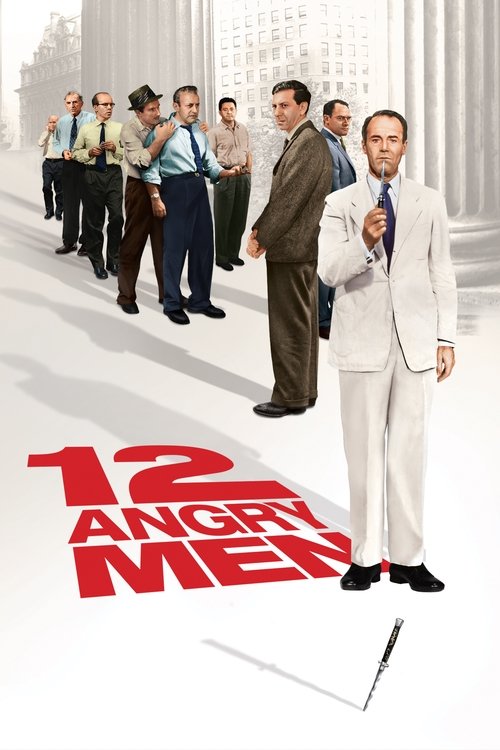
12 Angry Men
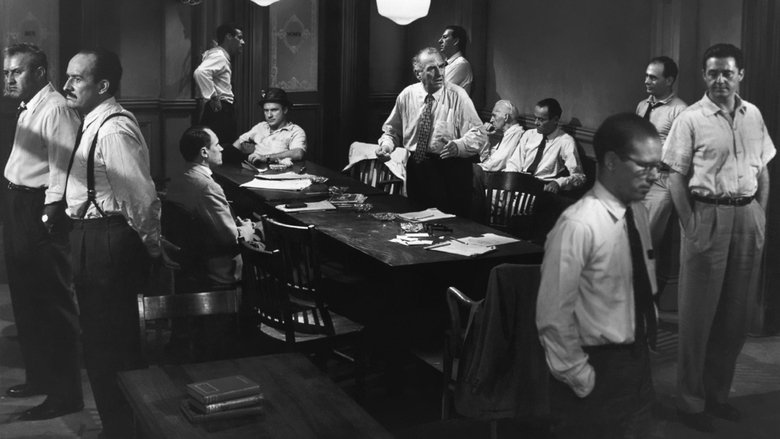
A sweltering huis clos drama where the weight of a life hangs in the balance, as twelve ordinary men become a storm of conflicting ideologies and hidden prejudices.
12 Angry Men
12 Angry Men

"It explodes like 12 sticks of dynamite!"

10 April 1957 United States of America 97 min ⭐ 8.5 (9,434)
Director: Sidney Lumet
Cast: Martin Balsam, John Fiedler, Lee J. Cobb, E.G. Marshall, Jack Klugman
Drama
Justice and Reasonable Doubt Prejudice and Bias The Power of the Individual Social Class and Environment
Budget: $397,751
Box Office: $4,360,000

12 Angry Men - Symbolism & Philosophy

Symbols & Motifs

The Switch Knife

Meaning:

The switch knife initially represents the seemingly irrefutable evidence of the defendant's guilt. However, when Juror 8 produces an identical knife, it symbolizes the introduction of reasonable doubt. The two knives represent two possible versions of reality: one where the boy is guilty and one where he is innocent. The knife ceases to be a unique object and becomes a symbol of the fallibility of evidence and the importance of questioning assumptions.

Context:

The prosecution claims the murder weapon is rare and unique. The jurors examine it, and it seems to be a key piece of evidence. The turning point comes when Juror 8 pulls an identical knife from his pocket, which he bought in the defendant's neighborhood, shattering the prosecution's claim of its uniqueness and opening the door for other jurors to reconsider their votes.

The Weather (Heat and Rain)

Meaning:

The oppressive heat in the jury room at the beginning of the film mirrors the simmering tension and anger among the jurors. The claustrophobic, sweltering environment reflects the high stakes and the heated, often irrational, arguments. The eventual thunderstorm that breaks symbolizes a catharsis, a washing away of prejudices and a clearing of the air. The rain brings a sense of relief and clarity as the jurors begin to reach a more reasoned consensus.

Context:

The film is set on the "hottest day of the year." The jurors are constantly shown sweating, fanning themselves, and complaining about the heat, which exacerbates their irritability. The fan in the room is initially broken, adding to the discomfort. The storm begins as the deliberations reach their most intense point, coinciding with a key shift in the voting, and the room cools as the truth becomes clearer.

Eyeglasses

Meaning:

The eyeglasses symbolize clarity of vision, both literally and figuratively. They become the key to dismantling the testimony of a crucial witness, representing the idea that what one perceives as fact may be flawed or incomplete. They highlight the theme that one must look closely and critically to see the truth, and that appearances can be deceiving.

Context:

Late in the film, Juror 9 observes Juror 4 rubbing the indentations on the bridge of his nose left by his eyeglasses. This leads to the realization that the female witness, who claimed to have seen the murder from across the street, had the same marks on her nose, indicating she was a glasses-wearer. The jurors deduce she likely wasn't wearing her glasses in bed and couldn't have seen the events as clearly as she testified, thus creating reasonable doubt about her testimony.

Philosophical Questions

What is the nature of truth and justice?

The film delves into the epistemological question of how we can know the truth. It suggests that "facts" are not always as solid as they appear and can be colored by perception, bias, and context. Justice, therefore, is not a simple matter of applying rules to facts, but a complex, fallible human process. The film explores the idea that true justice requires not just an examination of evidence, but also a deep self-examination of one's own prejudices and motives. It asks whether a truly objective verdict is possible when the decision-makers are inherently subjective human beings.

What is the moral responsibility of an individual within a collective?

"12 Angry Men" is a profound exploration of individual versus group morality. It poses the question of whether one has a duty to dissent when they believe the majority is wrong, even at the cost of conflict and ostracization. Juror 8's struggle highlights the tension between the desire for social harmony and the moral imperative to stand up for one's convictions. The film ultimately argues that the health and integrity of a democratic process, like a jury trial, depends on the willingness of individuals to take personal responsibility and challenge a potentially flawed consensus.

How do personal experiences and prejudices shape our perception of reality?

The film is a case study in how our internal worlds construct our external realities. Each juror's interpretation of the evidence is filtered through their own life experiences, social status, and prejudices. Juror 3's relationship with his son makes him see guilt, while Juror 5's experience in a slum allows him to see a detail others miss. The film asks the viewer to consider how their own biases affect their judgments. It suggests that achieving a more objective view requires acknowledging and actively questioning the lens through which we see the world.

Core Meaning

The core meaning of "12 Angry Men" revolves around the themes of justice, prejudice, and the paramount importance of civic duty and moral responsibility. Director Sidney Lumet and writer Reginald Rose crafted a powerful critique of the American jury system, emphasizing that justice is not a foregone conclusion but a fragile ideal that requires courage, reason, and empathy to uphold. The film argues that a single individual, through persistent and reasoned argument, can challenge the tide of popular opinion and prevent a miscarriage of justice.

The central message is a profound exploration of the concept of "reasonable doubt." It posits that the legal system's safeguard against wrongful conviction is only as strong as the individuals who comprise the jury. The film powerfully illustrates how personal biases, stemming from classism, racism, and personal history, can cloud judgment and obstruct the truth. Ultimately, "12 Angry Men" is a testament to the triumph of reason and compassion over prejudice and haste, championing the idea that true justice requires a willingness to question assumptions and to afford every individual a thorough and unbiased examination of the facts.