
빈집
"In the quietness of empty houses, love finds a voice."
3-Iron - Ending Explained
⚠️ Spoiler Analysis
The central twist of "3-Iron" occurs in its final act. After being arrested for trespassing and suspected murder (the elderly man they found had died of lung cancer), Tae-suk and Sun-hwa are separated. Sun-hwa is returned to her abusive husband, while Tae-suk is sent to prison. In his cell, Tae-suk diligently practices becoming invisible. He uses his time to master the art of hiding in the peripheral vision of his guards, moving silently and positioning himself in their blind spots until he can effectively vanish within the confined space. This is not just a clever trick; it is a spiritual and physical transformation.
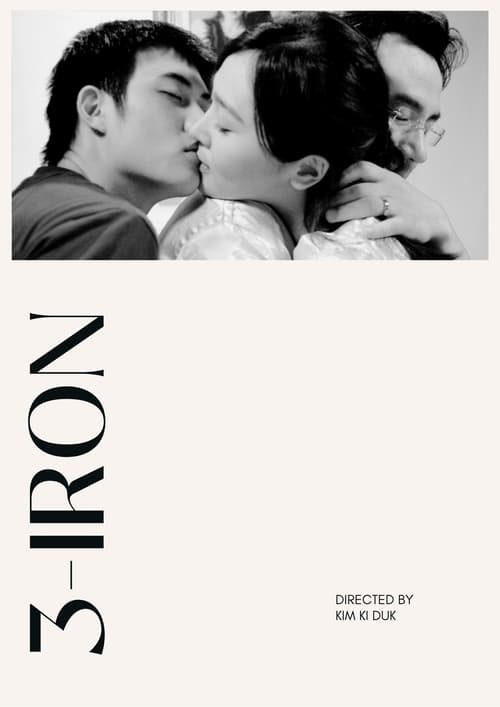
Upon his release, Tae-suk does not seek revenge or a dramatic reunion. Instead, he becomes a literal ghost in Sun-hwa's home. He lives there, unseen by her husband, shadowing his every move. The hidden meaning here is that Tae-suk has transcended the physical realm. He is no longer a person who needs to break into houses; he has become the ghost that haunts the space, a permanent, invisible presence. Sun-hwa is aware of him, and they share a life parallel to her marriage. The climax of this spectral existence is the final scene: she embraces her husband while kissing the invisible Tae-suk behind him, a perfect depiction of her dual reality. The final shot of them standing on a scale that reads "0" confirms their transcendence. Their love is weightless, not of the physical world, signifying that they have created their own reality, invisible to everyone else.
Alternative Interpretations
The film's ambiguous narrative, especially its ending, has generated numerous interpretations among critics and viewers.
- Tae-suk as Sun-hwa's Fantasy: One of the most popular interpretations is that Tae-suk is not a real person, but a figment of Sun-hwa's imagination. He is an idealized rescuer she creates to mentally escape her abusive marriage. His silent, gentle nature is the perfect antidote to her husband's loud, violent presence. In this reading, the entire journey is an internal one, and his "return" as a ghost is her final embrace of this fantasy, allowing her to find peace within her inescapable reality.
- Sun-hwa as Tae-suk's Fantasy: Director Kim Ki-duk himself suggested the reverse could also be true: that Sun-hwa is a fantasy created by the lonely Tae-suk. She represents the connection and purpose he lacks in his solitary life of drifting through empty homes. Their journey gives his existence meaning, and her presence is what he carries with him after his imprisonment.
- A Ghost Story: Another interpretation takes the film's events more literally, suggesting Tae-suk either dies in prison or achieves a state of spiritual enlightenment that allows him to become a ghost. His love for Sun-hwa is so strong that it transcends death or physical form, enabling him to return as an invisible protector and companion. The film then becomes a tale of love conquering all, even the boundary between life and death.
- A Metaphor for Class Struggle: Some analyses view the film through a socio-economic lens. Tae-suk, the homeless transient, represents the invisible and marginalized underclass. He temporarily inhabits the world of the affluent (symbolized by the empty houses and Sun-hwa's husband) but can never truly belong. His ultimate invisibility can be seen as a commentary on how society ignores the disenfranchised, who exist as ghosts within the system.