
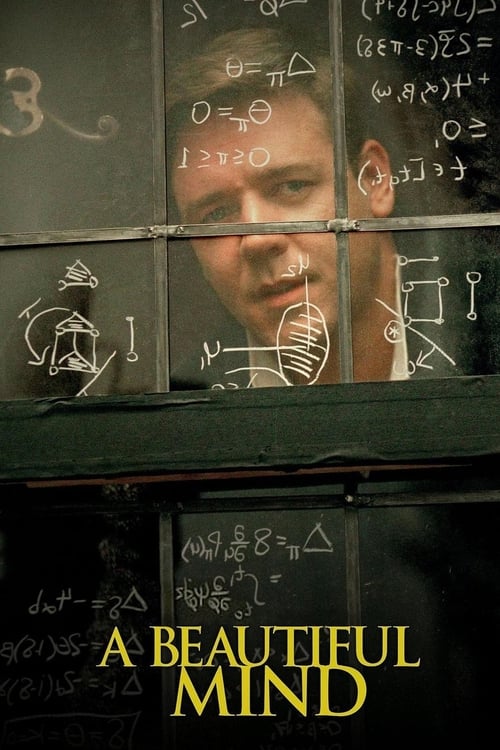
"He saw the world in a way no one could have imagined."
Director: Ron Howard
Cast: Russell Crowe, Jennifer Connelly, Ed Harris, Paul Bettany, Christopher Plummer
A Beautiful Mind — Characters & Cast
Character Analysis
John Forbes Nash, Jr.
Russell Crowe
Motivation
Initially, his motivation is purely intellectual and ego-driven: to create a "truly original idea" and matter in the world. After his diagnosis, his motivation shifts to survival and the desperate need to reclaim his mind and his life. Ultimately, his love for his wife Alicia becomes his primary reason to fight and endure.
Character Arc
John Nash begins as an arrogant, socially inept, and intensely ambitious Princeton graduate student, convinced of his own superiority yet insecure about his legacy. His descent into paranoid schizophrenia transforms him into a fearful and tormented man, isolated by a reality he can't trust. Through the unwavering support of his wife Alicia and his own incredible force of will, he gradually learns to manage his condition. He evolves from someone who fights his delusions to someone who accepts and coexists with them, ultimately becoming a humbled, beloved, and Nobel Prize-winning figure who values love and relationships over intellectual acclaim.
Alicia Nash
Jennifer Connelly
Motivation
Her primary motivation is her deep and abiding love for John. She is driven by a need to believe that "something extraordinary is possible" – that they can overcome his schizophrenia together and that the brilliant man she fell in love with is still there.
Character Arc
Alicia starts as a bright, confident physics student who is intrigued by John's eccentric genius. After falling in love and marrying him, her life is upended by his diagnosis. She transforms from a romantic partner into a resilient and fiercely protective caregiver. Her journey is one of immense sacrifice and strength, as she navigates the pain and fear of John's illness. Despite moments of despair, she makes the conscious choice to stand by him, becoming the anchor that saves him from being lost to his illness entirely. Her love matures from infatuation into a profound, enduring commitment.
William Parcher
Ed Harris
Motivation
As a figment of Nash's imagination, Parcher's motivation is a projection of Nash's own desires and fears. He represents Nash's yearning for importance beyond academia and, later, his deep-seated paranoia and the aggressive, self-destructive aspects of his illness.
Character Arc
Parcher appears as a charismatic and menacing government agent who recruits Nash into the world of espionage. He represents purpose, danger, and national importance, feeding into Nash's ego and desire to matter. His arc is entirely illusory; he is a hallucination. He transitions from a commanding figure of authority to a threatening tormentor who embodies Nash's paranoia and fear of failure, goading him even as Nash tries to reclaim his sanity.
Charles Herman
Paul Bettany
Motivation
As a hallucination, Charles's motivation is to provide the friendship, encouragement, and emotional support that John desperately craves but is unable to find. He fills the void of Nash's social isolation.
Character Arc
Charles is introduced as John's cheerful, literary, and supportive Princeton roommate, the one person who seems to understand and accept him. He acts as John's social guide and confidant. The shocking reveal is that Charles, along with his young niece Marcee, is a hallucination. His arc is a complete fabrication of Nash's mind, representing a deep-seated need for friendship and human connection that Nash struggled to achieve in reality. He remains a presence in Nash's mind, a symbol of a companionship that was never real.
Cast
Explore More About This Movie
Dive deeper into specific aspects of the movie with our detailed analysis pages