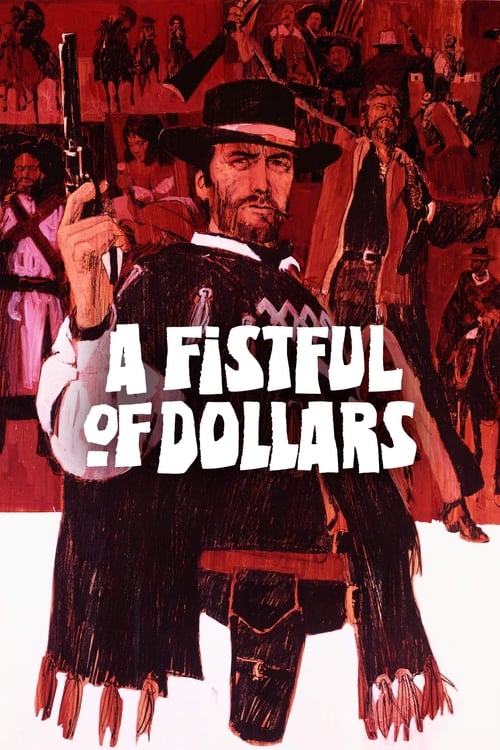
A Fistful of Dollars
A dust-choked Spaghetti Western odyssey where a lone, amoral gunslinger's arrival ignites a maelstrom of greed and violence, painting the desert town red with avarice.
A Fistful of Dollars

Per un pugno di dollari

"In his own way he is, perhaps, the most dangerous man who ever lived!"

12 September 1964 Germany 99 min ⭐ 7.8 (4,522)
Director: Sergio Leone
Cast: Clint Eastwood, Marianne Koch, Gian Maria Volonté, Wolfgang Lukschy, Sieghardt Rupp
Western
Greed and Capitalism The Anti-Hero Cynicism and Violence Deconstruction of the Western Genre
Budget: $200,000
Box Office: $14,500,000

A Fistful of Dollars - Ending Explained

⚠️ Spoiler Analysis

The central twist of "A Fistful of Dollars" is the Stranger's masterful manipulation of both the Rojo and Baxter families. He is not loyal to either side; his allegiance is solely to himself and his pursuit of money. A key plot point is his decision to help Marisol and her family escape from the clutches of Ramón Rojo. He creates a diversion, making it appear as though the Baxters were responsible for her rescue, which incites the Rojos to launch a full-scale, bloody assault on the Baxters, wiping them out.

After being brutally beaten by the Rojos for his betrayal, the Stranger escapes with the help of the coffin-maker, Piripero. He recovers in hiding while the Rojos, believing him to be an ally of the Baxters, torture the bartender Silvanito to find him. The film's climax reveals the Stranger's cleverest trick. He returns for a final showdown with Ramón, wearing a makeshift steel chest plate under his poncho. Ramón repeatedly shoots him in the chest to no effect. This apparent invulnerability unnerves Ramón and his men, allowing the Stranger to pick them off before facing Ramón in a quick-draw duel, which the Stranger handily wins. Having eliminated both families, he leaves the now-peaceful town, his job done, without taking any of the families' money, reinforcing his enigmatic nature.

Alternative Interpretations

One interpretation of the film views the Man with No Name as a Christ-like figure or a savior. He arrives in a corrupt town, endures torture (a "passion"), disappears, and is seemingly resurrected to bring judgment upon the wicked and liberate the innocent (Marisol and her family). The final scene, where he emerges from smoke and dust, seemingly impervious to bullets, adds to this quasi-supernatural reading.

Another perspective interprets the film through a Marxist lens, with the warring families representing the ruling class, exploiting the townspeople (the proletariat) for their own gain. The Stranger, in this view, acts as an external force that disrupts the established power structure, leading to its self-destruction. His motivation for money can be seen as a critique of capitalism, as it is the driving force behind all the conflict and suffering in the town.