
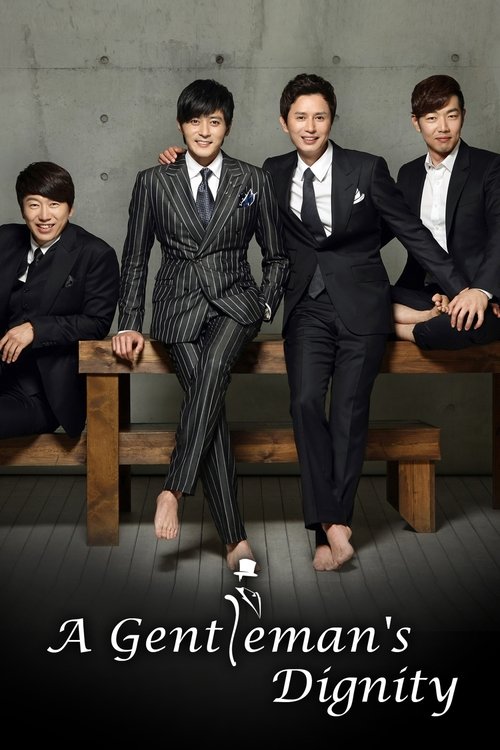
Full spoilers for all twenty episodes follow.
The first reversal. The series' opening move is to strip its most confident character of his advantage. Kim Do-jin, a self-assured playboy, falls for Seo Yi-soo and finds she does not give him the time of day — and then discovers that she is carrying a crush on his best friend, Im Tae-san. This gives a forty-year-old man his first one-sided love, and it means the central romance is entangled with the central friendship from the beginning. Everything afterwards is the working-out of that knot.
The four threads. Tae-san spends the run in a relationship with a cold-hearted woman while quietly wondering whether someone else exists for him — the show's study of romantic inertia. Choi Yoon, four years widowed, is presented as the group's steady centre and revealed as its most damaged member; his courtesy is a mechanism for not being asked how he is, and his arc moves from managed grief toward permitting himself to want something again. Lee Jung-rok, who married a wealthy older woman for money, faces a divorce that would end his comfortable life — a plot that begins as pure farce and becomes the series' bluntest test of the title, since he must find out whether he can actually love the person he has been living off.
The hinge. Do-jin's courtship of Yi-soo repeatedly stalls on the same flaw: he cannot be sincere without a joke attached. He runs an 'until the day we marry' campaign, presenting her with candy, a tiara and a dress at successive meetings — gifts that hurt rather than charm, because to Yi-soo the proposal reads as a gag. This is the drama's diagnosis of him made literal. Her own retrospective confession completes the picture from the other side: the butterflies when he spoke, the flutter at finding her photograph in his wallet, the wavering at 'Can you love me?' — an inventory of small, unperformed moments, none of them the grand gestures he was staging.
The finale. Realising the problem, Do-jin gathers his friends and colleagues and stages a public musical proposal to Lee Seung-gi's 'Will You Marry Me?', surrounded by the men and women of the ensemble. The scene is the resolution of the title: Do-jin acquires dignity precisely by surrendering the irony that constituted it, making himself undeniable and slightly ridiculous in front of everyone he knows. Episode 20 also frames Yi-soo through an interview (with Bae Ji-hyun cameoing as the interviewer), a final formal echo of the prologues that have been narrating this group's past all series.
What the ending actually says. Crucially, the series does not tidy everything: by the finale some relationships succeed and some fail, even as the overall close is a happy one. That asymmetry is the retrospective key to the whole show. The prologues have spent twenty episodes arguing that the friendship, not any romance, is the constant — so a finale in which couples come out unevenly but the four men remain a unit is the structure paying off, not compromising. Watched a second time, every cold-open anecdote reads as foreshadowing: the adult humiliations are reruns of adolescent ones, and the men's capacity to forgive each other in the present was established decades earlier, off-screen, before the story began.