
Skip to content
A Gentleman's Dignity
A sunlit, sharp-tongued romantic comedy about four men at forty, where friendship is the oldest wine in the cellar and love arrives late, awkwardly, and beautifully — like spring in a suit.
A Gentleman's Dignity

A Gentleman's Dignity

신사의 품격

26 May 2012 — 12 August 2012 South Korea 1 season 20 episode Ended 8.0 (152)

Cast: Jang Dong-gun, Kim Ha-neul, Kim Soo-ro, Kim Min-jong, Lee Jong-hyun

Drama Comedy Male friendship as the true romance What dignity means at forty Love after you already know how it ends Ageing, career and the plateau Grief and the impossibility of moving on schedule

Overview

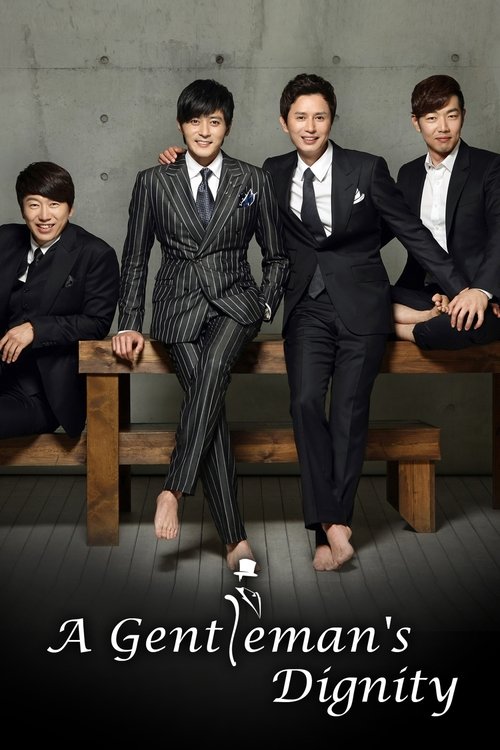
A Gentleman's Dignity (신사의 품격) is a twenty-episode South Korean romantic comedy that aired on SBS from 26 May to 12 August 2012, written by Kim Eun-sook and directed by Shin Woo-chul — the team behind Secret Garden, On Air, Lovers in Prague and Lovers in Paris. Rather than following teenagers or twenty-somethings, it follows four men in their forties who have been best friends since high school, tracking them through love, breakups, success and failure with equal amounts of comedy and bruise.

The quartet is built on contrast: Kim Do-jin (Jang Dong-gun), a scathingly witty architect; Im Tae-san (Kim Soo-ro), rough-edged but pure-hearted; Choi Yoon (Kim Min-jong), a considerate lawyer still carrying the loss of his wife four years earlier; and Lee Jung-rok (Lee Jong-hyuk), an idle philanderer whose comfortable life rests entirely on the wealthy older wife he may be about to lose. Around them orbit four women just as fully drawn, chief among them Seo Yi-soo (Kim Ha-neul), a strict high-school ethics teacher who moonlights as an umpire at amateur baseball games and who, to Do-jin's astonishment, is not remotely interested in him.

The series' signature device is a prologue at the head of nearly every episode — a flashback anecdote from the men's shared past, in high school, in college, in early adulthood — that quietly explains how these four became inseparable and why their present-day bickering carries so much weight. What follows is less a single love story than an ensemble portrait of middle age: careers that have plateaued or peaked, marriages that have curdled or never happened, grief that refuses a schedule, and the slow discovery that dignity is something you practise rather than possess.
Core Meaning

The title is the thesis. The series asks what dignity actually means for a man at forty — not the tailored-suit, wine-list, luxury-car surface the show lovingly photographs, but the harder version underneath: keeping your word, admitting a one-sided love, apologising to a friend, staying with grief instead of outrunning it, and telling the truth about money.

Kim Eun-sook's answer is that dignity is relational. It is not earned alone through success; it is granted and tested by the people who have known you longest. The prologues make the argument structurally — every adult humiliation or triumph is rhymed with an eighteen-year-old version of the same men — so that the show's real love story is the friendship, and the romances are what test it.

Its second, gentler claim is that love in midlife is not a diminished thing. It is slower, more embarrassing and better informed by failure, and the series treats a forty-year-old man's first experience of unrequited love as genuinely seismic rather than comic. The finale, in which some relationships hold and some do not, insists that a happy ending can accommodate loss.

Thematic DNA

Male friendship as the true romance 28%
What dignity means at forty 24%
Love after you already know how it ends 20%
Ageing, career and the plateau 16%
Grief and the impossibility of moving on schedule 12%

Male friendship as the true romance

The four men have been bound together since eighteen, and the series treats that bond as the load-bearing relationship of the whole run. The prologue flashbacks that open nearly every episode systematically build this history — schoolyard bravado, college humiliations, early-adult debts — so that by the later episodes a single glance between them carries decades. Across twenty episodes the friendship is stress-tested by money, by a friend's romance with the wrong person, by grief and by betrayal, and each time the show's answer is that these men return to the same table. Where a conventional romance would end on a couple, this one ends on the group.

What dignity means at forty

Each man embodies a different failing model of adult respectability: Do-jin's armour of wit, Tae-san's blunt pride, Yoon's impeccable politeness, Jung-rok's borrowed luxury. The series spends its run stripping these down. Do-jin's sharp tongue is exposed as cowardice about wanting things; Jung-rok's elegance is revealed to be financially dependent on a wife he has wronged; Yoon's composure is a way of not grieving. The recurring joke that these are 'gentlemen' becomes, by the end, sincere — dignity is relocated from surface to conduct.

Love after you already know how it ends

Every romance here is a second or third attempt. Do-jin, a confident playboy, experiences one-sided love for the first time in his life and finds himself outmatched by a woman who simply isn't interested. Yoon must decide whether loving again is a betrayal of a dead wife. Tae-san wonders, mid-relationship, whether someone else exists for him. Jung-rok has to earn back a marriage he treated as an allowance. The show's evolution is from flirtation to negotiation: by the final stretch the question is no longer 'will they' but 'can they be honest enough to deserve it'.

Ageing, career and the plateau

These are men at the top of their professions — architecture, business, law — and the drama is candid that arrival is its own crisis. Success does not resolve loneliness, and the younger characters around them (interns, students, a much younger admirer) function as mirrors showing what was traded away. The women, particularly Yi-soo as a teacher and amateur umpire, carry the same theme: adult life as a series of judgement calls made without an appeals process.

Grief and the impossibility of moving on schedule

Choi Yoon's widowerhood is the show's tonal ballast, the thread that keeps a glossy comedy honest. Four years after his wife's death he is still performing recovery for his friends' benefit. Over the run his storyline moves from suppression to admission to the tentative permission to want something again — and crucially, the series never asks him to stop mourning as the price of that. It is the strongest argument the show makes that its comedy is built over real grief.

Character Analysis

Kim Do-jin

Jang Dong-gun

Archetype: Charming antihero / reformed rake Key Trait: Devastating wit used as armour

Motivation

Initially the pleasure of winning and the maintenance of an unbothered image; increasingly, the specific and inconvenient wish to be chosen by one person who is unimpressed by all of it. By the end his motivation has shifted from being admired to being trusted.

Character Arc

An architect with a scathing tongue and total confidence with women, Do-jin begins the series believing he is unbeatable at romance. Meeting Seo Yi-soo, who does not give him the time of day and who is carrying a crush on his best friend Tae-san, hands him the first one-sided love of his life. His run is a long, funny demolition of his own defences: from performance to pursuit, from pursuit to actual vulnerability, and finally to a proposal he can only make by dropping the irony entirely and doing something publicly ridiculous in front of everyone he knows.

Seo Yi-soo

Kim Ha-neul

Archetype: Grounded heroine / moral centre Key Trait: Unbribable honesty

Motivation

Self-respect first, love second. She wants to be taken seriously — in the classroom, on the field, and in a relationship — and her evolution is from guarding that seriousness to trusting someone with it.

Character Arc

A strict high-school ethics teacher who moonlights as a baseball umpire, Yi-soo enters the story emotionally invested elsewhere — in Im Tae-san — and spends the early episodes refusing Do-jin's charm on principle. Her arc is one of hard-won discernment: learning to distinguish a man's performance from his character, articulating her own hurt rather than absorbing it, and demanding sincerity instead of spectacle. She is the character who most explicitly names the show's rule that men can be honest and inconstant on consecutive days.

All 5 characters and cast

Symbols & Motifs

The episode-opening prologue

Meaning:

A formal symbol of memory itself: the claim that no adult behaviour is legible without its adolescent original. It makes the past a permanent co-star rather than a flashback device.

Context:

A distinctive feature of the drama is that nearly every episode opens with a short anecdote about the four men's friendship through the years — high school, college, early adulthood — before the present-day story begins. The device teaches viewers to read every quarrel as a repetition.

The umpire's mask and the strike zone

Meaning:

Judgement, fairness and the loneliness of the person who has to make the call. Yi-soo's second job makes her, symbolically, the drama's moral arbiter — and the one everyone shouts at.

Context:

Seo Yi-soo is a strict high-school teacher who moonlights as an umpire at amateur baseball games, which is how she collides with the men's world. Her two jobs are the same job: deciding what counts as fair play, in ethics class and behind the plate.

The suit

Meaning:

The visible 'dignity' of the title — beautiful, expensive, and entirely external. The series uses tailoring as both aspiration and indictment.

Context:

The four leads are photographed as icons of grown-up style throughout the run; the show's fashion became one of its most-discussed features. The gag is that the better a man is dressed in a given scene, the more likely he is about to behave like a teenager.

The shared table

Meaning:

Continuity. The place where the group's accounts are settled — insults, confessions, apologies — and the physical proof that the friendship outlasts every romance.

Context:

Filming reportedly began with the first scene shot at a restaurant in Seocho-dong, Seoul, and the recurring restaurant-and-bar gatherings function as the series' equivalent of a home base across all twenty episodes.

The gifts that look like a joke

Meaning:

Do-jin's inability to be sincere without irony. Each object is a real feeling smuggled inside a punchline — and the reason his sincerity, when it finally arrives unarmoured, lands.

Context:

In the proposal storyline, Do-jin gives Yi-soo candy, a tiara and a dress at successive meetings, only for her to be hurt because the proposal seemed like he was joking — forcing him into the far more exposed public gesture that follows.

Memorable Quotes

Men like you one day, and the next day, they change their mind. The problem is that they're being honest both days.
— Seo Yi-soo

Context

Spoken by Yi-soo in the context of her wary early dealings with Do-jin, whose reputation precedes him. The line circulated widely in quote collections as the drama aired in 2012, and it sets the standard Do-jin spends the rest of the run trying to meet.

Meaning

The most quoted line of the series and, in miniature, its thesis about male behaviour. It refuses the easy consolation that inconstant men are liars — the crueller truth is that they mean it each time. It reframes the entire romance: Yi-soo's guardedness is not cynicism but accurate observation, and Do-jin's task becomes proving he can be honest on the same terms twice.

I got butterflies in my stomach when you said that. When I saw my picture in your wallet, my heart fluttered. When you said, 'Can you love me?' I wavered.
— Seo Yi-soo

Context

Yi-soo's retrospective accounting of the moments Do-jin got past her defences, including finding her photograph in his wallet — one of the small, unperformed gestures that undercut his cultivated cool.

Meaning

A rare moment of full disclosure from the drama's most self-protective character. By listing the exact instants she began to fall, Yi-soo turns her feelings into evidence — an inventory of small proofs rather than a grand declaration, which is precisely how this series believes adults fall in love.

All 4 quotes

Episode Highlights

Episode 1

S1E1

Establishes the entire architecture of the series in one hour: the four forty-something friends bound together since eighteen, the prologue flashback device that will open nearly every subsequent episode, and the collision between Kim Do-jin — a confident playboy at the height of his powers — and Seo Yi-soo, the teacher and amateur baseball umpire who is spectacularly unimpressed by him.

Significance:

Sets the show's controlling joke and its controlling ache in the same breath: these are grown men who behave exactly as they did at eighteen, and the series will spend twenty episodes deciding whether that is charming or a problem.

Episode 2

S1E2

Deepens the central reversal — Do-jin discovers that Yi-soo's interest lies with his best friend Im Tae-san, handing him the first one-sided love of his life. The friendship group's dynamics are complicated by a romance that cuts directly across them.

Significance:

Converts the premise from a standard rom-com chase into the drama's real engine: a man who has never lost learning what it costs to want someone who has already chosen otherwise, with his oldest friend standing in the way.

Episode 5

S1E5

A mid-early episode notable for its guest turn — Sooyoung of Girls' Generation appears in a cameo — as the ensemble widens beyond the core eight and the series settles into its rhythm of alternating farce and quiet hurt.

Significance:

Marks the point where the drama's confidence as a pop-cultural event matched its storytelling, folding star cameos and fashion-forward spectacle into what remained a character study of middle age.

Episode 16

S1E16

Deep in the final act, the series brings its accumulated pressures to bear at once: the romances have moved past flirtation into questions of honesty and commitment, Choi Yoon's grief plot approaches its reckoning, and Lee Jung-rok's marriage crisis stops being purely comic.

Significance:

The pivot from comedy of manners to consequence. Everything the prologues have been quietly arguing — that these men repeat their eighteen-year-old selves — is put to the test as they are finally required to behave like adults.

Episode 20 (Finale)

S1E20

The finale delivers Do-jin's musical proposal to Yi-soo, staged with his friends and colleagues to Lee Seung-gi's 'Will You Marry Me?' after his earlier joke-gifts of candy, a tiara and a dress had wounded rather than charmed her. Bae Ji-hyun cameos as an interviewer questioning Seo Yi-soo. Some relationships succeed and some fail, but the series closes happily.

Significance:

Resolves the title. Do-jin can only propose by abandoning the irony that constituted his 'dignity', and the ending's willingness to let some couples not make it is what keeps the happy resolution honest rather than tidy.

Philosophical Questions

Can a person be honest and inconstant at the same time?

Yi-soo's most quoted line — that men like you one day and change their mind the next, and the problem is that they are honest on both days — poses this directly, and the series never fully resolves it. Instead it dramatises the consequences: if sincerity in the moment is not the same as reliability over time, then love requires a second virtue beyond honesty. Do-jin's entire arc is an attempt to supply that second virtue.

Is dignity something you have, or something you keep doing?

The four men each begin with a possessive model of dignity — reputation, wealth, manners, professional standing — and the series methodically shows each one failing under pressure. Jung-rok's borrowed luxury and Do-jin's protective wit are exposed as costumes. What survives is behavioural: apologising, staying, telling the truth about money. The show's answer is that dignity is a practice with no permanent balance.

Does loving again betray the person you lost?

Choi Yoon carries this question for four years of story time. The series is unusual in refusing the standard consolation that grief ends; his politeness is shown to be a way of postponing the question rather than answering it. His arc argues that new attachment and continued mourning can coexist, and that requiring a widower to 'move on' is itself a kind of cruelty.

How much of an adult is just the teenager they were, better dressed?

This is the argument built into the show's form. By opening nearly every episode with a flashback to the men at eighteen or twenty, the series makes each adult conflict a rerun with better tailoring. The question it leaves open is whether this continuity is a limitation to be overcome or the thing that makes the friendship possible at all.

How It Ends

Alternative Interpretations

The friendship reading versus the romance reading. The most common critical split is over what the show is actually about. Read one way, the romances are the plot and the friendship is texture; read the other way — and the prologue structure strongly supports this — the four men's bond is the primary love story and every romantic arc exists to test it. Under the second reading, the finale's mixed romantic outcomes are not a compromise but the point: couples may or may not survive, the group does.

Full ending explanation

Cultural Impact

A Gentleman's Dignity arrived in 2012 as a deliberate demographic gamble. Korean romantic television at the time was dominated by leads in their twenties; Kim Eun-sook and Shin Woo-chul, fresh off the enormous success of Secret Garden, instead built a weekend prime-time show around four men in their forties and the women their own age, insisting that mid-life could carry a glossy romantic comedy. Its casting was itself a statement — Jang Dong-gun, one of Korean cinema's biggest film stars, in a television lead role — and the show aired in the Saturday–Sunday 21:55 slot reserved for SBS's marquee titles.

Its most durable pop-cultural legacy is aesthetic. The series turned the tailored, self-possessed man in his forties into an aspirational figure, and its fashion and lifestyle presentation — suits, restaurants, architecture, wine — were widely imitated and endlessly discussed. The phrase 'gentleman' as applied to a certain kind of Korean drama male lead owes a great deal to this show. Its structural innovation, the recurring flashback prologue opening each episode, remains one of the more distinctive formal signatures in the writer's body of work.

It also functioned as a launchpad. Kim Woo-bin's visibility here is widely credited as the turning point toward his career as a leading actor, and the soundtrack — two OST albums totalling seven parts — produced Lee Jong-hyun's 'My Love', which won Best OST at the 22nd High1 Seoul Music Awards in 2013. Internationally the series has held up as a comfort-watch classic within the K-drama canon, retaining a 7.9 rating on IMDb and continuing to draw retrospective reviews and essays more than a decade on, including newer coverage in 2022 revisiting it as a milestone in the genre's treatment of adult romance.

Audience Reception

The series was received as a hit and has aged into a genre staple, holding a 7.9 user rating on IMDb and continuing to attract fresh reviews and retrospectives long after its 2012 run — including a 2022 revisit by The Kraze and a steady stream of blog-based reviews across the intervening decade. It was recognised at the 2012 SBS Drama Awards, and its soundtrack drew its own honours, with Lee Jong-hyun taking Best OST for 'My Love' at the 22nd High1 Seoul Music Awards in 2013.

What audiences praised. Consistently, three things: the chemistry and comic timing of the four male leads, the decision to centre characters in their forties and treat their romantic lives as serious business, and the prologue device, which reviewers repeatedly single out as the show's most charming and distinctive feature for the way it reveals how the men became inseparable. The Jang Dong-gun–Kim Ha-neul pairing was widely admired, and the finale proposal — staged to Lee Seung-gi's 'Will You Marry Me?' — was reported at the time as the drama's standout scene, described in coverage as better than a movie.

Points of criticism. Reviewers who came to it expecting a tightly plotted narrative tended to find it loose and episodic, more a hangout comedy than a story with momentum, with a mid-run stretch where the ensemble's subplots multiply faster than they resolve. The sheer glossiness — the suits, the restaurants, the wealth — struck some as fantasy rather than any recognisable portrait of middle age. Opinion also divides on the show's gender politics: Yi-soo's celebrated line about men's honest inconstancy reads to some as sharp realism and to others as an alibi the drama grants its male leads a little too easily.

Verdict. The consensus that has settled over the years is that A Gentleman's Dignity is a warm, funny, exceptionally well-cast ensemble piece whose pleasures are companionable rather than propulsive — a comfort-watch that earns its emotional turns because the friendship underneath them was built, episode by episode, in the prologues.

Interesting Facts

  • The series was written by Kim Eun-sook and directed by Shin Woo-chul, the same writer-director team behind Secret Garden, On Air, Lovers in Prague and Lovers in Paris.
  • It aired on SBS from 26 May to 12 August 2012 in the Saturday–Sunday 21:55 slot, running 20 episodes.
  • Filming began on 7 April 2012, with the very first scene shot at a restaurant in Seocho-dong, Seoul.
  • The high school scenes used in the series' trademark flashback prologues were filmed at Hana High School.
  • A distinctive structural choice: nearly every episode opens with a prologue anecdote about the four men's friendship at different ages — high school, college and early adulthood — rather than a straight recap.
  • Kim Woo-bin drew significant attention through this drama, and it is widely credited as the opportunity that moved him toward leading-man roles.
  • Sooyoung of Girls' Generation made a cameo appearance in episode 5.
  • Bae Ji-hyun appeared in the final episode as an interviewer interviewing Seo Yi-soo.
  • The soundtrack was released across two OST albums comprising seven parts; Lee Jong-hyun won Best OST for 'My Love' at the 22nd High1 Seoul Music Awards in 2013.
  • Do-jin's climactic proposal was staged as a musical set piece using Lee Seung-gi's 'Will You Marry Me?', with the male and female leads assembled around him; press coverage at the time reported Kim Ha-neul in tears and called it the drama's best scene.

Easter Eggs

Sooyoung (Girls' Generation) cameo in episode 5

An idol cameo of the kind Kim Eun-sook dramas were known for, tying the series into the broader 2012 K-pop ecosystem and signalling its status as an event show rather than a niche middle-aged drama.

Bae Ji-hyun's cameo as an interviewer in the final episode

A closing-episode framing device: the interview format lets the finale look back at Seo Yi-soo's story from the outside, one last formal echo of the flashback prologues that opened the series.

Lee Seung-gi's 'Will You Marry Me?' scoring Do-jin's proposal

A pop-song needle-drop used diegetically as part of a staged musical number — the series borrowing from the K-pop performance vocabulary to let its most guarded character say something sincere without having to say it alone.

Kim Woo-bin and Lee Jong-hyun in early-career roles

Watched today the drama functions as a time capsule of two careers at their starting line; Kim Woo-bin's exposure here is credited with pushing him toward leading roles, and Lee Jong-hyun's OST contribution 'My Love' won Best OST at the 2013 High1 Seoul Music Awards.

The prologue flashbacks as a running self-reference

Each cold open quietly rhymes with the episode that follows, so long-term viewers are rewarded for noticing that an adult argument is a note-for-note replay of a schoolyard one — the show's most sustained piece of hidden structure.

Frequently Asked Questions

Explore More About This Movie

Dive deeper into specific aspects of the movie with our detailed analysis pages

Comments (0)

Leave a comment

No comments yet. Be the first to share your thoughts!

Similar Movies