Full spoilers for the entire series follow.
The origin. In 1972 a popular student of Yomiyama North Middle School's class 3-3 named Misaki died partway through the school year. Unable to accept it, the students and their teacher carried on as though Misaki were still alive — keeping the desk, speaking to the empty chair — and when the class photograph was taken, an inexplicable extra presence appeared in it. That shared refusal is the wound the entire series is built on. Ever since, in certain years, class 3-3 has become 'on': one extra person joins the class, unnoticed, and roughly once a month a student of 3-3 or someone directly related to them dies, in accidents of escalating grotesquerie, until graduation. By 1998 the phenomenon has been running, on and off, for over a quarter of a century.
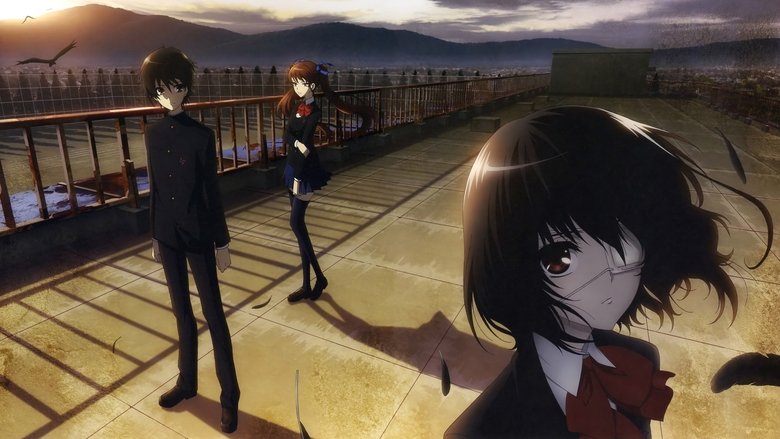
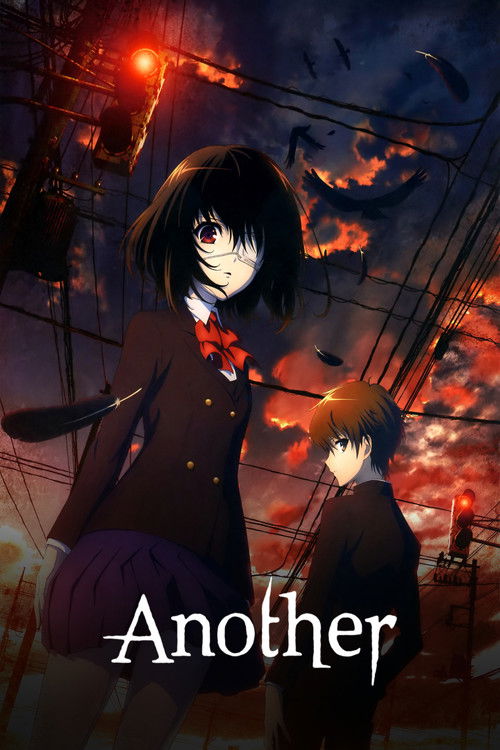
The countermeasure. Because the class contains one person too many, later generations discovered a workaround: at the start of the year, select one student and treat them as though they do not exist — never speak to them, never acknowledge them — restoring the correct count. Kōichi Sakakibara transfers in during spring 1998 without being told, and Mei Misaki is that year's non-existent student. His decision to talk to her, ask her name and treat her as a person is the transgression that breaks the countermeasure and switches the year fully 'on'. This is the series' cruellest irony: the only kind act in the classroom is also the trigger.
Mei's secret. Mei's covered eye conceals a prosthetic doll's eye which allows her to perceive the 'colour of death' — to see which person in a room is already dead. She has known from early on that the class contains a casualty, and she has withheld it. Her second secret is personal: her twin sister died shortly before Kōichi's transfer, and because that death was related to class 3-3, it means the year's death count actually began a month earlier than anyone had assumed — the class had been miscounting its own catastrophe from the start. This recalibration is the mystery's formal solution and the point where the puzzle-box logic clicks shut.
The escalation. Attempts to restore the countermeasure by making a second student non-existent fail; the deaths continue and become more baroque. Once the class learns that a previous year found a way to stop the phenomenon — by identifying the dead one and 'returning them to death' — the countdown becomes a manhunt. The eleventh episode, Makeup, is where the social order collapses entirely: with the rules discredited and information loose, terrified students turn on each other, and the class inflicts far more damage than the phenomenon ever managed unaided. This is the series' thesis made flesh — the curse is only ever a permission slip.
The finale. In Stand by Oneself, the dead one is identified — a figure the group had accepted without question as a living member of their world, whose presence had rewritten everyone's memories to accommodate them, including Kōichi's — and is put back into death, which ends the phenomenon for the year. With the casualty gone, the false memories dissolve: the class remembers the correct, unpadded version of their own lives, and the person they were closest to is simply, retroactively, someone who died long before. That is the twist's real payload. The horror is not the killing; it is that the mind will quietly reorganise itself around an impossible person and feel nothing amiss, and that the cure requires deliberately forgetting someone you loved.
What only makes sense afterwards. On rewatch the early episodes read differently: the adults' evasions are not obstruction but terror; the class's coldness to Mei is a protective ritual, not malice; and small inconsistencies in who is present, who is acknowledged and whose memories agree are all evidence hiding in plain sight. The doll-making episode titles turn out to be the series describing its own construction of a person who is not alive, finishing with a figure that can, at last, stand by itself. Reviewers have split on the execution — the objection that the reveal is rushed, and that Mei's crucial knowledge is disclosed too late to be fair play, is the most common criticism levelled at an otherwise highly praised series — but the design underneath is coherent, and grimly elegant.