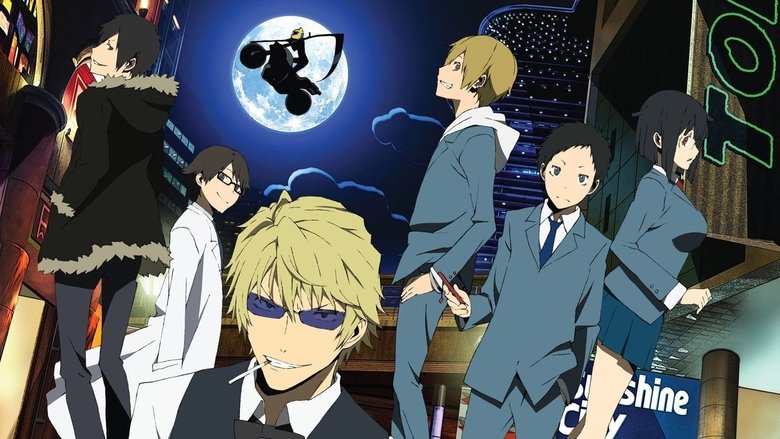
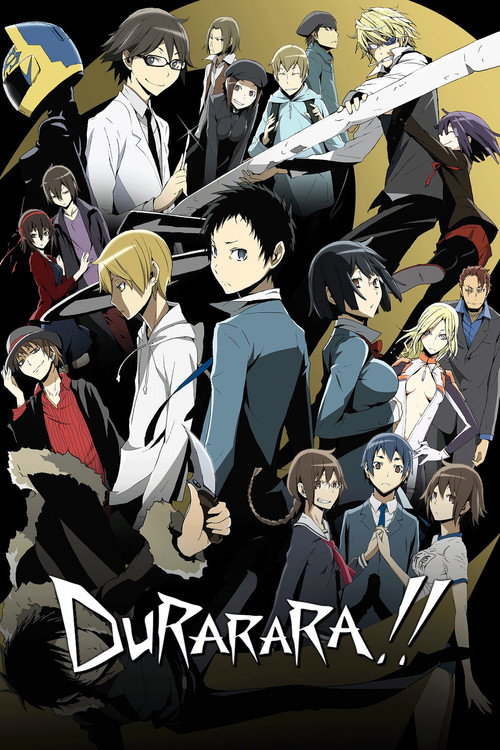
Season 1. The central twist is that the timid transfer student Mikado Ryūgamine is the founder of the Dollars, the colourless anonymous gang the whole city has been speculating about — a fact he reveals to Izaya and Celty, retroactively reframing the season's apparently unconnected incidents as products of his own creation. In parallel, Masaomi Kida's cheerful exterior conceals his history as a leader of the Yellow Scarves and the guilt attached to it, and Anri Sonohara is revealed to be bound to Saika, the cursed blade behind the city's slashing incidents, whose victims join a single collective voice. The season's cruel joke is that the three friends are each the secret the others are chasing. Behind them, Izaya Orihara seeds rumours precisely to see what they grow into, while Shizuo Heiwajima's feud with him — crystallised in episode 3, where he throws a vending machine that Simon intercepts — runs as the city's permanent weather.
×2 Shou and Ten. The revival escalates by removing Ikebukuro's stabilisers one at a time. Ten in particular delivers a cluster of revelations: a hit-and-run leaves Kyōhei Kadota fighting for his life, Shizuo is arrested, and the true identity of Jinnai Yodogiri is exposed. Mikado, meanwhile, drifts from curator of a harmless crowd to someone prepared to discipline it, as the Dollars prove trivially easy to impersonate and steer. The season's structural revelation is that Izaya's manipulations, treated as comedy in 2010, produce casualties: to him it remains a game in which he enjoys playing god, but to the people whose lives he has been rearranging it has become a matter of life and death.
×2 Ketsu and the finale. The concluding cour — the third part of the Final Curtain arc, the ninth and longest arc in the series — organises everything around three intertwined events: Kadota's removal, Saika's hypnosis, and Celty's lost, now found, head. Each is a private crisis; together they generate the unbridled chaos that engulfs the city, confirming that the supernatural and human plots were one mechanism all along. The resolution is built on reunion rather than victory: Celty is reunited with what she lost, and the three teenagers — each of whom spent the series certain that their real self would end the friendship — are reunited with one another. The hidden meaning that only lands in retrospect is that the head, the sword and the gang were never the problem; each was a way of not being known by the people closest to you. The series then withholds a definitive ending on purpose, closing on a 'life goes on' note: there is always something going on in Ikebukuro, and the audience's departure does not make life peachy for everyone still living there.