Skip to content
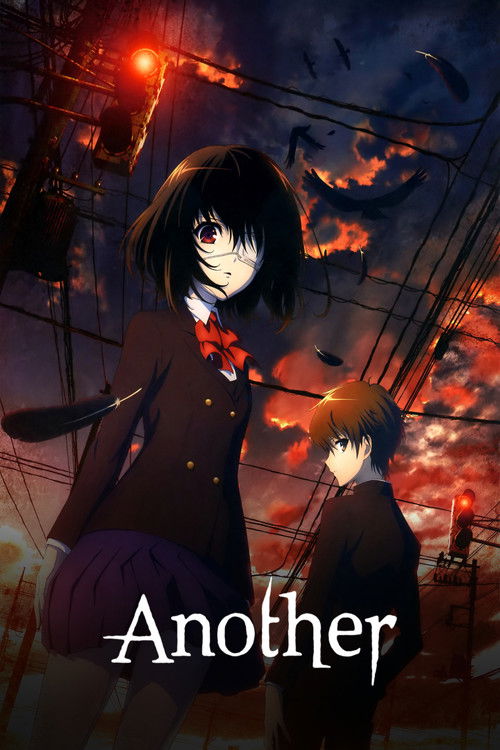
Another
A hushed, dread-soaked mystery in which one transfer student's polite question unravels a classroom's silent pact — small-town spring light curdling into the cold stare of a doll's glass eye.
Another

Another

"Plunge into the heart of terror…"

10 January 2012 — 27 March 2012 Japan 1 season 12 episode Ended 8.3 (1,087)

Cast: Atsushi Abe, Natsumi Takamori, Madoka Yonezawa, Tomoaki Maeno, Kazutomi Yamamoto

Drama Animation Mystery Denial and the deaths we refuse to admit The cruelty of group rules Death as arbitrary and ordinary Seeing, blindness and the unreliable eye Belonging and the wish to exist

Overview

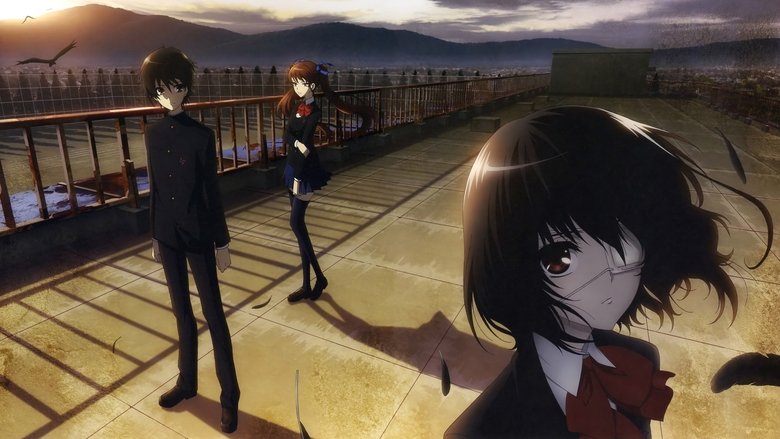
Another is a twelve-episode Japanese horror mystery produced by P.A. Works and directed by Tsutomu Mizushima, broadcast from 10 January to 27 March 2012 and adapted from Yukito Ayatsuji's 2009 novel of the same name. Set in 1998 in the provincial town of Yomiyama, it follows Kōichi Sakakibara, a boy who transfers into Yomiyama North Middle School's class 3-3 and immediately senses that something in the room is wrong: his classmates are watchful, their teacher evasive, and a quiet girl with an eyepatch named Mei Misaki seems to be treated as though she simply is not there.

What Kōichi slowly pieces together is a piece of local folklore that his classmates treat as operational fact. Since 1972 — when a popular student called Misaki died partway through the school year and the grieving class went on behaving as if nothing had happened, leaving an inexplicable extra presence in the graduation photograph — class 3-3 has been visited in certain years by a phenomenon that kills a student or someone related to them, roughly one a month, until graduation. The class has built rituals and countermeasures to survive it, and those rituals demand a cruelty that no one is willing to name aloud.

From there the series works as a closed-circle mystery wearing horror's clothes. Deaths arrive as grotesque accidents rather than the work of a monster; suspicion, rumour and denial corrode the group faster than the curse itself; and the central puzzle is not who is killing us but who among us should not be here. As a single self-contained season, the show's arc runs from unease to investigation to collapse, tightening steadily toward a climax in which the class's own logic turns on it.
Core Meaning

At its heart Another is about the price of a lie that a community agrees to keep telling. The phenomenon begins not with malice but with love badly handled: a class that could not accept a death chose to pretend it away, and that refusal to let go tore a hole in reality that outlives everyone who made it. The horror, then, is inherited denial — a debt passed down through classrooms of children who never chose it and who can only survive by repeating a smaller version of the same crime.

The countermeasure that structures the story is the series' moral core: to live, the class must decide that one of its own does not exist. Ayatsuji's premise takes the ordinary machinery of Japanese school life — group harmony, unspoken rules, the terror of standing out — and reveals it as something already lethal, needing only a supernatural nudge. The series suggests that the difference between a survival ritual and organised bullying is mostly a matter of what a group tells itself it is doing.

Against that, the show places one small counter-argument: Kōichi speaks to the girl no one will see. His transgression breaks the rules and arguably makes everything worse, yet the series treats acknowledgement — the simple act of seeing another person — as the only thing in Yomiyama that is not a lie. That is the message the whole run carries: denial is contagious and it kills, and the courage to name what is actually in the room is both dangerous and necessary.

Thematic DNA

Denial and the deaths we refuse to admit 25%
The cruelty of group rules 22%
Death as arbitrary and ordinary 20%
Seeing, blindness and the unreliable eye 18%
Belonging and the wish to exist 15%

Denial and the deaths we refuse to admit

The origin of the phenomenon is grief mishandled: in 1972 class 3-3 responded to the sudden death of a well-liked student, Misaki, by continuing to act as though they were still alive — a shared fiction so total that an extra figure appeared in the graduation photograph. The series returns to this again and again as escalation: every subsequent generation of 3-3 survives by refusing to see something, whether it is a classmate declared non-existent, a rumour no adult will confirm, or the plain fact that children are dying. By the late episodes the theme has inverted — the class's problem is no longer that it cannot see the truth but that it cannot bear to, and the horror arrives precisely at the moment denial finally cracks.

The cruelty of group rules

Class 3-3's countermeasure is a rule of exclusion enforced by consensus, complete with a designated head of countermeasures, whispered instructions to newcomers and penalties for breaking form. The show frames this as an extreme of ordinary Japanese school culture: harmony maintained by silent agreement, a group that can decide a person out of existence and call it survival. The theme develops from queasy comedy of manners in the early episodes — Kōichi baffled by classmates who talk around him — into open moral horror once the group starts weighing whose life the rules are worth, and finally into panic when the rules stop working and the mob has nothing left but fear.

Death as arbitrary and ordinary

There is no stalker and no monster with a face. People die by umbrella, by stairwell, by lift shaft, by the small mechanical accidents of everyday life, and the series stages them with a flatness that makes them worse than any pursuit scene. This is developed through the calendar structure — one death, roughly, per month — which turns mortality into a schedule rather than an event. The steady drip conditions both the class and the viewer into a numbness that the finale then detonates, insisting that a death you have learned to expect is still a death.

Seeing, blindness and the unreliable eye

Mei's covered eye and the show's obsession with looking — photographs, glass eyes, reflections, sketching — build a sustained argument that perception is the real battleground. Characters are undone by what they cannot see (the extra person in the room), by what they refuse to see (the non-existent student), and by what they see too clearly and cannot say. The motif intensifies as the mystery narrows: the puzzle's solution depends entirely on an act of accurate vision, and the series makes that act both a gift and a curse.

Belonging and the wish to exist

Kōichi is a transfer student, an outsider by definition, and Mei is an outsider by decree; the series pairs them as two people negotiating what it costs to be counted as present. Around them the class dramatises the same need in uglier forms — the desperation to be inside the group, to be one of the ones who survives. Over the run this deepens from a friendship story into the series' most painful idea: that the dead in Yomiyama are dangerous not because they hate the living but because they want, quite reasonably, to still belong.

Character Analysis

Kōichi Sakakibara

Atsushi Abe

Archetype: Outsider protagonist / reluctant investigator Key Trait: Stubborn, unfashionable decency — he acknowledges the person everyone else has agreed not to see

Motivation

Initially simple curiosity and loneliness — he wants to understand the classroom he has been dropped into, and he wants a friend. That mutates into a need for the truth as the death toll rises, and then into something more desperate: protecting Mei, and finding a way to stop the phenomenon without becoming the kind of person the countermeasure requires.

Character Arc

He arrives in Yomiyama in spring 1998 as a transfer student recovering from illness, polite, curious and entirely ignorant of the local rules — which makes him the one person who will speak to Mei. His arc runs from innocent rule-breaker to active investigator, digging into the class's history because no adult will explain it, and finally to someone forced to live with the consequences of his own decency once the deaths start landing on people he loves. By the finale he has lost the outsider's luxury of distance: he is not a boy who stumbled into a curse but a participant in what the class becomes.

Mei Misaki

Natsumi Takamori

Archetype: Enigmatic outsider / oracle Key Trait: Unnerving calm concealing grief; she sees what others cannot and says less than she knows

Motivation

At first, endurance — obeying the role assigned to her and keeping her distance from people who will not last. Later her motivation becomes disclosure and repair: she has been carrying knowledge about a death in her own family that reframes the entire year, and she chooses to use what she can see rather than continue to look away.

Character Arc

She begins as a figure of pure unease: an eyepatched girl sketching in an empty classroom whom nobody addresses, seemingly half-ghost. Through her friendship with Kōichi she is gradually restored to personhood, and the series reveals that her detachment is not otherworldliness but the discipline of someone told to be nothing for a year while privately carrying a recent, unspeakable loss. In the final stretch she moves from passive symbol to the story's decisive agent, the one whose sight the class's survival depends on.

All 4 characters and cast

Symbols & Motifs

The doll and the glass eye

Meaning:

Dolls stand for the perfect imitation of a living person — a body assembled from parts, beautiful and empty, which is precisely what the phenomenon produces. The artificial eye extends the idea: an organ for seeing that is itself a lifeless object, truth arriving through something dead.

Context:

The doll motif is woven into the show's very architecture: the episode titles follow the sequential stages of traditional Japanese doll-making, from Rough Sketch through Bone Work, Body Paint, Glass Eye and Makeup to the finale, so that each instalment quietly assembles a figure. Mei's covered eye and the title of episode 10 make the motif explicit at the exact point the mystery turns.

The 1972 graduation photograph

Meaning:

Photographic evidence of a lie — the image records what the class swore was not there. It symbolises memory's refusal to be edited: you can talk a person out of the room but not out of the film.

Context:

Established as the origin of the whole phenomenon and returned to as the class digs into its own history, the photograph functions as the series' primary document and its cruellest joke: the proof was always sitting in the school records, waiting for someone willing to look.

The non-existent one

Meaning:

A living person treated as absent — the show's central image of social death, and its argument that erasure is a violence a group can commit while feeling responsible and even virtuous.

Context:

Introduced through Mei in the first episodes as an eerie puzzle (why does no one answer her?), it later becomes an escalating stake as the class debates extending the measure. The rule's logic — sacrifice one person's existence to preserve everyone's — is the moral engine of the entire run.

The monthly calendar of deaths

Meaning:

Time as an executioner. The regular interval converts dread into arithmetic and denies the characters the comfort of randomness; they always know roughly when, never who.

Context:

The rhythm of one death a month, in a phenomenon that has recurred for more than two decades, paces the series episode by episode. The eventual discovery that the count may have started earlier than anyone assumed is the hinge on which the mystery swings.

The provincial town of Yomiyama

Meaning:

A closed world where folklore has the force of law and where leaving is no escape. It embodies the inheritance of communal guilt across generations.

Context:

The 1998 setting — before mobile phones and easy information — keeps the town sealed and the rumour intact, and the school's institutional silence, with adults who know and will not say, makes the whole town complicit rather than merely haunted.

Episode Highlights

Rough Sketch

S1E1

The premiere establishes the entire machine: Kōichi's hospital stay, his arrival in Yomiyama North Middle School's class 3-3 in spring 1998, and his first sight of the eyepatched girl who seems to exist just outside everyone else's attention. Nothing is explained, and the episode's power comes from ordinary school-life beats played a half-step wrong — evasive teachers, classmates who look at Kōichi rather than answer him.

Significance:

It sets the series' contract: this is a mystery whose first question is not 'what is killing them' but 'why is everyone behaving like this'. The doll-making title Rough Sketch also announces the season's hidden structure, since every subsequent episode is named for the next stage of assembling a figure.

Bone Work

S1E3

Broadcast in late January 2012, this instalment moves the series from atmosphere to mechanism as the shape of class 3-3's problem — the deaths, the rumour, the rules nobody will state plainly — begins to acquire a skeleton for Kōichi and the audience alike.

Significance:

The turning point where Another stops being a ghost story and becomes an investigation. Once the pattern is visible, every ordinary object in the show becomes a potential instrument, and the series' famous dread of staircases, umbrellas and lifts sets in.

Hair Stand

S1E8

Airing 27 February 2012, the eighth episode belongs to the run where the phenomenon's toll has become undeniable and the class's countermeasures are visibly failing. The social order that seemed merely strange in episode 1 is now openly fracturing under fear.

Significance:

It marks the pivot from mystery-solving to endurance: the characters shift from asking what the rules are to asking whether the rules were ever true, which is what makes the final act's collapse possible.

Body Paint

S1E9

Broadcast 5 March 2012, this episode continues the doll-assembly progression at the point where the season's accumulated dread starts to take on flesh, and where the search for a way to end the phenomenon becomes urgent rather than academic.

Significance:

Positions the last quarter of the series as a race: the class now believes an ending exists, and the belief that a solution is available is precisely what will drive them to do terrible things with it.

Glass Eye

S1E10

Aired 13 March 2012, the episode whose title names the series' central symbol. Mei's covered eye — the show's standing image for sight that is both artificial and true — moves to the centre of the plot, and the mystery's solution is finally framed as a problem of looking correctly rather than reasoning correctly.

Significance:

The hinge of the whole series. Everything the show has said about perception, denial and what a group refuses to see is converted here into a concrete plot mechanism, setting up the identification that the finale turns on.

Makeup

S1E11

Broadcast 20 March 2012 and rated among the season's highest-scoring episodes on IMDb, Makeup is the point where the class's surface finally comes off. The countermeasures have failed, information has escaped containment, and terrified children begin acting on fear rather than rules.

Significance:

The series' moral climax arrives before its plot climax: the phenomenon barely needs to act, because the group has become its own catastrophe. This is Another's clearest statement that the curse only ever weaponised what the class was already willing to do.

Stand by Oneself

S1E12

The finale, closing the run on 27 March 2012. The identity of the one who should not be there is revealed and the year's accounts are settled, with the doll-making progression completing in a title that means, exactly, a figure that can stand up alone.

Significance:

The most debated episode of the series — the resolution that critics have argued either crowns or undercuts the whole show, with reviewers such as CBR contending that Another would rank among the best horror anime ever made were it not for how the ending lands. Whatever one's verdict, it retroactively rewrites the meaning of the entire season.

Philosophical Questions

Can a person be made not to exist by collective agreement?

The countermeasure literalises a social act: the class decides someone is absent, and everyone behaves accordingly. The series tests this from both sides — Mei's endurance of being unseen, and the group's discovery that a decision about reality does not actually change reality. The unsettling implication is that the fiction works well enough, for long enough, that the difference stops mattering to the people enforcing it.

Is it moral to sacrifice one person's existence to save many?

The class runs a live trolley problem for a full school year, with the twist that the sacrifice is initially only social. The series watches the calculus escalate — from ignoring someone, to considering extending the measure, to the panic of the late episodes — and suggests that the arithmetic never stays where you set it. Once a group accepts that a person can be spent, the only remaining question is the price.

What do the living owe the dead?

The phenomenon originates in an act of devotion: children who loved someone too much to admit they were gone. Another refuses to treat that as simple foolishness, framing the returning dead as sympathetic rather than malevolent — they want to belong, and the horror is that belonging is exactly what cannot be granted. The series argues that genuine respect for the dead consists in letting them be dead.

Can you trust what you see, and can you act on what you cannot prove?

Nearly every catastrophe in the series follows from an epistemic failure: rumours accepted as law, adults who know but will not say, records nobody consults, memories that have been quietly rewritten. The resolution depends on a form of sight no one else can verify, which raises the sharper question — what should a frightened group do with knowledge that only one person can confirm? The late episodes give an ugly answer.

Alternative Interpretations

The supernatural reading. Taken at face value, the phenomenon is real: the 1972 class's refusal to accept a death opened a rupture through which the dead return, and the countermeasures are genuine folk technology, imperfectly understood by the children who inherit them. On this reading the series is a straightforward ghost story about grief that will not stay buried.

Full ending explanation

Cultural Impact

Another arrived in the winter 2012 season and was quickly treated as one of that year's standouts, credited with reviving television horror as a serious register for anime rather than a comic or supernatural-action mode. It came from an unlikely source — P.A. Works, a studio better known for luminous slice-of-life work — and from Tsutomu Mizushima, a director whose credits run to comedy and industry drama, and the mismatch is part of the show's texture: the deaths land inside a warmly lit, ordinary school world.

Its literary pedigree matters. Yukito Ayatsuji is a mystery novelist, and the 2009 source novel applies the closed-circle detective structure — a sealed community, a fixed set of suspects, a rule-bound puzzle — to supernatural horror. That hybrid is the series' real contribution: the phenomenon obeys laws, the characters research and test them, and the climax is a deduction rather than an exorcism. The influence shows in the wave of school-set mystery-horror that followed, and in how routinely Another is now cited as an entry point for viewers who assume anime horror means gore or comedy.

Culturally, the show reads as a commentary on Japanese school life, where the countermeasure of declaring a student 'non-existent' is only a degree removed from real practices of collective exclusion — a resonance domestic viewers registered immediately. Its imagery, particularly the eyepatched Mei and the doll motifs, became durable shorthand in fan art and cosplay, and ALI PROJECT's 'Kyōmu Densen' remains one of the more recognisable horror openings of the era. Ayatsuji has continued the world in prose, with the sequel compilation Another 2001 scheduled for September 2020, keeping the franchise alive well over a decade after the broadcast.

Audience Reception

Overall. As a single twelve-episode season, Another was well received on broadcast and has held a solid reputation since, sitting at a 7.5 user rating on IMDb. Contemporary reviews called it one of the highlights of 2012, praising suspenseful storytelling that maintained a stoic, uncanny atmosphere from beginning to end, and noting approvingly that the narrative rarely went where viewers expected it to.

What audiences praised. The mood is the near-universal point of agreement: the sound design, the unhurried menace of ordinary school corridors, and the willingness to stage deaths as banal accidents rather than monster attacks. Mei Misaki became an instant icon of the era. Viewers also credited the show for treating its premise as a puzzle with rules, giving the horror an investigative spine that rewarded attentive watching, and for pacing the reveals so that each episode adjusted the picture rather than merely delaying it.

Where opinion split. The finale is the fault line. A substantial share of viewers found the climax cathartic and the payoff earned; others considered the identification of the dead person hastily assembled, and specifically objected that crucial information — what Mei had witnessed — was withheld until the very end, which felt to them like the story hiding evidence rather than planting clues. CBR's much-circulated framing, that the show would have been the best horror anime ever if not for its ending, captures the majority version of the complaint: enormous goodwill, spent unevenly in the last stretch. A secondary strand of criticism targets the death set-pieces, which some found so elaborate as to tip from dread into unintentional comedy, and the thinness of the supporting class, many of whom exist mainly to be counted.

Evolution of opinion. Over the years the show has settled into the role of a gateway horror anime — the one recommended first to viewers who think the genre has nothing to offer them. Retrospective discussion has grown more interested in its social reading (the countermeasure as institutionalised bullying) and less exercised about the plot mechanics of the finale. Verdict: an exceptionally atmospheric, tightly premised horror mystery whose reputation rests on the eleven episodes of accumulating dread more than on how it chooses to discharge them.

Interesting Facts

  • The series was animated by P.A. Works and directed by Tsutomu Mizushima, running twelve episodes from 10 January to 27 March 2012.
  • It adapts Yukito Ayatsuji's 2009 horror novel of the same name; the anime adaptation was announced by Kadokawa in early December 2010, over a year before broadcast.
  • The story is deliberately set in 1998 — a pre-smartphone, pre-social-media Japan in which a rumour can stay sealed inside one provincial town and one classroom.
  • Character designs were handled by Yuriko Ishii, who also served as the series' chief animation director, adapting Noizi Ito's original illustrations for Ayatsuji's novel.
  • Every episode title is named for a sequential stage in traditional Japanese doll-making — 'Rough Sketch', 'Bone Work', 'Body Paint', 'Glass Eye', 'Makeup', and finally 'Stand by Oneself'.
  • The opening theme is 'Kyōmu Densen' (凶夢伝染, roughly 'Nightmare Contagion') by ALI PROJECT — the duo's 29th single, released on 25 January 2012, which peaked at number 16 on the Oricon singles chart.
  • Beyond the twelve broadcast episodes, the franchise produced an additional OVA episode.
  • Director Tsutomu Mizushima is notable for a filmography that ranges far outside horror; alongside the darker Blood-C he is known for comedy and the anime-industry drama Shirobako.
  • Ayatsuji later expanded the world in prose: the sequel novel compilation 'Another 2001' was scheduled for release in September 2020.
  • The series holds a 7.5 user rating on IMDb, where it is catalogued as a 2012 mini-series.

Easter Eggs

The episode titles secretly build a doll

Read in order, the twelve titles are the assembly instructions for a traditional Japanese doll — sketch, bones, painted body, glass eye, makeup, until the figure can 'stand by oneself'. It is a structural joke and a thesis at once: the season is not investigating a monster, it is manufacturing a person who is not alive.

The opening theme's title, 'Kyōmu Densen' (凶夢伝染)

ALI PROJECT's title translates roughly as 'nightmare contagion' — an infection metaphor rather than a haunting one. It flags the series' actual mechanism before the story does: the phenomenon spreads like rumour and denial spread, from class to class and year to year, not like a ghost that occupies a house.

The extra figure in the 1972 graduation photograph

The origin story's key detail is a photographic anomaly: the class insisted the dead student Misaki was still with them, and an unaccountable presence duly showed up in the class picture. It is both the series' foundational clue and a nod to a long tradition of Japanese ghost photography (shinrei shashin), in which the camera catches what the community has agreed not to.

Frequently Asked Questions

Explore More About This Movie

Dive deeper into specific aspects of the movie with our detailed analysis pages

Comments (0)

Leave a comment

No comments yet. Be the first to share your thoughts!

Similar Movies