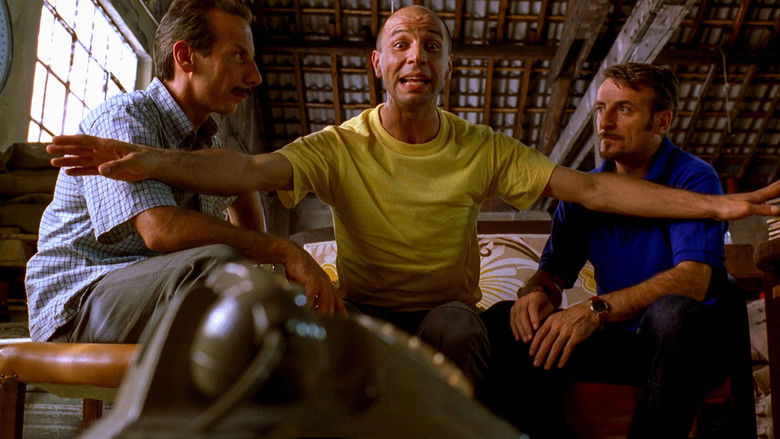
The film structures itself as a tragedy wrapped in a comedy: Aldo is supposedly dying in Sicily, and his estranged friends travel to see him for the last time. Flashbacks slowly reveal the heartbreaking reason for their three-year estrangement—Giacomo kissed Giovanni's girlfriend, Marina, destroying their friendship and their dream of staging a play. The massive, metatextual twist occurs when Giovanni and Giacomo arrive at Aldo's "deathbed." As they prepare for his tragic passing, the walls of the hospital room literally fall away to reveal they are actually standing on a theater stage in front of a live, cheering audience. Aldo's illness was a complete fabrication—a brilliant ruse orchestrated by Aldo and Marina to trick the stubborn friends into reuniting. The film concludes with them finally performing their dream play, Cyrano de Bergerac, beautifully merging the play's ending with the resolution of their real-life trauma.
Chiedimi se sono felice
Director: Giacomo Poretti, Giovanni Storti, Aldo Baglio, Massimo Venier
Cast: Aldo Baglio, Giovanni Storti, Giacomo Poretti, Marina Massironi, Silvana Fallisi
Ask Me If I'm Happy — Ending Explained
⚠️ Spoiler Analysis
Alternative Interpretations
While the twist ending is generally accepted as a literal prank orchestrated by Marina and Aldo to force a reconciliation, some critics offer a more profound metatextual interpretation. In this reading, the final shift from the hospital room to the theater stage suggests that the "play" is the only safe space where Giacomo and Giovanni can express their repressed emotions and forgive one another. The stage becomes a psychological space rather than a literal one, implying that art and cinema are necessary fictions we use to resolve the unsolvable tragedies of real life. Additionally, some debate Giacomo's kiss with Marina: rather than an act of malicious betrayal, it is viewed as the inevitable tragedy of the Cyrano dynamic playing out in reality, where the proxy lover is doomed to fall for the subject of affection.
Explore More About This Movie
Dive deeper into specific aspects of the movie with our detailed analysis pages