Full spoilers follow.
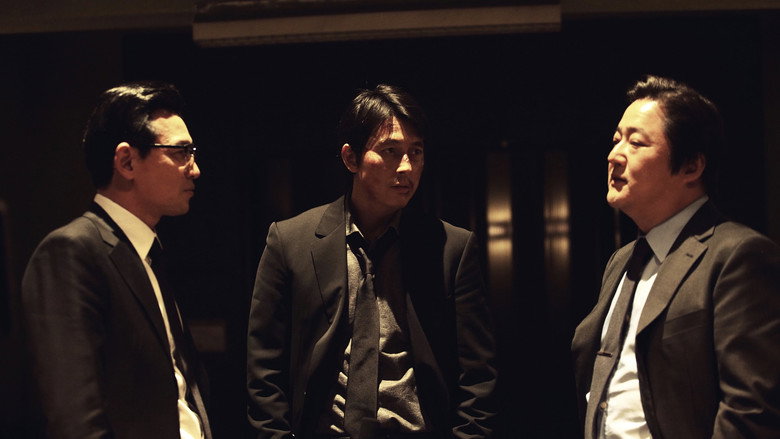
Han Do-kyung's position is untenable from the first scene, and the film's structure is a slow demonstration of why. He is already the mayor Park Sung-bae's personal enforcer, paid to handle the ugly work that municipal power requires, and he accepts this because his wife is dying and the hospital has to be paid. When a job goes wrong, investigators led by Kwak Do-won's prosecutor seize on his exposure and squeeze him into becoming their informant against Park. From that moment Han is owned twice: by the man who pays him and by the men who can destroy him.
The pivot: Sun-mo. Han's solution is to bring his junior, Sun-mo, into the arrangement as cover and insurance — a buffer he can use when the pressure becomes unmanageable. This is the decision that kills him. Sun-mo is not the pliable rookie Han assumed; he takes to the work with an appetite that outstrips his mentor's, and gradually edges Han out to become Park's right-hand man. The mentor is replaced by his own creation, and the hierarchy proves indifferent to which body occupies which slot. The film's hidden thesis surfaces here: Han never had leverage, because the system does not need any particular person.
The meaning of the real-estate scam. Everything — the prosecution's interest, Park's savagery, the money in Han's pocket — converges on a massive development scheme. The scam is the film's engine and its explanation: in a city invented to resemble the satellite towns thrown up during Seoul's 1970s–80s boom, land is the only thing worth killing for, and every institution has already been bought by it. Once the investigation closes on the project, restraint ceases to have any value for anyone.
The ending. The climax is a Grand Guignol massacre staged entirely inside a funeral parlor, where the surviving characters come at each other with guns, machetes and hatchets in an extended, escalating sequence, crawling through rapidly expanding pools of blood. Essentially none of the principals survive: the film ends in a splatter, with the cast having annihilated one another rather than having resolved anything. There is no arrest, no exposure of the scheme as justice, no survivor who walks out cleaner.
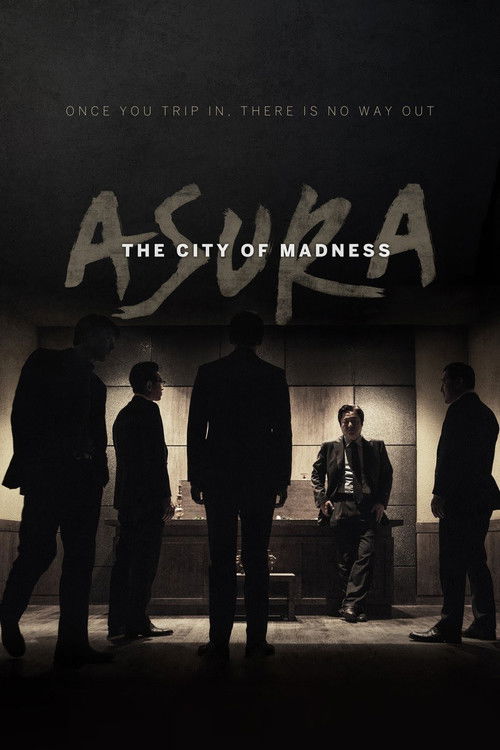
What becomes clear only afterward. The title stops being decoration and becomes the plot's explanation — these are asuras, beings consumed by their own passions and condemned to fight each other without end, so the massacre is not a climax but the natural state of their realm made visible. Han's battered face, accumulating cuts and bruises scene by scene, reads in retrospect as a countdown rather than a wound-tally. And his one sympathetic motive is revealed as the trap itself: the love that made him serve Park is what ensured he could never refuse him. The funeral parlor is the final irony — a room built for mourning the dead, used instead to manufacture them, because this city has no sacred ground left to desecrate.