Skip to content
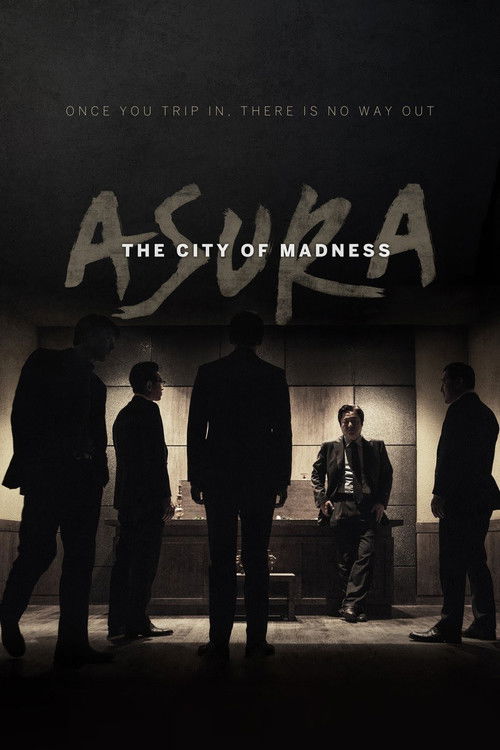
Asura: The City of Madness
A neo-noir descent where loyalty rots into survival instinct: every ally is a debt, every city light a trap, and the blood on one cop's face becomes the only honest ledger in town.
Asura: The City of Madness

Asura: The City of Madness

아수라

"Once you trip in, there is no way out."

28 September 2016 South Korea 136 min 6.8 (125)

Director: Kim Sung-soo

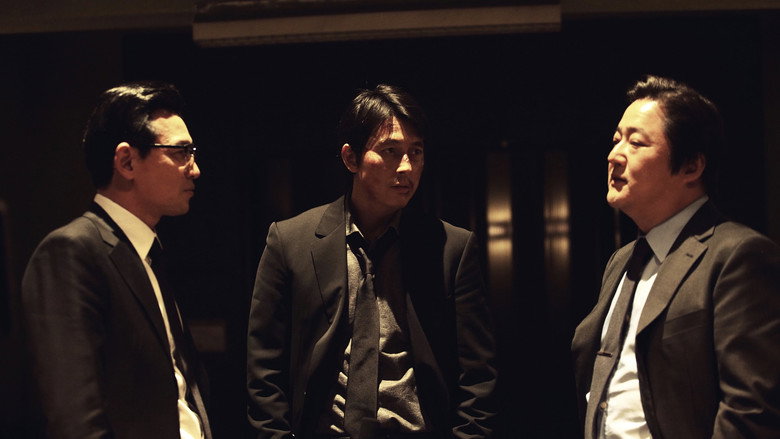
Cast: Jung Woo-sung, Hwang Jung-min, Ju Ji-hoon, Kwak Do-won, Jeong Man-sik

Crime Action Thriller Systemic corruption as architecture Loyalty as a form of ownership The impossibility of escape Violence without catharsis, then catharsis as violence The mentor who makes monsters
Box Office: $18,200,000

Overview

Han Do-kyung is a detective who long ago stopped pretending to be clean. He works as the personal enforcer and errand-runner for a brutally ambitious mayor, trading his badge for the cash that keeps his dying wife in a hospital bed. The arrangement is unbearable but functional — until a routine job goes wrong and investigators close in on him, demanding he wear a wire against the man who owns him.

Caught between prosecutors who smell blood and a patron who punishes disloyalty with annihilation, Han tries to play both sides, and pulls his younger colleague Sun-mo into the scheme as insurance. As the mayor's plans converge on an enormous real-estate development scam, the balance of power inside the circle begins to shift: the protégé learns the game faster than anyone expected, and the men who thought they were handlers discover they are merely pieces.

Directed by Kim Sung-su, the film is a 136-minute exercise in sustained pressure rather than relief — a crime thriller stripped of heroes, where order and criminality are the same machine wearing different suits, and the only question left is who will still be breathing when the machine finally jams.

Core Meaning

Kim Sung-su set out to make, in his own words, not the kind of movie you can comfortably enjoy while eating popcorn, but something you have to stay focused on right through to the end — and that intention is also the film's argument. Asura proposes that corruption in a modern Korean city is not a deviation from the system but its operating logic: the police, the prosecution and municipal government are not three checks on one another but three appetites feeding from the same trough.

The title does the thematic work. In Indian mythology the asuras are demigods consumed by negative passions, condemned to fight one another forever. The film literalizes that cosmology as urban politics: nobody here can win, nobody can leave, and the violence is not a path to a goal but the permanent condition of existence. Han Do-kyung's tragedy is that his one sympathetic motive — money for a dying wife — is exactly the hook by which he is owned, which suggests that in this world even love is absorbed as leverage.

What the director ultimately says is bleaker than "power corrupts." He says that a city built on a development boom and its kickbacks produces men who can no longer imagine an outside, and that for such men regret arrives only as a late, useless companion to slaughter.

Thematic DNA

Systemic corruption as architecture 28%
Loyalty as a form of ownership 24%
The impossibility of escape 20%
Violence without catharsis, then catharsis as violence 16%
The mentor who makes monsters 12%

Systemic corruption as architecture

The film's fictional satellite city — conceived by Kim Sung-su as a town shaped by the development boom Seoul experienced in the 1970s and 1980s — is held together by a real-estate scam. The mayor is a mobbed-up sociopath with municipal authority; the police are corrupt without exception; the prosecutors investigating them are driven by ambition rather than justice. Corruption isn't a subplot but the load-bearing structure.

Loyalty as a form of ownership

Every relationship in the film is a debt. Han serves the mayor because of his wife's medical bills; Sun-mo is dragged in by Han's need for insurance; the prosecution leverages Han's crimes to make him an informant. Nobody is loyal out of love, and betrayal is less a moral failure than a predictable accounting adjustment.

The impossibility of escape

Han's recurring fantasy is getting out — one more job, one more payment, and then clear air. The structure of the film denies it: each attempt to extricate himself binds him tighter, until the only exit left is the one cut open in the finale. This is the asura realm as narrative design: motion without progress.

Violence without catharsis, then catharsis as violence

For most of its length the film withholds release, grinding through interrogations, beatings and humiliations. The Grand Guignol climax — guns, machetes and hatchets inside a funeral parlor, survivors crawling through expanding pools of blood — is the only discharge the film permits, and it arrives as annihilation rather than justice.

The mentor who makes monsters

Han inducts Sun-mo into the mayor's orbit as a protégé and a pawn, and is then edged out by him. The film treats corruption as contagious and self-replicating: the teacher is replaced by a faster, hungrier student, and the hierarchy regenerates without the men in it mattering at all.

Character Analysis

Han Do-kyung

Jung Woo-sung

Archetype: Antihero / compromised man Key Trait: Doomed pragmatism

Motivation

Money for his dying wife's medical expenses, and, beneath that, the fantasy of surviving long enough to get out of the city.

Character Arc

Begins as a shady detective who has already made his peace with serving a criminal mayor, and spends the film trying to hold two irreconcilable masters at once. Pressure from investigators pushes him into ever more desperate improvisations — including pulling a colleague into the filth as leverage — until his usefulness expires and he is left with nothing to trade but violence. His arc is not redemption but attrition, written across his increasingly battered face.

Park Sung-bae

Hwang Jung-min

Archetype: Tyrant / devouring patron Key Trait: Jovial brutality

Motivation

Total control of the city and the enormous development scam that funds it, defended by punishing disloyalty absolutely.

Character Arc

A vicious, mobbed-up sociopath who holds municipal power and treats men as disposable instruments. Rather than developing, he escalates: as the prosecution tightens around his real-estate scheme, his charm curdles into open savagery, and his conviction that he can own anyone becomes the flaw that detonates the finale.

All 4 characters and cast

Symbols & Motifs

The asura realm

Meaning:

The Buddhist and Hindu asuras — demigods consumed by negative passions, perpetually fighting one another — supply the film's entire moral cosmology: a plane of existence defined by endless, purposeless conflict among beings who are powerful but damned.

Context:

Present in the title itself rather than stated on screen, and borne out by a plot in which no character occupies higher moral ground and every alliance converts into combat.

Han Do-kyung's face

Meaning:

A living ledger of his compromises. As he accumulates debts to both sides, the damage becomes literal, so that his body records what his words keep denying.

Context:

Across the film Jung Woo-sung's face is progressively cut, bloodied and bruised in successive confrontations, so that by the end the trauma of events is visible on him without dialogue.

The funeral parlor

Meaning:

A space set aside for mourning the dead becomes the site of mass killing — the film's flat statement that in this city there is no neutral or sacred ground, only venues not yet used for murder.

Context:

The climactic massacre unfolds entirely within its walls, with the surviving combatants crawling through rapidly expanding pools of blood.

The hospital bed

Meaning:

The one innocent thing in the story, and therefore the most effective instrument of control: care for a dying wife is converted into a permanent financial leash.

Context:

Han's need to cover his wife's medical expenses is the stated reason he works as the mayor's right hand, making domestic devotion the root of his criminality.

The development project

Meaning:

Urban growth as legalized plunder. The promise of a new city stands in for the corrupting energy of Korea's boom decades, where concrete and kickbacks rose together.

Context:

The narrative converges on a massive real-estate scam driving the mayor's ambitions, in a city the director imagined as a satellite town of Seoul built in the image of the 1970s–80s boom.

The wire

Meaning:

Surveillance as a second kind of ownership: the instrument that supposedly serves justice functions identically to blackmail, proving the two sides are procedurally indistinguishable.

Context:

Investigators pressure Han to inform on the mayor, which turns him into a double agent owned twice over rather than a man redeemed.

Philosophical Questions

Can a good motive launder a corrupt life?

Han's justification — his wife's medical bills — is the film's test case. It is sincere, and it is also precisely the lever by which he is controlled. The film suggests that motive is morally irrelevant once a system has learned to monetize it, and that self-justification is the mechanism by which complicity becomes permanent.

If every institution is compromised, does the concept of justice still mean anything?

Police, prosecution and city government are shown as variations of the same appetite. The investigators use coercion indistinguishable from blackmail, so the film strands the viewer without a position from which judgment could be issued — and quietly asks whether people invoke justice mainly as a tool.

Is evil a choice or an environment?

Sun-mo's transformation from rookie to the mayor's most effective instrument argues for environment: given proximity to power and no functioning rules, he simply optimizes. The film offers no character who resists, which makes the absence itself the argument.

What is the value of regret that arrives too late?

Reviewers have noted threads of contemplation and regret running under the violence. The characters do glimpse what they have become, but only at the point where nothing can be altered — raising the question of whether conscience that cannot change behaviour is moral awareness or merely additional suffering.

Does depicting a world without hope illuminate anything, or only degrade the viewer?

The film's own critical reception stages this question. Kim Sung-su explicitly refused comfortable viewing, and the 136-minute grind toward a funeral-parlor slaughter forces the audience to decide whether sustained ugliness is a form of honesty or a kind of aggression.

Alternative Interpretations

As moral nihilism. The most common reading takes the film at face value: there are no heroes, only different shades of black, and the final massacre states that such a world can only cancel itself. Critics who dislike the film read this as adolescent edginess — cynicism performed rather than earned.

Full ending explanation

Cultural Impact

Asura: The City of Madness arrived at the height of Korean cinema's appetite for institutional-corruption thrillers, and it pushed that cycle to its most nihilistic extreme. Where many of its contemporaries offered a surviving honest man or a final reckoning, Kim Sung-su's film refused both, presenting police, prosecution and city hall as a single organism. Its fictional city drew explicitly on the speculative development boom that reshaped Seoul in the 1970s and 1980s, giving the fantasy of total municipal rot a recognizable historical address — and making the film legible to Korean audiences as commentary rather than pure genre.

Commercially it succeeded immediately, debuting at number one during the Foundation Day holiday with 2.08 million admissions and $14.9 million in that frame, reaching roughly US$18.3 million overall. Critically it was more divisive: reviewers admired its craft and ferocity while flinching at its 136-minute grind and its insistence, as one critic put it, that people are terrible and we should hate all of them. It travelled the festival circuit, including Toronto, where it was covered by Variety.

Its afterlife has been unusually generous. Streaming exposure on Netflix turned it into a word-of-mouth discovery for Western genre audiences, and retrospective criticism has been markedly warmer than the first wave — it is now frequently described as a modern Korean crime masterpiece, with its funeral-parlor climax cited as a landmark of grindhouse-scale catharsis in mainstream Korean cinema. For Jung Woo-sung it stands as a pivot toward worn, morally soiled leading men, and for Ju Ji-hoon it is routinely named as the role that reframed him as a serious screen presence.

Audience Reception

Praised: Audiences and critics consistently single out the performances — Hwang Jung-min's jovially monstrous mayor, Jung Woo-sung's hollowed-out detective, and Ju Ji-hoon's breakout turn as the protégé who devours his mentor. The claustrophobic camerawork, built on constant close-ups that hold every glare without blinking, and the extraordinary funeral-parlor climax are the most frequently celebrated elements; many viewers describe the finale as the payoff that earns the title.

Criticized: The recurring objections are the 136-minute running time, the unbroken bleakness of tone, and violence that several reviewers found over the top. The most substantive complaint is thematic rather than technical: the film's premise that everyone is irredeemable leaves nobody to care about, which some viewers experienced as exhausting or as edginess for its own sake. Writing that the film \"definitely falls into an edgy category\" while still owning the more obnoxious parts of its script captures the split fairly.

Contested: The massacre ending divides viewers sharply — grindhouse catharsis to some, nihilistic punishment to others — and the near-total absence of women with agency in the story is a common retrospective criticism.

Verdict: A commercial hit on release (number one over the Foundation Day holiday, roughly US$18.3 million total) with a mixed critical welcome that has warmed considerably over time. Its IMDb user score of 6.7 understates its current standing among crime-genre enthusiasts, where it is often discussed as a modern Korean crime masterpiece — with the caveat that it is a relentlessly cynical ride that will not be for everyone.

Interesting Facts

  • The film marked the fourth collaboration between director Kim Sung-su and star Jung Woo-sung, following Beat (1997), City of the Rising Sun (1998) and Musa the Warrior (2001).
  • Principal photography began on 22 September 2015 and wrapped on 25 January 2016.
  • Kim Sung-su said in an interview that he deliberately did not want to make "the kind of movie that you can comfortably enjoy while eating popcorn, but something that you have to stay focused on right through to the end."
  • The film's fictional city was imagined by the director as a satellite city around Seoul, inspired by the development boom Seoul experienced during the 1970s and 1980s.
  • It was released theatrically in South Korea on 28 September 2016 by CJ Entertainment, opening on 1,278 screens.
  • The film topped the Korean box office over the three-day Foundation Day holiday, earning $14.9 million from 2.08 million admissions between Wednesday and Monday, and had sold roughly 1.8 million tickets by the end of its opening weekend.
  • Its total box office gross was approximately US$18.3 million.
  • The film ran 136 minutes — an unusually long stretch for a relentlessly bleak crime thriller, a point repeatedly raised in reviews.
  • It played the international festival circuit, including a screening at the Toronto International Film Festival, where Variety reviewed it.
  • Jung Woo-sung's appearance was used as a running record of the story's damage: his character's face is progressively cut, bloodied and bruised through successive confrontations, so the cumulative trauma is visible by the finale.
  • The film holds a 6.7 user rating on IMDb and found a substantial second life internationally through streaming on Netflix.

Easter Eggs

The title's mythological source

"Asura" refers to the demigods of Indian mythology who are consumed by negative passions and perpetually fight one another. The film never explains this, but it functions as an embedded key: the entire plot is a depiction of that realm transposed onto municipal politics.

Kim Sung-su and Jung Woo-sung's fourth film together

Having launched Jung to stardom with the youth classic Beat (1997) and continued with City of the Rising Sun (1998) and Musa the Warrior (2001), the director casts him here as an exhausted, complicit middle-aged cop — a deliberate inversion of the charismatic young men of their earlier collaborations.

The 1970s–80s development boom buried in the setting

The invented satellite city is modelled on the real speculative expansion of Seoul in those decades, making the film's fictional land scam a coded reference to an actual, widely understood chapter of Korean urban history and its politics of kickbacks.

Frequently Asked Questions

Explore More About This Movie

Dive deeper into specific aspects of the movie with our detailed analysis pages

Comments (0)

Leave a comment

No comments yet. Be the first to share your thoughts!

Similar Movies