Full spoilers follow.
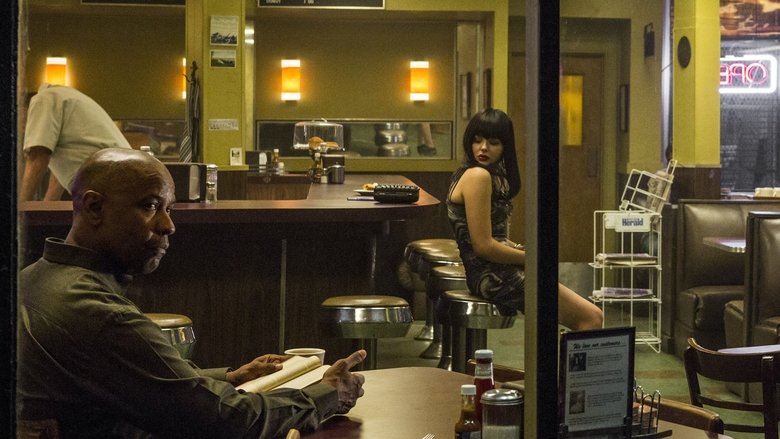
The setup. Robert McCall is a retired CIA black-ops operative who is presumed dead by his former employers. He promised his dying wife he would leave that life behind, and he has: he works at the Home Mart home-improvement store, lives alone, cannot sleep, and spends nights reading at a 24-hour diner. His quiet friendship there is with Alina — working under the name Teri — a young woman controlled by Russian traffickers.
The trigger. Alina is severely beaten and hospitalized. McCall learns that her pimp, Slavi, is responsible. Crucially, his first move is not violence: he goes to Slavi's club and, holding his temper under a stream of contempt, calmly offers $9,800 — his savings — to buy her freedom. The offer is refused and mocked. McCall then kills Slavi and his men, and the sequence establishes the film's grammar: he assesses a room, times it, and uses whatever is present as a weapon.
Escalation. Slavi was not an independent operator but a node in a large criminal enterprise. The organization dispatches Teddy (Marton Csokas), an enforcer and fixer, to identify and eliminate whoever destroyed their operation. Teddy is McCall's structural mirror — methodical, unhurried, professionally excellent — and the middle of the film is a hunt in which each man slowly assembles a picture of the other. McCall, meanwhile, escalates outward, striking at the organization's money and its corrupt local protection rather than only its muscle.
The climax. Teddy eventually identifies where McCall works. He and his men occupy the Home Mart after closing and take the employees hostage to force McCall into the open. This is the film's decisive inversion: the sanctuary of ordinary life becomes the killing floor. McCall fights them through the darkened aisles using the store's own stock, including a rig of barbed wire attached to bags of cement dropped from the high shelving. He kills Teddy and dismantles the crew.
The ending. With the American operation destroyed, McCall goes to the source and eliminates the organization's principal, closing the threat at its root. He then says goodbye to Alina, who is free and beginning again — the farewell scene that functions as the emotional payoff for the entire film. In the coda he does not return to hiding; he takes up the work deliberately, offering his help anonymously to strangers who have nowhere else to turn.
What becomes clear in retrospect. The obsessive routines, the exact arrangements, the timing — read at first as eccentricity or trauma — are revealed as the discipline of a man holding a weapon in check. His promise to his wife was not peace but suppression. And the film's title lands as a mission statement rather than a nickname: the $9,800 offer proves McCall genuinely preferred a bloodless outcome, so what he becomes at the end is not a man who chose violence but a man who ran out of alternatives and decided never to be caught without an answer again. The ending's warmth — the surviving girl, the new vocation — is what a portion of the audience finds slightly too clean for the world the film built.