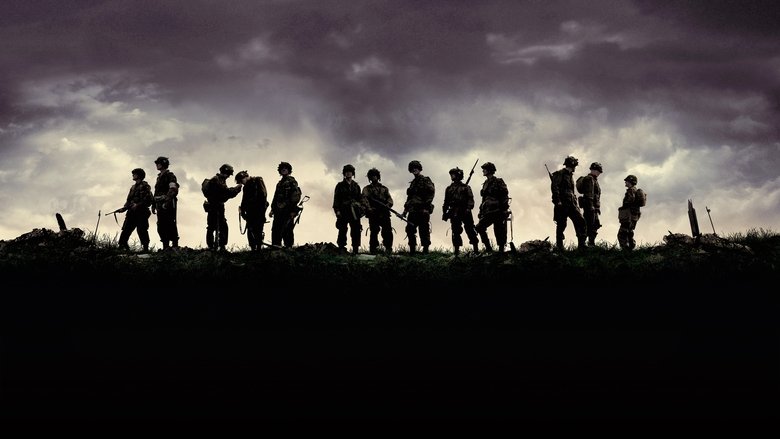
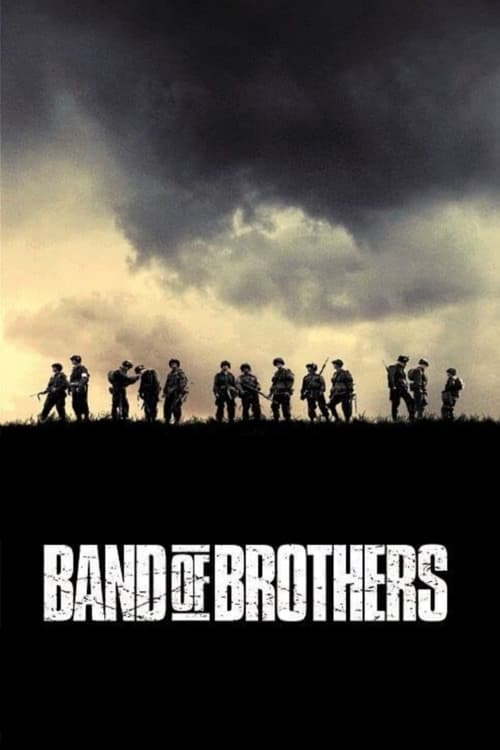
"There was a time when the world asked ordinary men to do extraordinary things."
Band of Brothers - Symbolism & Philosophy
Symbols & Motifs
Currahee Mountain
"Currahee" is the name of the mountain the paratroopers repeatedly run "three miles up, three miles down" during their training. It symbolizes their shared hardship, endurance, and the forging of their identity as an elite unit. The Cherokee word means "Stands Alone," which perfectly encapsulates the spirit of the airborne soldiers and the bond that makes them a singular, cohesive group. The chant becomes a recurring motif representing their shared foundation and resilience.
The mountain and the chant are heavily featured in the first episode, "Currahee," establishing the grueling training regimen under Captain Sobel that unites the men. It is a memory and a standard they carry with them throughout the war, a reminder of the initial crucible they passed through together.
Vat 69 Whiskey
Captain Lewis Nixon's preferred brand of blended Scotch whisky, Vat 69, symbolizes his privileged background, his coping mechanism for the stress of war, and his moments of detached observation. His constant search for it provides moments of dark humor and highlights his personal struggles with alcohol, which worsen as the war progresses and he faces troubles on the home front.
Nixon is seen with or searching for his Vat 69 throughout the series, from England to the battlefields of Holland and Germany. His toast with Winters upon discovering a vast cellar of Hermann Göring's stolen liquor in the final episode marks a culmination of this personal motif.
The Luger Pistol
The German Luger pistol is a coveted battlefield trophy, representing a tangible piece of victory and survival. For some soldiers, collecting one becomes a personal quest. However, it also symbolizes the moral complexities and dangers of war, as seen when Private Babe Heffron's friend is killed by a fellow GI who is showing off his Luger.
The desire for a Luger is mentioned by various soldiers throughout the campaign in Europe. The accidental death associated with one serves as a stark reminder that the dangers of war are not always confined to enemy action. The final scene where Winters gives a Luger he took from a surrendering German officer to another soldier signifies his detachment from the symbols of conquest.
Philosophical Questions
What is the nature of heroism?
The series consistently challenges the traditional idea of a hero as a lone, fearless warrior. Instead, it presents heroism as a collective act of endurance, sacrifice, and loyalty to one's comrades. The famous quote, "I served in a company of heroes," suggests that true heroism lies in being a reliable part of a team facing unimaginable circumstances. The characters who perform the most heroic acts are often terrified, but they push through their fear for the sake of the men beside them. The series posits that heroism isn't the absence of fear, but acting in spite of it for a cause greater than oneself—in this case, the survival of the brotherhood.
How does extreme adversity forge human connection?
"Band of Brothers" is a deep exploration of how the shared trauma of war creates bonds stronger than family. The men of Easy Company come from diverse backgrounds, but their grueling training and the life-or-death reality of combat strip away these differences, uniting them in a singular, shared experience. They become intimately familiar with one another's strengths, weaknesses, and fears. The series demonstrates that in the face of death, social constructs collapse, leaving a raw, profound human connection based on mutual dependence and shared sacrifice, a theme best exemplified during the desperate siege of Bastogne.
What is the true cost of war?
Beyond depicting the physical carnage, the series delves into the immense psychological and moral costs of war. We see soldiers succumbing to shell shock, grappling with the morality of killing, and becoming hardened and cynical. Characters like Captain Nixon battle alcoholism as a coping mechanism, while even a stoic leader like Major Winters is haunted by his actions. The finale, showing the men trying to readjust to a peaceful world, suggests the scars of war are permanent. The true cost is not just the lives lost, but the innocence and peace of mind stolen from the survivors.
Core Meaning
The core meaning of "Band of Brothers" is an exploration of the extraordinary bonds forged between ordinary men under the extreme duress of war. It moves beyond a simple depiction of historical battles to examine the nature of courage, leadership, sacrifice, and the deep, familial connection that develops among soldiers who depend on one another for survival. The series posits that this brotherhood is the key to enduring the unimaginable horrors of combat. It also serves as a powerful memorial to the real-life Easy Company, emphasizing that they were not mythical heroes, but ordinary individuals who accomplished extraordinary things together. The narrative grapples with the human cost of conflict, not just in terms of lives lost, but the lasting psychological scars carried by the survivors.