Band of Brothers
"There was a time when the world asked ordinary men to do extraordinary things."
Overview
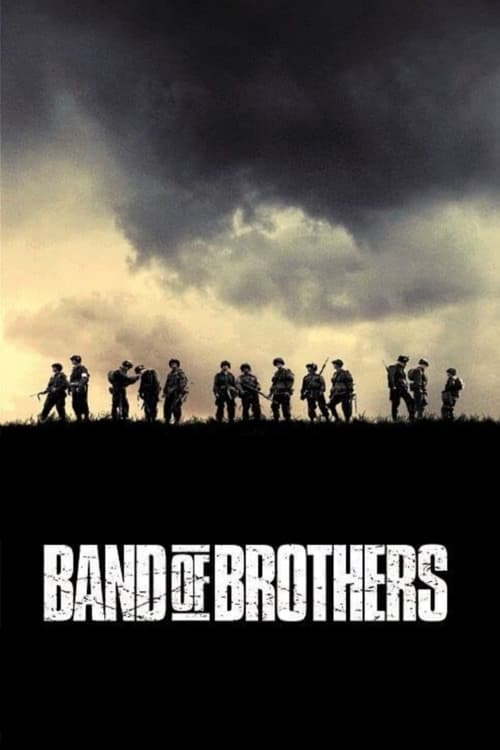
Based on Stephen E. Ambrose's non-fiction book, "Band of Brothers" dramatizes the history of "Easy" Company, 2nd Battalion, 506th Parachute Infantry Regiment of the 101st Airborne Division. The ten-part miniseries begins with the company's rigorous paratrooper training at Camp Toccoa, Georgia, under the demanding and often despised Captain Herbert Sobel. His harsh methods, while creating friction, inadvertently forge an unbreakable bond among the men.
The series follows Easy Company from their jump into Normandy on D-Day, through key battles like Operation Market Garden in Holland, the brutal siege of Bastogne during the Battle of the Bulge, and their push into Germany. The narrative provides a soldier's-eye view of the war, focusing on their triumphs, immense suffering, and the psychological toll of combat. Each episode often shifts perspective to highlight the experiences of different members of the company, while Major Richard "Dick" Winters serves as the central figure, progressing from a platoon leader to the battalion commander. The story concludes with the war's end, the capture of Hitler's Eagle's Nest, and the soldiers' attempts to return to civilian life, forever shaped by their shared experiences.

Core Meaning
The core meaning of "Band of Brothers" is an exploration of the extraordinary bonds forged between ordinary men under the extreme duress of war. It moves beyond a simple depiction of historical battles to examine the nature of courage, leadership, sacrifice, and the deep, familial connection that develops among soldiers who depend on one another for survival. The series posits that this brotherhood is the key to enduring the unimaginable horrors of combat. It also serves as a powerful memorial to the real-life Easy Company, emphasizing that they were not mythical heroes, but ordinary individuals who accomplished extraordinary things together. The narrative grapples with the human cost of conflict, not just in terms of lives lost, but the lasting psychological scars carried by the survivors.
Thematic DNA
Brotherhood and Camaraderie
This is the central theme of the series. From the shared misery of training under Captain Sobel to huddling in frozen foxholes in Bastogne, the bond between the men of Easy Company is their greatest strength. The series repeatedly shows that their loyalty is not to a flag or a cause in the abstract, but to the man next to them. This bond transcends rank and personal differences, creating a unique family forged in the crucible of war. The series argues this selfless connection, the willingness to die for a brother-in-arms, is what enables them to endure and triumph.
The Nature of Leadership
"Band of Brothers" presents a nuanced study of leadership through its various officers. It contrasts the tyrannical, by-the-book style of Captain Sobel with the quiet, competent, and deeply respected leadership of Dick Winters. Winters earns his men's loyalty not through fear, but by leading from the front, demonstrating tactical brilliance, and genuinely caring for their welfare. The series explores how effective leadership in combat is about earning trust and inspiring men to follow, not just demanding obedience, a point underscored by the failures of incompetent officers like Lieutenant Dike in the heat of battle.
The Horrors and Reality of War
The series offers a visceral, unflinching look at the brutal realities of combat. It strips away any romanticism, depicting the fear, chaos, and sheer randomness of death. Episodes like "Bastogne" and "The Breaking Point" excel at showing the physical and psychological toll: the freezing cold, the constant shelling, the loss of friends, and the mental breakdown of soldiers. The discovery of a concentration camp in "Why We Fight" confronts the soldiers (and the audience) with the ultimate evil they are fighting against, contextualizing their sacrifices and reinforcing the grim purpose of the war.
The Transition from Civilian to Soldier and Back
The series begins with young civilians from all walks of life and documents their transformation into an elite fighting unit. It explores how the innocence and perspectives of these men are irrevocably altered by what they witness and endure. The final episode, "Points," focuses on the difficult aftermath of victory, as the soldiers grapple with their experiences and the uncertainty of returning to a world that cannot possibly understand what they've been through. It highlights that even after the fighting stops, the war continues within them.
Character Analysis
Richard D. Winters
Damian Lewis
Motivation
Winters is driven by a profound sense of duty to the men under his command. His primary motivation is their survival and success on the battlefield. He is not motivated by glory or ambition, but by a quiet determination to be the best leader he can be and to see his soldiers through the war. His promise to himself to find a quiet farm and live in peace after the war underscores his desire to escape the violence he has had to master.
Character Arc
Winters begins as a quiet, principled First Lieutenant, demonstrating immense tactical skill but discomfort with the politics of command. After proving his bravery on D-Day, he is thrust into leadership of Easy Company and quickly becomes its moral and strategic center. His arc is one of ascending responsibility, from company to battalion command, while struggling to maintain his humanity and moral compass. He is haunted by the act of killing, particularly a young German soldier, which marks the end of him firing his weapon in the war. By the end, he is a respected Major who has successfully led his men through the war's worst trials, defined by his mantra of never letting his men down.
Lewis Nixon
Ron Livingston
Motivation
Nixon's primary motivation is to survive the war with his intellect and sanity intact. He is also deeply loyal to Winters, often acting as his confidant and strategic sounding board. His constant pursuit of Vat 69 whisky is a surface-level motivation that masks a deeper need to numb the psychological pain of the war and his failing personal life. Uniquely, he never fires his weapon in combat, solidifying his role as an observer rather than a direct participant in the violence.
Character Arc
Nixon, from a wealthy background, serves as an intelligence officer and Winters' closest friend. His arc is not one of battlefield promotion but of internal struggle. He begins as a sharp, witty, and somewhat detached observer, but the relentless stress of war, coupled with the dissolution of his marriage back home, leads him into a deepening battle with alcoholism. Despite his cynicism and personal demons, he remains a brilliant strategist and a steadfast friend to Winters. His journey is about trying to find meaning and stability amidst the chaos of war and personal loss, culminating in a moment of quiet hope at the war's end.
C. Carwood Lipton
Donnie Wahlberg
Motivation
Lipton is motivated by a deep-seated belief in Easy Company and its potential. He strives to maintain the high standards the men set for themselves and to ensure they have the leadership they deserve. He is a problem-solver and a morale-booster, always focused on the well-being of the company as a whole. His motivation is fundamentally selfless, centered on the preservation and success of the brotherhood.
Character Arc
Lipton begins as a Platoon Sergeant and evolves into the essential backbone of Easy Company. He serves as the crucial link between the enlisted men and the officers. His arc is defined by his unwavering commitment to the company's morale and integrity. During the company's lowest point in "The Breaking Point," under the command of the incompetent Lieutenant Dike, Lipton effectively holds the company together, providing the de facto leadership the men need. His dedication and competence are formally recognized when Winters promotes him to Second Lieutenant on the battlefield, completing his journey from a respected NCO to a commissioned officer who earned his rank through merit, not connections.
Symbols & Motifs
Currahee Mountain
"Currahee" is the name of the mountain the paratroopers repeatedly run "three miles up, three miles down" during their training. It symbolizes their shared hardship, endurance, and the forging of their identity as an elite unit. The Cherokee word means "Stands Alone," which perfectly encapsulates the spirit of the airborne soldiers and the bond that makes them a singular, cohesive group. The chant becomes a recurring motif representing their shared foundation and resilience.
The mountain and the chant are heavily featured in the first episode, "Currahee," establishing the grueling training regimen under Captain Sobel that unites the men. It is a memory and a standard they carry with them throughout the war, a reminder of the initial crucible they passed through together.
Vat 69 Whiskey
Captain Lewis Nixon's preferred brand of blended Scotch whisky, Vat 69, symbolizes his privileged background, his coping mechanism for the stress of war, and his moments of detached observation. His constant search for it provides moments of dark humor and highlights his personal struggles with alcohol, which worsen as the war progresses and he faces troubles on the home front.
Nixon is seen with or searching for his Vat 69 throughout the series, from England to the battlefields of Holland and Germany. His toast with Winters upon discovering a vast cellar of Hermann Göring's stolen liquor in the final episode marks a culmination of this personal motif.
The Luger Pistol
The German Luger pistol is a coveted battlefield trophy, representing a tangible piece of victory and survival. For some soldiers, collecting one becomes a personal quest. However, it also symbolizes the moral complexities and dangers of war, as seen when Private Babe Heffron's friend is killed by a fellow GI who is showing off his Luger.
The desire for a Luger is mentioned by various soldiers throughout the campaign in Europe. The accidental death associated with one serves as a stark reminder that the dangers of war are not always confined to enemy action. The final scene where Winters gives a Luger he took from a surrendering German officer to another soldier signifies his detachment from the symbols of conquest.
Memorable Quotes
Grandpa, were you a hero in the war?' 'No,' I answered, 'but I served in a company of heroes.'
— Richard D. Winters (in his memoirs, quoted in the series)
Context:
This quote is spoken by the real Richard Winters in the documentary portion of the final episode, "Points," as he reflects on his service. It serves as the series' powerful concluding thought.
Meaning:
This quote encapsulates the humble ethos of the real veterans and the series' central theme of collective heroism. It deflects individual praise, instead honoring the entire company and the brotherhood they formed. It defines heroism not as a singular act, but as being part of a collective that achieved extraordinary things together.
We're paratroopers, Lieutenant. We're supposed to be surrounded.
— Richard D. Winters
Context:
Spoken in Episode 5, "Crossroads," after Easy Company has successfully held off a superior German force at a crossroads in Holland. When a concerned officer points out their precarious position, Winters delivers this classic line with calm confidence.
Meaning:
A line demonstrating Winters' cool-headed leadership and the elite, unflappable mindset of the airborne troops. It turns a dire tactical situation—being cut off—into a statement of identity and purpose, boosting morale and reinforcing their unique role as shock troops who operate behind enemy lines.
Captain Sobel, we salute the rank, not the man.
— Richard D. Winters
Context:
In the final episode, "Points," a post-war Winters, now a Major, encounters Sobel, who is still a Captain. Sobel gives a half-hearted gesture of recognition, and Winters stops him to enforce the proper salute due to a superior officer, delivering this cutting line.
Meaning:
This quote is a sharp, satisfying assertion of military protocol over personal animosity. It's a moment of quiet victory for Winters over his former tormentor, Captain Sobel, demonstrating that while respect for the chain of command is absolute, respect for an individual must be earned.
The only hope you have is to accept the fact that you're already dead. The sooner you accept that, the sooner you'll be able to function as a soldier is supposed to function.
— SSgt. Bill Guarnere
Context:
This advice is given to a replacement soldier in Episode 3, "Carentan," as the veterans try to explain the mental state required to endure the horrors they face daily.
Meaning:
This quote expresses a grim philosophy of survival in combat. It suggests that overcoming fear requires a fatalistic acceptance of death, which in turn frees a soldier to act without hesitation, remorse, or compassion—qualities considered essential for effective fighting in the brutal calculus of war.
From this day to the ending of the world... we in it shall be remembered. We lucky few, we band of brothers. For he today that sheds his blood with me shall be my brother.
— Carwood Lipton (quoting Shakespeare's Henry V)
Context:
Lipton recites this line from Shakespeare's play in Episode 7, "The Breaking Point," during the brutal fighting around Foy, Belgium. It serves as a poignant reminder of the source of their strength during one of their darkest moments.
Meaning:
This quote, from which the series takes its title, explicitly states the central theme of brotherhood forged in battle. It elevates the bond between soldiers to a timeless, almost sacred level, suggesting that their shared sacrifice creates a connection deeper than family and worthy of historical remembrance.
Episode Highlights
Day of Days
This episode depicts the chaotic and terrifying D-Day parachute drop into Normandy. With the company commander killed on the jump, Lt. Winters finds himself in charge. He gathers scattered paratroopers and leads a textbook assault on a German artillery battery at Brécourt Manor, a pivotal and historically significant engagement that showcases his tactical genius and leadership under fire.
"Day of Days" establishes Winters as the true leader of Easy Company. The Brécourt Manor assault is a defining moment for the series, demonstrating the effectiveness of the paratroopers' training and the calm competence that would come to define Winters' command style. It transitions the series from the trials of training to the brutal reality of combat.
Crossroads
Directed by Tom Hanks, this episode centers on Captain Winters' leadership during a daring charge against a much larger SS force across an open dike in Holland. The successful but costly action earns him a promotion to Battalion Executive Officer, removing him from direct command of Easy Company. The episode is framed by Winters' report on the battle and his haunting memory of killing a young German soldier.
This episode marks a major turning point for Winters' character. His promotion signifies his growing reputation but also creates a painful distance from the men he feels closest to. His struggle with the memory of killing highlights the personal, moral cost of war, even for a successful and respected leader.
Bastogne
Told from the perspective of medic Eugene "Doc" Roe, this episode immerses the viewer in the brutal conditions of the Siege of Bastogne during the Battle of the Bulge. Easy Company, ill-equipped for the freezing weather and under constant artillery bombardment, struggles to hold the line while suffering immense casualties. Roe scrambles to save his friends, desperately low on medical supplies in a frozen, hellish landscape.
"Bastogne" is a masterclass in depicting the misery and endurance of war. By focusing on the medic, the episode emphasizes the human cost of the battle rather than grand strategy. It is a powerful, atmospheric portrayal of the company's resilience and the sheer grit required to survive one of the war's most infamous battles, solidifying the theme of brotherhood in the face of absolute despair.
The Breaking Point
Narrated by First Sergeant Lipton, this episode details the assault on the German-held town of Foy, which follows the ordeal at Bastogne. Morale is at an all-time low, and the company is led by the incompetent and cowardly Lt. Norman Dike. Lipton struggles to hold the men together as Dike's leadership falters, culminating in a disastrously stalled attack until Lt. Ronald Speirs heroically relieves Dike and leads the charge.
This episode is a raw depiction of the psychological toll of prolonged combat and the critical importance of competent leadership. It shows the men at their most vulnerable, near their breaking point, and highlights the internal strength of the company's NCOs, particularly Lipton, in holding them together when their officer fails. Speirs' legendary run through the town cements his mythical status among the men.
Why We Fight
As the war in Europe nears its end, Easy Company, now in Germany, stumbles upon a Nazi concentration camp. The discovery is a profound shock, confronting the soldiers with the horrifying reality of the evil they have been fighting. The episode, seen through the eyes of a cynical Captain Nixon, contrasts the relative peace of occupied Germany with this unimaginable horror.
This episode provides a stark, horrifying answer to its own title. For soldiers who had become disillusioned and weary of fighting, the discovery of the concentration camp provides a grim, undeniable moral clarity for their sacrifices. It's a pivotal moment that re-contextualizes the entire war for the characters and the audience, moving beyond battles and tactics to the fundamental conflict of humanity versus inhumanity.
Philosophical Questions
What is the nature of heroism?
The series consistently challenges the traditional idea of a hero as a lone, fearless warrior. Instead, it presents heroism as a collective act of endurance, sacrifice, and loyalty to one's comrades. The famous quote, "I served in a company of heroes," suggests that true heroism lies in being a reliable part of a team facing unimaginable circumstances. The characters who perform the most heroic acts are often terrified, but they push through their fear for the sake of the men beside them. The series posits that heroism isn't the absence of fear, but acting in spite of it for a cause greater than oneself—in this case, the survival of the brotherhood.
How does extreme adversity forge human connection?
"Band of Brothers" is a deep exploration of how the shared trauma of war creates bonds stronger than family. The men of Easy Company come from diverse backgrounds, but their grueling training and the life-or-death reality of combat strip away these differences, uniting them in a singular, shared experience. They become intimately familiar with one another's strengths, weaknesses, and fears. The series demonstrates that in the face of death, social constructs collapse, leaving a raw, profound human connection based on mutual dependence and shared sacrifice, a theme best exemplified during the desperate siege of Bastogne.
What is the true cost of war?
Beyond depicting the physical carnage, the series delves into the immense psychological and moral costs of war. We see soldiers succumbing to shell shock, grappling with the morality of killing, and becoming hardened and cynical. Characters like Captain Nixon battle alcoholism as a coping mechanism, while even a stoic leader like Major Winters is haunted by his actions. The finale, showing the men trying to readjust to a peaceful world, suggests the scars of war are permanent. The true cost is not just the lives lost, but the innocence and peace of mind stolen from the survivors.
Alternative Interpretations
While overwhelmingly praised, "Band of Brothers" has faced some critical discussion regarding its perspective. One interpretation is that, despite its focus on the horrors of war, the series can be seen as a glorification of the American military and the concept of the "good war." The narrative is told almost exclusively from the American soldiers' point of view, and while it depicts their suffering, it rarely questions the overarching mission or the morality of their actions in a broader context. Some viewers have noted that the portrayal of German soldiers is often one-dimensional, serving primarily as antagonists without the same human depth afforded to the members of Easy Company.
Another point of discussion revolves around its historical accuracy. Although based on extensive research and veteran interviews, the series is a dramatization. Liberties were taken for narrative effect, such as compressing events, creating composite characters, or altering details of certain engagements and personnel issues (like the depiction of Lt. Norman Dike, who in reality received two Bronze Stars). Therefore, some historians argue it should be viewed as a powerful piece of historical fiction that captures the spirit of events rather than a completely factual documentary.
Cultural Impact
"Band of Brothers" is widely regarded as a landmark television event that redefined the scope of what a miniseries could achieve. Premiering on HBO in September 2001, shortly before the 9/11 attacks, its themes of unity, sacrifice, and ordinary people rising to an extraordinary challenge resonated deeply with a shaken American public. Created by Tom Hanks and Steven Spielberg, the series built upon the realistic, visceral aesthetic they established in the film "Saving Private Ryan," bringing cinematic production values, historical detail, and emotional depth to the small screen.
Its influence on television was profound. Along with shows like "The Sopranos," it helped solidify HBO's reputation for high-quality, ambitious programming and is considered a pioneering entry in the era of "Peak TV." Its success paved the way for subsequent large-scale historical miniseries, including its own companion pieces, "The Pacific" (2010) and "Masters of the Air" (2024).
Critically, the series received universal acclaim, winning the Primetime Emmy for Outstanding Miniseries and a Golden Globe. Audiences lauded its realism, emotional weight, and respectful tribute to the veterans. The series had a significant cultural impact by renewing public interest in the history of World War II and the experiences of the "Greatest Generation." It turned the surviving members of Easy Company into reluctant celebrities and ensured their stories of courage and brotherhood would be preserved for future generations, becoming a benchmark for historical dramas.
Audience Reception
"Band of Brothers" was met with widespread critical and audience acclaim upon its 2001 release and its reputation has only grown since. It holds exceptionally high ratings on review aggregation sites like Rotten Tomatoes (94% approval) and Metacritic (87/100, indicating "universal acclaim"). Audiences consistently praise the series for its stunning realism, emotional depth, and cinematic quality, often citing it as one of the greatest television shows ever made. The powerful storytelling, compelling character development, and respectful tribute to the veterans of Easy Company are frequently highlighted points of praise. The series is lauded for its ability to balance intense, visceral battle sequences with quiet, profound moments of humanity.
Criticism is minimal but occasionally points to the difficulty in distinguishing between the large cast of characters in the early episodes. Some have also debated whether its singular focus on the American perspective inadvertently glorifies war, though many viewers feel it serves as a powerful anti-war statement by showing the conflict's brutal reality. Overall, the audience verdict is overwhelmingly positive, with the series being regarded as a timeless and impactful masterpiece that set a new standard for historical drama on television.
Interesting Facts
- The miniseries had a budget of approximately $125 million, making it one of the most expensive television productions of its time, with an average cost of $12.5 million per episode.
- To prepare for their roles, the main cast underwent a grueling ten-day boot camp led by retired U.S. Marine Captain Dale Dye, where they were subjected to rigorous physical training and addressed only by their characters' names.
- The extensive battle scenes in the Ardennes forest for the "Bastogne" episode were filmed entirely inside a massive airplane hangar, where the art department constructed a forest set with real and artificial trees and used over 300,000 pounds of paper for snow.
- A single 12-acre village set built on a backlot in Hatfield, England, was continually modified to represent 11 different European towns throughout the series.
- The production used an enormous number of resources, including 10,000 extras, 500 speaking roles, 700 authentic period weapons, and would sometimes expend 14,000 rounds of ammunition in a single day of filming.
- The opening interviews with the actual veterans of Easy Company were a late addition to the production. Director Tom Hanks decided to incorporate the powerful documentary footage after seeing the interviews conducted by Mark Cowen, and made the decision not to identify the men by name until the final episode.
- The cast features a remarkable number of actors who would later become major stars, including Tom Hardy, Michael Fassbender, James McAvoy, Simon Pegg, and Andrew Scott in small roles.
- There is a historical inaccuracy in the third episode, where Private Albert Blithe is depicted as never recovering from his wounds and dying in 1948. In reality, Blithe recovered, served in the Korean War, and died in 1967.
⚠️ Spoiler Analysis
Click to reveal detailed analysis with spoilers
Frequently Asked Questions
Explore More About This Movie
Dive deeper into specific aspects of the movie with our detailed analysis pages
Comments (0)
No comments yet. Be the first to share your thoughts!