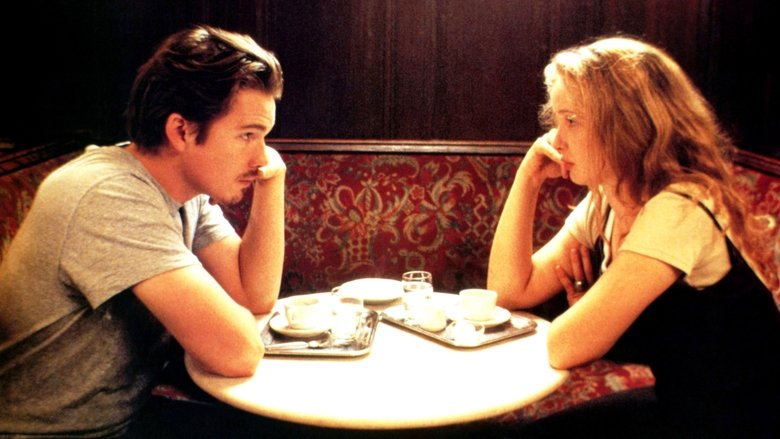

"Can the greatest romance of your life last only one night?"
Before Sunrise - Ending Explained
⚠️ Spoiler Analysis
The entire narrative of "Before Sunrise" builds towards its famously ambiguous ending. After a night of profound connection and falling in love, Jesse and Céline arrive at the train station for their separation. The key plot point is their mutual decision not to exchange phone numbers or addresses, an act that seems counterintuitive but is rooted in a desire to preserve the perfection of their shared experience. They fear that a long-distance correspondence would inevitably fizzle out, tainting the memory of their magical night.
Instead, they make a pact: to meet at the exact same spot on the train platform in six months' time, on December 16th. This decision elevates their romance from a simple one-night stand to an epic, fate-driven love story. The film's final sequence intercuts shots of Jesse on his train and Céline on hers, both looking contemplative, with shots of the now-empty Viennese locations they had populated just hours before. This montage powerfully underscores the transient nature of their encounter and leaves the audience in a state of hopeful uncertainty. The film deliberately does not show the reunion. The central question of whether they keep their promise and successfully meet again is left entirely unanswered, a narrative choice that generated intense speculation among fans for the nine years leading up to the sequel, "Before Sunset." The hidden meaning is that the power of the story lies not in its resolution, but in the perfection of the moment itself and the enduring hope of what could be.
Alternative Interpretations
While the film is largely interpreted as a straightforward, albeit bittersweet, romance, some alternative readings exist. One perspective views the entire encounter as a romantic fantasy or delusion, a projection of idealized love that is intentionally unrealistic. Jesse's initial pitch of "time travel" sets the stage for a narrative that consciously steps outside of reality. From this viewpoint, the film is less about the viability of their relationship and more a commentary on how people construct romantic narratives to escape the banalities or disappointments of real life.
Another interpretation focuses on the film as a critique of youthful pretension. Some viewers find the characters, particularly Jesse, to be narcissistic and their philosophical musings to be immature. In this reading, the film isn't necessarily celebrating their connection but rather presenting a painfully accurate snapshot of two young, verbose intellectuals who are more in love with their own ideas and the idea of romance than they are with each other. Their dialogue can be seen as posturing, a way to perform intelligence and sensitivity for a potential romantic partner.
The ending, before the sequels existed, was also open to vastly different interpretations. Optimists believed Jesse and Céline's connection was so profound they would undoubtedly meet again. Pessimists and realists argued that the practicalities of life and the fading of a single night's memory would prevent their reunion, making the story a beautiful but tragic one-off encounter. The film itself supports both readings, leaving the ultimate conclusion to the viewer's own romantic sensibilities.