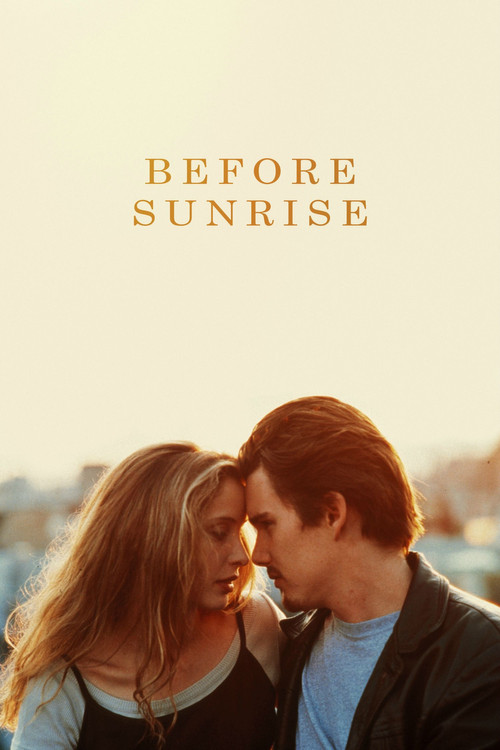
Before Sunrise
A fleeting, dialogue-driven romance where youthful idealism and cynicism dance through Vienna's streets, capturing the ephemeral magic of a chance encounter.
Before Sunrise

Before Sunrise

"Can the greatest romance of your life last only one night?"

27 January 1995 Austria 101 min ⭐ 8.0 (4,436)
Director: Richard Linklater
Cast: Ethan Hawke, Julie Delpy, Andrea Eckert, Hanno Pöschl, Karl Bruckschwaiger
Drama Romance
The Ephemeral Nature of Time and Love Connection Through Conversation Idealism vs. Cynicism Self-Discovery and Identity
Budget: $2,500,000
Box Office: $5,987,386

Overview

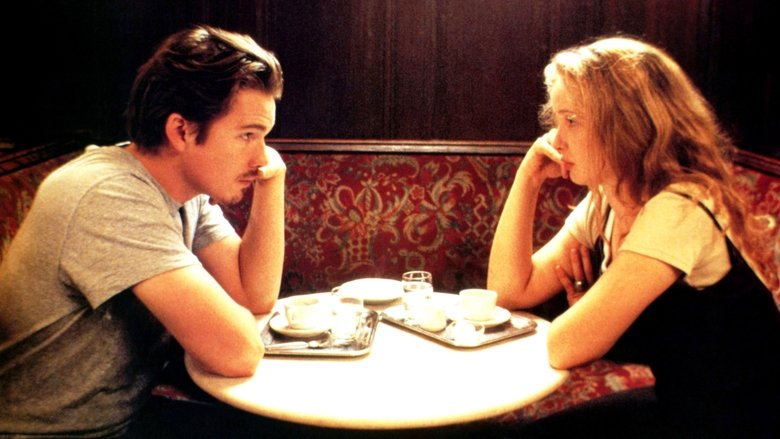
"Before Sunrise" follows Jesse, an American tourist, and Céline, a French student, who meet on a train in Europe. On a whim, Jesse convinces Céline to disembark with him in Vienna and spend his last hours in Europe together before he catches a flight back to the United States. What unfolds is a single night of exploration, both of the city and of each other, as they wander through Vienna's streets, parks, and cafes.

The film is almost entirely composed of their conversations, which range from the deeply philosophical to the charmingly mundane. They discuss love, life, death, and their personal histories and dreams with a startling honesty and intimacy. As the night progresses, a profound connection forms between them, tinged with the bittersweet knowledge that their time together is finite. The minimalist plot focuses on this intense, fleeting romance, leaving the audience to wonder if this brief encounter will be just a memory or the beginning of something more.
Core Meaning

The core meaning of "Before Sunrise" revolves around the beauty and significance of ephemeral moments and authentic human connection in a world often characterized by fleeting interactions. Director Richard Linklater explores the idea that a profound, life-altering connection can be forged in a very short period. The film posits that the value of an experience is not measured by its longevity but by its depth and intensity. It's a celebration of youth, intellectual curiosity, and the courage to seize a spontaneous opportunity for connection. The film suggests that in the spaces between our planned lives, in these brief, unscripted encounters, we can often find the most meaningful and memorable experiences. Ultimately, it's a poignant reflection on the nature of memory, the passage of time, and the romantic ideal of a perfect, albeit temporary, union.

Thematic DNA

The Ephemeral Nature of Time and Love 35%
Connection Through Conversation 30%
Idealism vs. Cynicism 20%
Self-Discovery and Identity 15%

The Ephemeral Nature of Time and Love

Time is a central, almost tangible, force in the film. From Jesse convincing Céline to get off the train by framing it as a form of "time travel," to the constant awareness of the approaching sunrise and his departure, their entire encounter is defined by its limited duration. This finite timeframe forces a level of honesty and vulnerability that might not exist in a conventional relationship. Their love story is beautiful precisely because it is fleeting, a perfect moment suspended in time that cannot last. The film constantly references time and mortality, from visiting a cemetery to quoting W.H. Auden's poem about the impossibility of conquering time, emphasizing that all relationships and life itself are transient.

Connection Through Conversation

The film champions the idea that deep, meaningful connection is forged through dialogue. The plot is minimalistic, driven almost entirely by the conversations between Jesse and Céline. They explore each other's minds, sharing philosophies, fears, dreams, and past heartaches. This intellectual and emotional intimacy, built word by word, forms the foundation of their romance. The film suggests that true compatibility is found not in shared circumstances, but in the ability to communicate openly and understand one another on a profound level, a "magic... in the attempt of understanding someone."

Idealism vs. Cynicism

Jesse and Céline embody a blend of youthful idealism and burgeoning cynicism. Jesse, recently heartbroken, often presents a more jaded and skeptical view of love and relationships, while Céline holds onto a more romantic, albeit guarded, perspective. Their conversations are a dance between these two viewpoints. They question romantic conventions and the idea of soulmates, yet they are living out a scenario that is the epitome of romantic fantasy. This tension reflects the transitional state of being in one's twenties—caught between the hopeful dreams of youth and the pragmatic, sometimes harsh, realities of adult life.

Self-Discovery and Identity

In their anonymous encounter, both Jesse and Céline are free to be their truest selves, unburdened by the expectations of their daily lives. This freedom allows for a unique form of self-discovery. By articulating their thoughts and feelings to a receptive stranger, they come to understand themselves better. Céline discusses the pressure to be a "strong and independent icon of womanhood" while also craving love, and Jesse confronts his own escapism and fears. Their interaction becomes a mirror, reflecting their own identities and desires back at them in a new light.

Character Analysis

Jesse

Ethan Hawke

Archetype: The Romantic Cynic
Key Trait: Inquisitive

Motivation

Jesse's primary motivation is to escape his own loneliness and find a genuine human connection. He is running from the disappointment of his past relationship and is searching for meaning. His impromptu decision to ask Céline to spend the day with him is driven by an intuitive feeling that she is someone with whom he can share an authentic and meaningful experience, however brief.

Character Arc

Jesse begins the film as a somewhat cynical and disillusioned romantic, fresh off a painful breakup and feeling aimless while traveling through Europe. He's a talkative, philosophical wanderer who uses intellectualism as both a charm and a defense mechanism. Throughout his night with Céline, her genuine curiosity and romantic idealism challenge his cynicism. He opens up, revealing his vulnerabilities and a deeper, more hopeful nature. By the end, he is willing to risk future heartbreak for the chance of seeing her again, showing a renewed belief in the possibility of a profound connection.

Céline

Julie Delpy

Archetype: The Idealistic Realist
Key Trait: Insightful

Motivation

Céline is motivated by a deep-seated desire to be truly seen and understood. She is returning to Paris from visiting her grandmother and feels a sense of restlessness. She is drawn to Jesse's invitation because it offers an escape from the mundane and a chance for a genuine, unfiltered human experience. She craves a connection that goes beyond superficiality, one where she can explore ideas and emotions freely.

Character Arc

Céline is introduced as an intelligent, independent, and romantic Sorbonne student. She is hopeful about love but also guarded, expressing both a desire for deep connection and a fear of losing her independence. Initially hesitant, she takes a leap of faith by joining Jesse. Her journey through the night involves letting down her guard and embracing the spontaneity of the moment. She challenges Jesse's cynicism with her own thoughtful and often idealistic philosophies, and in doing so, reaffirms her own belief in the magic of connection, even if it's temporary.

Symbols & Motifs

Vienna

Meaning:

The city of Vienna acts as a third character, symbolizing a liminal, dream-like space where the rules of ordinary life are suspended. It is a neutral ground, a fairytale-like backdrop that is both romantic and temporary, allowing Jesse and Céline's encounter to exist outside of their real lives and responsibilities.

Context:

Throughout the film, Jesse and Céline wander through Vienna's historic streets, parks, cafes, and landmarks. The city's beauty enhances the romance of their night, but it also reinforces the feeling that this is a temporary escape from reality. The final shots of the film show the locations they visited, now empty in the morning light, emphasizing that the magic was tied to their fleeting presence there.

The Listening Booth

Meaning:

The listening booth scene symbolizes the burgeoning, unspoken intimacy and attraction between Jesse and Céline. It represents a private, shared world they create amidst a public space, where their connection deepens without the need for words.

Context:

Inside a record store, they spontaneously decide to listen to a record by Kath Bloom. Crowded into the small booth, they don't speak, but their shy, stolen glances and the charged silence between them convey their growing feelings more powerfully than any conversation could. It is a moment of pure, unspoken romantic tension and mutual acknowledgment of their connection.

The Sunrise

Meaning:

The sunrise symbolizes the inevitable end of their magical night and the return to reality. It is the beautiful but melancholic deadline for their fleeting romance, representing the boundary between their dream world and the real world they must return to.

Context:

The title itself points to the significance of this moment. As dawn approaches, the mood shifts. The conversations become more urgent and tinged with the sadness of their impending separation. The sunrise itself, when it arrives, is both beautiful and a painful reminder that their time is up, forcing them to confront the future of their connection.

The Ferris Wheel (Wiener Riesenrad)

Meaning:

The Ferris wheel symbolizes the peak of their romantic journey and the cyclical, up-and-down nature of life and relationships. It's a moment where they are literally and figuratively elevated above the real world, suspended in a perfect, intimate moment.

Context:

At the top of the Wiener Riesenrad, as the sun sets over Vienna, Jesse and Céline share their first kiss. This scene marks a turning point where their intellectual connection blossoms into a physical and explicitly romantic one. The enclosed cabin creates a private, intimate space, separating them from the world below and cementing the magic of their encounter.

Memorable Quotes

I believe if there's any kind of God it wouldn't be in any of us, not you or me but just this little space in between. If there's any kind of magic in this world it must be in the attempt of understanding someone sharing something.

— Céline

Context:

Céline says this to Jesse as they are sitting in a quiet alleyway, reflecting on the nature of their connection and the night they've shared. It's a moment of pure, philosophical intimacy where they try to define the intangible bond that has formed between them.

Meaning:

This quote encapsulates the film's central theme: that the most profound and almost spiritual experiences in life are found in the act of connecting with another person. It suggests that magic isn't an external force, but something created in the shared understanding and vulnerability between two people. The meaning lies not in succeeding, but in the effort—the "attempt"—itself.

Isn't everything we do in life a way to be loved a little more?

— Céline

Context:

This line is spoken during one of their many meandering conversations as they walk through Vienna. Céline is discussing the societal pressures on women to be strong and independent, while also admitting her own deep-seated need for love and connection, framing it as a universal human trait.

Meaning:

This question touches upon a fundamental human motivation. Céline cuts through layers of cynicism and intellectual posturing to suggest that, at its core, the human drive—for success, for knowledge, for experience—is rooted in a simple, universal desire for love and acceptance.

I think I can really fall in love when I know everything about someone—the way he's going to part his hair, which shirt he's going to wear that day, knowing the exact story he'd tell in a given situation. I'm sure that's when I know I'm really in love.

— Céline

Context:

Near the end of their night, as they lie together in a park, Céline revisits a topic Jesse brought up hours earlier about how couples grow to hate each other's mannerisms. She offers her completely opposite, more romantic viewpoint, showcasing her underlying optimism about love.

Meaning:

This is Céline's direct rebuttal to Jesse's earlier cynical idea that familiarity breeds contempt in relationships. For her, true love isn't found in the initial spark or mystery, but in the deep comfort and profound intimacy of knowing someone completely. It's a beautifully idealistic and mature perspective on long-term love.

Think of this as time travel, from then to now, to find out what you're missing out on.

— Jesse

Context:

Jesse uses this imaginative pitch on the train to convince a hesitant Céline to get off with him in Vienna. He paints a picture of her as an older, married woman wondering about the paths not taken, and presents himself as a chance for her future self to satisfy that curiosity.

Meaning:

This is Jesse's clever and romantic proposition that frames their potential encounter not as a risky, impulsive act, but as a harmless exploration of a possible future. It's a persuasive fantasy that speaks to the universal question of "what if?" and gives them permission to step outside of reality for one night.

Philosophical Questions

Can a profound, life-changing connection be formed in a single day?

The entire film is an exploration of this question. It presents a scenario where two strangers, through intense and honest conversation, build a level of intimacy that many people don't find in years. The film argues that the depth of a connection isn't necessarily tied to the length of time shared, but rather to the quality of the interaction and the willingness of individuals to be vulnerable and open with one another. It champions the idea of the "coup de foudre" or love at first sight, but grounds it in intellectual and emotional compatibility rather than just physical attraction.

What is the relationship between memory, fantasy, and reality in romance?

Jesse and Céline are acutely aware that their night together will soon become a memory. They actively discuss how they will remember each other and the experience, blurring the line between the reality of the moment and the fantasy it will become. The film suggests that romantic experiences are co-creations, part reality and part the story we tell ourselves afterward. By deciding not to exchange numbers and instead planning a future meeting, they attempt to preserve the purity of their memory, keeping it separate from the potential disappointments of a "real" long-distance relationship.

Is love found in the mystery of a new person or the deep familiarity of a long-term partner?

The film presents a compelling dialogue on this topic. Jesse initially voices a cynical view, suggesting that couples grow to hate each other through over-familiarity. Their night together is magical precisely because they are strangers, full of mystery and discovery. However, Céline later counters this by stating she believes true love is achieved only when you know someone completely—their habits, their stories, their very essence. The film doesn't resolve this debate, instead presenting both the intoxicating allure of a new, idealized connection and the profound beauty of a love built on deep, lasting intimacy.

Alternative Interpretations

While the film is largely interpreted as a straightforward, albeit bittersweet, romance, some alternative readings exist. One perspective views the entire encounter as a romantic fantasy or delusion, a projection of idealized love that is intentionally unrealistic. Jesse's initial pitch of "time travel" sets the stage for a narrative that consciously steps outside of reality. From this viewpoint, the film is less about the viability of their relationship and more a commentary on how people construct romantic narratives to escape the banalities or disappointments of real life.

Another interpretation focuses on the film as a critique of youthful pretension. Some viewers find the characters, particularly Jesse, to be narcissistic and their philosophical musings to be immature. In this reading, the film isn't necessarily celebrating their connection but rather presenting a painfully accurate snapshot of two young, verbose intellectuals who are more in love with their own ideas and the idea of romance than they are with each other. Their dialogue can be seen as posturing, a way to perform intelligence and sensitivity for a potential romantic partner.

The ending, before the sequels existed, was also open to vastly different interpretations. Optimists believed Jesse and Céline's connection was so profound they would undoubtedly meet again. Pessimists and realists argued that the practicalities of life and the fading of a single night's memory would prevent their reunion, making the story a beautiful but tragic one-off encounter. The film itself supports both readings, leaving the ultimate conclusion to the viewer's own romantic sensibilities.

Cultural Impact

"Before Sunrise" was a significant film in 1990s independent cinema, praised for its minimalist, dialogue-driven narrative that defied mainstream romantic comedy conventions. It resonated with audiences, particularly Generation X, for its realistic and intelligent portrayal of young people grappling with love, life, and their own identities. The film received critical acclaim, with praise for Richard Linklater's direction, the screenplay, and the compelling chemistry between Ethan Hawke and Julie Delpy. It elevated Linklater's status as a distinctive voice in American filmmaking.

Its influence can be seen in numerous subsequent romantic dramas that prioritize naturalistic dialogue and character development over plot-heavy structures. The film launched a beloved trilogy—followed by "Before Sunset" (2004) and "Before Midnight" (2013)—that has been lauded as a masterful, long-form study of a relationship over nearly two decades, an ambitious approach that predated Linklater's own "Boyhood". The open-ended conclusion of "Before Sunrise" became a major point of discussion among fans, sparking years of debate about whether the two lovers ever met again, a question that fueled anticipation for the sequels. The film has become a cultural touchstone for its depiction of idealized, fleeting romance and remains a benchmark for character-driven love stories.

Audience Reception

"Before Sunrise" was met with widespread critical acclaim upon its release and has since become a beloved cult classic. Critics praised its intelligence, honesty, and its departure from typical Hollywood romance tropes. The naturalistic dialogue and the palpable chemistry between Ethan Hawke and Julie Delpy were frequently cited as the film's greatest strengths. Roger Ebert described it as being "so much like real life—like a documentary with an invisible camera."

Audiences have generally been captivated by the film's romantic and philosophical nature, with many viewers finding the conversations relatable and the central relationship deeply moving. It resonates with those who appreciate character-driven stories and the exploration of complex emotional themes. However, a minority of viewers have criticized the film for being pretentious and slow-paced, finding the characters' constant talking to be self-indulgent or boring. Some have described Jesse's character in particular as obnoxious and insincere. Despite this, the overwhelming consensus from both critics and audiences is that "Before Sunrise" is a unique, intelligent, and beautifully executed romance.

Interesting Facts

  • The film was inspired by a real-life encounter director Richard Linklater had in 1989 with a woman named Amy Lehrhaupt, with whom he spent a night walking and talking in Philadelphia. He later found out that she had passed away in a motorcycle accident before the film was even released. The third film, "Before Midnight," is dedicated to her memory.
  • The screenplay, co-written by Linklater and Kim Krizan, was written in just 11 days.
  • Despite the naturalistic and conversational feel of the dialogue, there was no improvisation allowed during filming; the actors stuck to the script precisely. However, Ethan Hawke and Julie Delpy contributed significantly to the writing process, though they were uncredited for the first film.
  • The film was shot in chronological order to help the actors authentically portray the developing intimacy and memory of their characters' brief time together.
  • The street poet who writes a poem for Jesse and Céline was based on a real street poet named David Jewell, and the poem used in the film, "Delusion Angel," was written by him.
  • The film takes place on June 16th, which is known as "Bloomsday," the day on which James Joyce's novel "Ulysses" is set.
  • Director Richard Linklater has a cameo in the film playing foosball in the bar where Jesse and Céline play pinball.

Easter Eggs

Adam Goldberg, who starred in Linklater's earlier film "Dazed and Confused," has a brief cameo as the man sleeping on the train at the very beginning of the film, just before Jesse and Céline meet.

This is a fun nod for fans of Linklater's work, connecting "Before Sunrise" to his broader filmography. It's a subtle appearance that rewards attentive viewers and highlights the recurring ensemble of actors Linklater often works with.

In the opening scene on the train, an older German couple is arguing loudly. Their dialogue is not subtitled.

According to reports, the couple is arguing about their relationship and accusing each other of being alcoholics. Their discordant, unhappy interaction provides a stark contrast to the nascent, idealized romance that is about to blossom between Jesse and Céline, subtly highlighting the different paths a relationship can take.

Jesse and Céline briefly appear in Richard Linklater's 2001 animated film "Waking Life."

In "Waking Life," the two are seen in bed together, continuing their philosophical conversations. Released before the sequel "Before Sunset," this scene led many fans to believe that they had successfully met up again after six months. "Before Sunset" later revealed this was not the case, making the "Waking Life" scene a sort of dream-like, alternate reality for the characters.

⚠️ Spoiler Analysis

Click to reveal detailed analysis with spoilers

Frequently Asked Questions

Explore More About This Movie

Dive deeper into specific aspects of the movie with our detailed analysis pages

Comments (0)

Leave a comment

No comments yet. Be the first to share your thoughts!