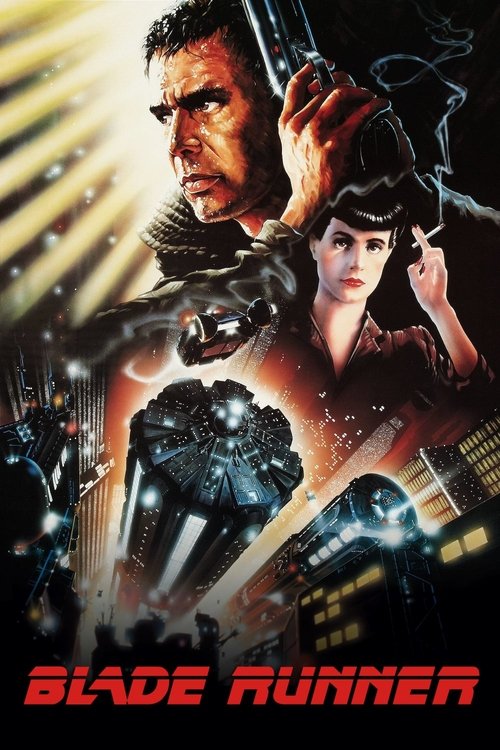
"Man has made his match... now it's his problem."
Blade Runner - Ending Explained
⚠️ Spoiler Analysis
The narrative of Blade Runner follows Rick Deckard as he hunts four fugitive Nexus-6 replicants: Roy Batty, Zhora, Leon, and Pris. Deckard successfully 'retires' Zhora after a chase through crowded city streets and is then saved from being killed by a vengeful Leon when Rachael intervenes, shooting Leon with Deckard's gun.
Meanwhile, Roy Batty and Pris manipulate the lonely genetic designer J.F. Sebastian to gain access to their creator, Dr. Eldon Tyrell. In the film's pivotal confrontation, Roy demands 'more life' from Tyrell, who explains it is impossible. In a moment of rage and despair at his creator's impotence, Roy kisses Tyrell and then crushes his skull, killing him. Sebastian is presumed killed shortly after.
The climax occurs at Sebastian's apartment in the Bradbury Building, where Deckard retires Pris. He is then hunted by a physically deteriorating but immensely powerful Roy. The chase leads to the rooftops, where Deckard is left dangling for his life. In a stunning reversal, Roy, whose pre-determined lifespan is ending, chooses to save Deckard. With his final breaths, he delivers his famous 'Tears in rain' monologue, demonstrating a profound understanding of life and mortality before he dies. A shaken Deckard returns to his apartment to flee with Rachael. He finds an origami unicorn left by Gaff, a sign that Gaff knows about his private dream and has spared Rachael's life. The ending remains ambiguous, as the unicorn strongly implies Deckard is a replicant with implanted memories, just like Rachael, and that their future is uncertain.
Alternative Interpretations
The most significant alternative interpretation of Blade Runner centers on the question: Is Rick Deckard a replicant? This debate is fueled by clues across the film's different versions.
The 'Deckard is a Replicant' Theory:
- The Unicorn Dream: In the Director's and Final Cuts, Deckard has a daydream of a unicorn running through a forest. At the end of the film, he finds an origami unicorn left by Gaff. This implies that Gaff knows Deckard's private thoughts, suggesting they are implanted memories, just like Rachael's.
- Glowing Eyes: For a brief moment in one scene with Rachael, Deckard's eyes appear to have the same subtle red glow seen in the eyes of known replicants.
- Director's Intent: Director Ridley Scott has stated definitively in interviews that he intended for Deckard to be a replicant.
- Gaff's Final Line: Gaff's parting words, 'It's too bad she won't live! But then again, who does?', can be interpreted as a nod to Deckard's own limited lifespan.
The 'Deckard is Human' Theory:
- Audience Connection: Harrison Ford has always maintained that he played the character as a human. He argued it was crucial for the audience to have a human point of view to emotionally connect with the story's themes.
- The Original Film: The 1982 theatrical release contains no unicorn dream, making Gaff's origami unicorn simply an enigmatic symbol that Deckard understands Rachael is also a 'mythical creature' who deserves to be free. The studio-imposed happy ending also strongly suggests Deckard is human.
- Thematic Resonance: Some argue that the film's themes are more powerful if Deckard is a human who learns to empathize with the 'other'. If he is just another replicant, his journey of rediscovering humanity loses some of its impact.
Ultimately, the film's enduring power lies in this ambiguity, forcing the viewer to ask the same questions as the characters: what does it mean to be human, and how can we be sure of our own identity?