
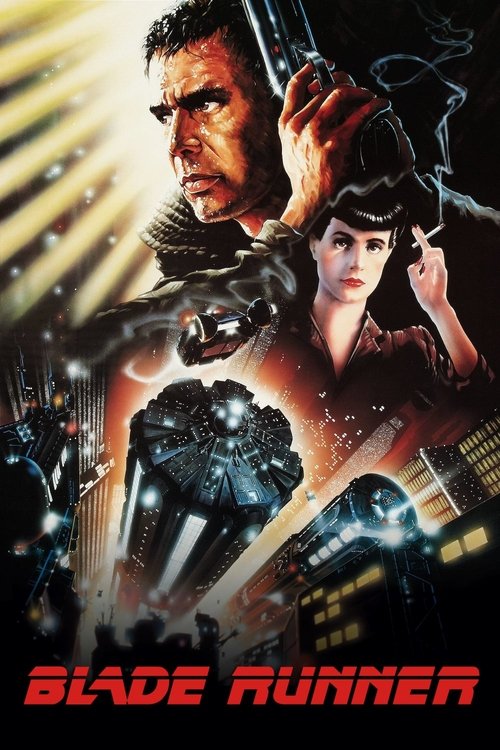
"Man has made his match... now it's his problem."
Director: Ridley Scott
Cast: Harrison Ford, Rutger Hauer, Sean Young, Edward James Olmos, M. Emmet Walsh
Blade Runner — Movie Quotes
Memorable Quotes
I've seen things you people wouldn't believe. Attack ships on fire off the shoulder of Orion. I watched C-beams glitter in the dark near the Tannhäuser Gate. All those moments will be lost in time, like tears in rain. Time to die.
Context
After saving Deckard's life on a rain-soaked rooftop, a dying Roy Batty sits down and delivers this speech. He reflects on his life's memories as his body shuts down, choosing to share his soul with his enemy rather than die in violence. Rutger Hauer famously improvised and shortened the scripted speech, adding the final, poignant line himself.
Meaning
This iconic monologue is the culmination of Roy's character arc. It's a profound meditation on memory, mortality, and the beauty of a life lived, however short. By sharing his extraordinary experiences, he asserts the value of his existence and laments that his unique consciousness will vanish. The line 'like tears in rain' is a beautiful, tragic metaphor for the transient nature of memory and life itself, cementing his humanity in his final moments.
Quite an experience to live in fear, isn't it? That's what it is to be a slave.
Context
During the final rooftop chase, Deckard is dangling precariously, about to fall to his death. Roy Batty, having easily made the jump, stands over him and delivers this line, savoring the reversal of power before ultimately deciding to save Deckard's life.
Meaning
This line directly addresses the film's theme of slavery and oppression. Roy turns Deckard's own fear against him, forcing the hunter to experience the constant terror that defines the replicants' existence. It's a powerful indictment of the human society that created beings for servitude and then hunts them for desiring freedom.
The light that burns twice as bright burns half as long - and you have burned so very, very brightly, Roy.
Context
Roy Batty confronts his maker, Dr. Tyrell, in his penthouse, demanding a way to extend his four-year lifespan. Tyrell explains that the process is irreversible and attempts to placate his 'prodigal son' with these words, moments before Roy kisses and then kills him.
Meaning
This quote is Tyrell's poetic, yet cold, dismissal of Roy's plea for more life. It acknowledges Roy's brilliance and the intensity of his short existence but frames his mortality as an unavoidable consequence of his superior design. It reflects Tyrell's detached, god-like perspective, admiring his creation's perfection while refusing to take responsibility for its built-in tragedy.
You know that Voight-Kampff test of yours? Did you ever take that test yourself?
Context
After Deckard has brutally revealed to Rachael that her memories are implants and she is a replicant, she confronts him in his apartment. Hurt and disillusioned, she challenges his authority and the very basis of his identity as a human Blade Runner.
Meaning
Rachael's question is a pivotal moment that directly introduces the ambiguity of Deckard's own humanity. It plants a seed of doubt for both Deckard and the audience, suggesting that the hunter might be no different from the hunted. Deckard's non-answer hangs over the rest of the film, fueling the central debate about his possible replicant nature.
It's too bad she won't live! But then again, who does?
Context
As Deckard and Rachael are leaving the apartment, Gaff appears and speaks this line to Deckard. He allows them to leave, but not without this final, enigmatic remark. He then leaves behind the origami unicorn, reinforcing the film's ambiguity.
Meaning
Gaff's final line serves as a philosophical capstone to the film, blurring the line between the fates of humans and replicants. On one level, it's a cold reminder of Rachael's limited lifespan. On a deeper level, it's a universal statement about mortality. It implies that all life is finite, and in that sense, the struggle and the death sentence are universal, making the distinction between human and replicant ultimately meaningless.
Explore More About This Movie
Dive deeper into specific aspects of the movie with our detailed analysis pages