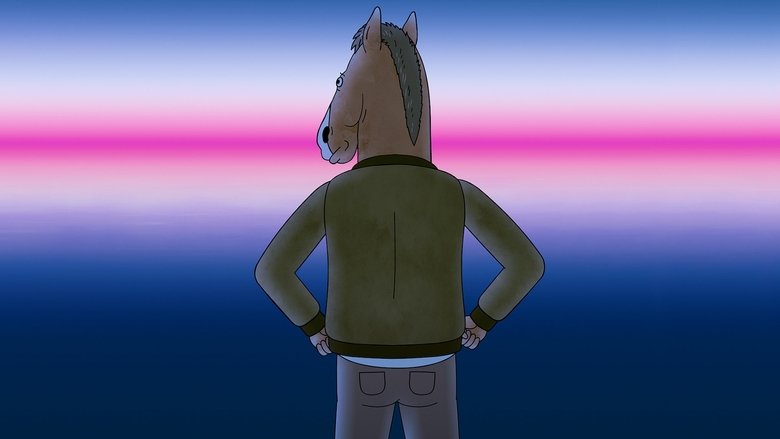

"Don't look back. You're not going that way."
BoJack Horseman - Symbolism & Philosophy
Symbols & Motifs
The Drowning Motif / Underwater
Symbolizes BoJack's overwhelming depression, isolation, and feelings of being submerged by his own self-destructive tendencies. The opening credits famously end with him sinking into his pool, representing his passive descent into despair.
This motif is present throughout the series, from the opening credits to BoJack's near-death experience in the penultimate episode, "The View from Halfway Down," where he is literally drowning in his pool. The critically acclaimed dialogue-free episode "Fish Out of Water" takes place almost entirely underwater, physically manifesting BoJack's inability to communicate and connect with the world around him.
The 'Horsin' Around' Sitcom
Represents BoJack's idealized past and the source of his arrested development. It's a fantasy of a simple life with easy resolutions and unconditional love—everything his real life lacks. It symbolizes the gap between the person he wanted to be and the person he became.
The show is referenced constantly. BoJack often re-watches it during moments of crisis, seeking comfort in a past where problems were solved in 22 minutes. His relationship with his former co-stars, particularly Sarah Lynn, is defined by the toxic environment of their shared past on the show, which ultimately contributes to her tragic end.
Secretariat
Secretariat is BoJack's childhood hero, a figure who represents both greatness and tragic self-destruction. He symbolizes the idea that even heroes are flawed and broken, and that success does not preclude profound sadness. Secretariat's on-screen suicide advice to a young BoJack is a dark premonition of BoJack's own struggles.
BoJack idolizes Secretariat from a young age. His dream role is to play him in a biopic, a project that dominates the early seasons and forces BoJack to confront his own legacy and failures. The poem from "The View from Halfway Down," read by Secretariat, powerfully articulates the regret of suicide, a theme that haunts BoJack throughout the series.
Philosophical Questions
Can a bad person become good, and what does 'good' even mean?
This is the central question of the series. BoJack constantly asks if he is a good person deep down, seeking external validation for an internal state. The show explores whether goodness is an inherent quality or the result of consistent actions. It suggests that grand, redemptive gestures are less meaningful than the small, daily efforts to be dependable and kind. The series avoids giving a simple answer, instead showing that the struggle itself—the continuous effort to be better—is what defines a person's moral journey.
How do we find meaning in an absurd and often indifferent universe?
The show is steeped in existentialist themes. Characters grapple with feelings of emptiness despite achieving traditional markers of success like fame and wealth. The series explores various coping mechanisms: Mr. Peanutbutter's hedonistic distraction, Diane's search for political purpose, and BoJack's destructive narcissism. Ultimately, "BoJack Horseman" suggests that there may be no grand, cosmic meaning to life. Instead, meaning is created in small, fleeting moments of connection and in the responsibility we take for ourselves and our impact on others.
To what extent are we defined by our trauma?
Through BoJack and Beatrice's backstories, the show delves into the long-reaching effects of generational trauma. It posits that while suffering can explain why people become cruel, selfish, or self-destructive, it does not excuse their behavior. The series argues that acknowledging one's trauma is the first step, but true growth comes from taking responsibility for one's own actions and actively working to break the cycle, a difficult and lifelong endeavor.
Core Meaning
The core message of "BoJack Horseman" is a nuanced and often somber exploration of accountability, change, and the human (and animal) condition. The creators, led by Raphael Bob-Waksberg, convey that redemption is not a single, grand gesture but a continuous, difficult, and often thankless process of daily effort. The series posits that while trauma and personal history shape who we are, they do not absolve us of responsibility for our actions. It argues against the idea of simple happy endings, suggesting instead that life is a series of moments, and the pursuit of happiness is less about finding a permanent state of bliss and more about learning to live with one's flaws and continuing to move forward, even after causing or experiencing immense pain.