BoJack Horseman
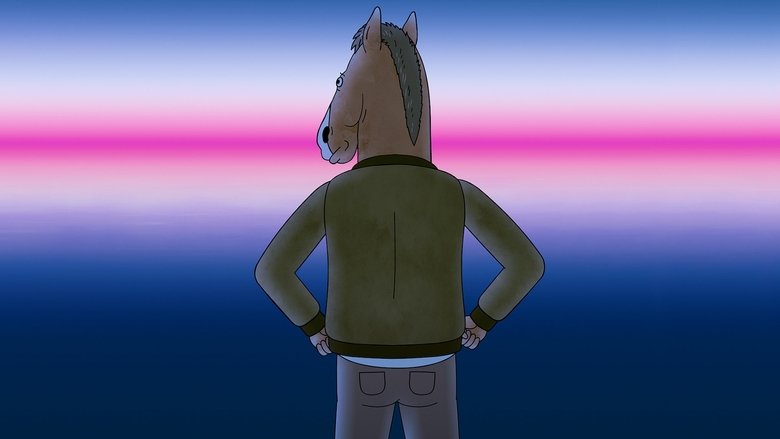
"Don't look back. You're not going that way."
Overview
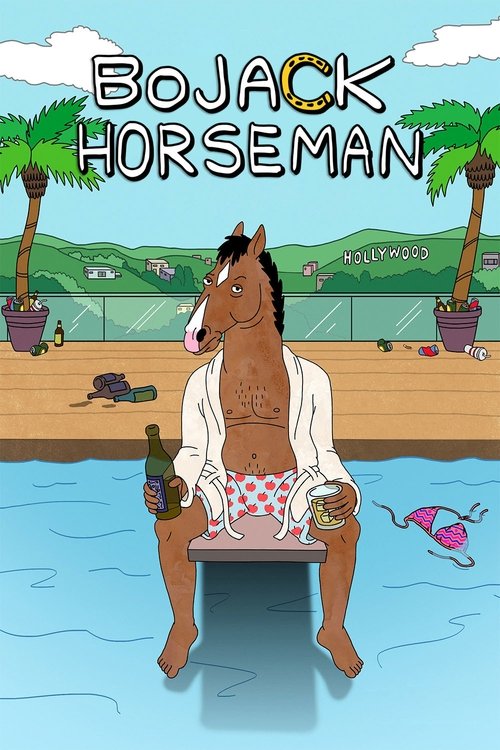
"BoJack Horseman" chronicles the life of its titular character, an anthropomorphic horse who was the star of a popular 1990s sitcom called "Horsin' Around." Two decades later, BoJack is a washed-up, deeply cynical, and self-loathing alcoholic living in Hollywood (renamed "Hollywoo"). The series follows his attempts to reignite his career and find happiness, all while navigating complex relationships with his human ghostwriter Diane Nguyen, his feline agent and ex-girlfriend Princess Carolyn, his perpetually cheerful canine rival Mr. Peanutbutter, and his freeloading human roommate Todd Chavez.
Across its six seasons, the show peels back the layers of BoJack's glamorous misery, exploring his traumatic childhood, his struggles with depression and addiction, and the destructive impact his actions have on those around him. It begins as a satire of celebrity culture and the entertainment industry but evolves into a profound and often heartbreaking examination of mental illness, existential dread, the possibility of change, and the search for meaning in a seemingly uncaring universe.

Core Meaning
The core message of "BoJack Horseman" is a nuanced and often somber exploration of accountability, change, and the human (and animal) condition. The creators, led by Raphael Bob-Waksberg, convey that redemption is not a single, grand gesture but a continuous, difficult, and often thankless process of daily effort. The series posits that while trauma and personal history shape who we are, they do not absolve us of responsibility for our actions. It argues against the idea of simple happy endings, suggesting instead that life is a series of moments, and the pursuit of happiness is less about finding a permanent state of bliss and more about learning to live with one's flaws and continuing to move forward, even after causing or experiencing immense pain.
Thematic DNA
Mental Health, Depression, and Addiction
This is the central theme of the series. BoJack's depression is not just sadness; it's a constant, self-loathing internal monologue vividly depicted in episodes like "Stupid Piece of Sh*t." His alcoholism and substance abuse are shown as both symptoms and causes of his destructive behavior, leading to blackouts, ruined relationships, and tragedy. The show portrays mental illness and addiction not as quirks but as debilitating conditions that require constant, arduous work to manage, with recovery being a non-linear path filled with relapses and small victories.
The Search for Meaning and Happiness
Nearly every character is searching for fulfillment. BoJack believes fame and validation will make him happy, only to find them empty. Diane seeks to make a meaningful impact on the world but struggles with her own hypocrisy and depression. Princess Carolyn pursues career success to find self-worth. The series consistently questions whether happiness is a destination one can arrive at. Characters often achieve their goals only to find themselves still unfulfilled, suggesting, as Mr. Peanutbutter puts it, that happiness might just be about keeping "busy with unimportant nonsense."
Accountability and Consequences
Unlike many sitcoms, "BoJack Horseman" operates in a world where actions have lasting and often devastating consequences. BoJack's selfishness, neglect, and cruelty lead to irreparable harm, most notably in his relationships with Sarah Lynn, Penny, and Herb Kazzaz. The show's later seasons focus heavily on whether BoJack can—or should—be forgiven. The finale doesn't offer a clean slate; instead, it shows him living with the fallout of his choices, including a prison sentence, emphasizing that true change involves facing the repercussions of one's past.
Hollywood Satire and Celebrity Culture
The show is a sharp critique of the entertainment industry. It satirizes the superficiality of Hollywood, the fickle nature of fame, the absurdity of celebrity worship, and systemic issues like sexism and power abuse. Through anthropomorphic animals and Hollywoo's absurd logic, the series comments on how the industry packages trauma as entertainment, celebrates problematic figures, and creates a toxic environment that exacerbates the personal demons of its stars.
Character Analysis
BoJack Horseman
Will Arnett
Motivation
His primary motivation is a desperate, insatiable need for love and approval, stemming from his abusive parents. He believes that fame and adoration will fill the void inside him, but as he achieves success, he realizes the emptiness persists. His motivation slowly shifts from seeking external validation to a fragile, internal desire to stop hurting people and maybe, just maybe, find a way to live with himself.
Character Arc
BoJack begins as a deeply narcissistic, self-pitying has-been, using alcohol and toxic relationships to numb the pain of his traumatic upbringing and deep-seated self-loathing. His journey is a cyclical battle between his desire to be a good person and his self-destructive impulses. Over six seasons, he makes halting progress, attending rehab and briefly finding purpose as a professor. However, his past actions eventually catch up to him, leading to public disgrace and a prison sentence. His arc is not one of complete redemption but of painful, incremental growth. The finale sees him accepting the consequences of his actions and learning to exist without the constant validation or destruction of those closest to him.
Diane Nguyen
Alison Brie
Motivation
Diane is motivated by a deep-seated desire to do good and to live a life of meaning and integrity. She is driven to expose injustice and understand the world on a deeper level. This motivation often clashes with her own feelings of inadequacy and depression, leading her to question if she's a good person. Ultimately, her motivation evolves into a quest for personal happiness and stability.
Character Arc
Diane starts as BoJack's ghostwriter, an intelligent and principled third-wave feminist who sees through Hollywoo's facade. Initially, she acts as a moral foil to BoJack, but her arc reveals her own struggles with depression, imposter syndrome, and a need to feel like she's making a difference. She goes from writing celebrity memoirs to investigative journalism to eventually finding peace and happiness writing young adult fiction in Houston. Her journey is about accepting that she doesn't have to carry the weight of the world's problems and that it's okay to be happy, even if it feels unearned. Her final conversation with BoJack signifies her moving on from their codependent, often toxic, friendship.
Princess Carolyn
Amy Sedaris
Motivation
Her motivation is twofold: an unyielding drive for professional success and a deep-seated need to fix things and take care of people. She believes she can have it all—the career, the family—if she just works hard enough. Over time, her motivation becomes less about proving herself to others and more about building a life that is personally fulfilling for her.
Character Arc
Princess Carolyn is a relentlessly ambitious agent who constantly puts her clients' needs (especially BoJack's) before her own. Her arc is a journey of learning to balance her career with her personal desire for a family. She faces numerous professional setbacks and personal heartbreaks, including miscarriages, but her defining trait is her resilience. She never gives up. By the end of the series, she successfully adopts a child, starts her own agency, and finds a healthy romantic relationship with her assistant, Judah. She learns to set boundaries with BoJack and prioritize her own hard-won happiness.
Todd Chavez
Aaron Paul
Motivation
Todd is primarily motivated by a desire for fun, friendship, and a sense of belonging. He is creative and finds joy in bizarre projects, but what he truly seeks is acceptance for who he is. His motivation evolves into a need for self-respect, leading him to establish boundaries and seek relationships where he is valued.
Character Arc
Todd begins as BoJack's freeloading, simple-minded roommate, often getting caught up in absurd, Rube Goldberg-esque business schemes. While serving as comic relief, his arc is one of self-discovery and growing independence. He eventually confronts BoJack for his toxicity and moves out, building his own life separate from his former friend's destructive orbit. A major part of his journey is coming to terms with his asexuality, providing one of the first prominent representations of the identity on television. He finds success on his own terms and builds a healthy relationship, demonstrating that growth is possible outside of conventional metrics of success.
Mr. Peanutbutter
Paul F. Tompkins
Motivation
Mr. Peanutbutter is motivated by a desperate need to be liked by everyone. He craves constant attention and validation, throwing himself into grand romantic gestures and harebrained schemes to avoid confronting his own inner emptiness and fear of being alone. His motivation begins to shift toward a more genuine desire for connection, rather than just adoration.
Character Arc
Mr. Peanutbutter is BoJack's former sitcom rival, a golden retriever with an endlessly cheerful and simplistic outlook on life. He represents a foil to BoJack: effortlessly happy and beloved, yet emotionally shallow. His arc reveals the dark side of his relentless optimism; it's a defense mechanism that prevents him from engaging in difficult emotions or truly understanding his romantic partners, leading to a string of failed marriages. His journey involves a slow, painful recognition that ignoring problems doesn't make them go away. He begins to take small steps towards self-awareness and accountability, acknowledging his own patterns of emotional avoidance.
Symbols & Motifs
The Drowning Motif / Underwater
Symbolizes BoJack's overwhelming depression, isolation, and feelings of being submerged by his own self-destructive tendencies. The opening credits famously end with him sinking into his pool, representing his passive descent into despair.
This motif is present throughout the series, from the opening credits to BoJack's near-death experience in the penultimate episode, "The View from Halfway Down," where he is literally drowning in his pool. The critically acclaimed dialogue-free episode "Fish Out of Water" takes place almost entirely underwater, physically manifesting BoJack's inability to communicate and connect with the world around him.
The 'Horsin' Around' Sitcom
Represents BoJack's idealized past and the source of his arrested development. It's a fantasy of a simple life with easy resolutions and unconditional love—everything his real life lacks. It symbolizes the gap between the person he wanted to be and the person he became.
The show is referenced constantly. BoJack often re-watches it during moments of crisis, seeking comfort in a past where problems were solved in 22 minutes. His relationship with his former co-stars, particularly Sarah Lynn, is defined by the toxic environment of their shared past on the show, which ultimately contributes to her tragic end.
Secretariat
Secretariat is BoJack's childhood hero, a figure who represents both greatness and tragic self-destruction. He symbolizes the idea that even heroes are flawed and broken, and that success does not preclude profound sadness. Secretariat's on-screen suicide advice to a young BoJack is a dark premonition of BoJack's own struggles.
BoJack idolizes Secretariat from a young age. His dream role is to play him in a biopic, a project that dominates the early seasons and forces BoJack to confront his own legacy and failures. The poem from "The View from Halfway Down," read by Secretariat, powerfully articulates the regret of suicide, a theme that haunts BoJack throughout the series.
Memorable Quotes
It gets easier. Every day it gets a little easier. But you gotta do it every day — that’s the hard part. But it does get easier.
— Jogging Baboon
Context:
In the final episode of Season 2, "Out to Sea," a demoralized BoJack attempts to start jogging. He quickly gives up, collapsing on the side of the road, where a random jogging baboon offers him this piece of advice before running off.
Meaning:
This quote encapsulates the show's core philosophy on change and recovery. It acknowledges that healing and self-improvement are not a one-time fix but a continuous, daily commitment. It offers a rare, earned moment of hope in a series often steeped in cynicism.
When you look at someone through rose-colored glasses, all the red flags just look like flags.
— Wanda Pierce
Context:
This line is said by Wanda, BoJack's owl girlfriend who just woke up from a 30-year coma, in Season 2, Episode 10, "Yes And." She says it as she is breaking up with BoJack, having finally recognized the toxic patterns she had previously overlooked.
Meaning:
A poignant observation about the nature of love and denial. This quote speaks to the universal experience of ignoring warning signs in a relationship because of infatuation. It highlights how people's desires can blind them to the reality of who someone is.
Sometimes life’s a bitch and then you keep living.
— Diane Nguyen
Context:
In Season 6, Episode 16, "Nice While It Lasted," Diane says this to BoJack during their final conversation on the roof. It is a reflection on their shared struggles and a quiet acknowledgment of the path forward.
Meaning:
A sober and realistic counterpoint to the nihilistic cliché "life's a bitch and then you die." This quote embodies the show's theme of endurance. It suggests that the true challenge of life isn't death, but the necessity of continuing to live through pain, disappointment, and hardship.
I need you to tell me that I'm a good person. I know that I can be selfish and narcissistic and self-destructive, but underneath all that, deep down, I'm a good person... Tell me that I'm good.
— BoJack Horseman
Context:
At the end of Season 1, Episode 11, "Downer Ending," after a drug-fueled trip where he imagines a better life, BoJack anxiously asks this of Diane. The episode famously ends with her silence, refusing to give him the easy absolution he craves.
Meaning:
This quote perfectly captures BoJack's desperate need for external validation and his refusal to do the internal work required to actually be good. He wants the label of 'good' without the effort, showing his deep insecurity and desire for a simple answer to his complex moral failings.
The view from halfway down.
— Secretariat
Context:
This is the title and centerpiece of Season 6, Episode 15. In a near-death hallucination, BoJack watches his hero, Secretariat, perform a poem about his own suicide by jumping off a bridge. The poem describes the horrifying realization, halfway down, that life was worth living after all.
Meaning:
This phrase, from a poem recited in the episode, is a devastating metaphor for the regret felt in the moment of suicide. It speaks to the sudden clarity and terror of realizing you've made an irreversible mistake, but only when it's too late. It is one of the show's most haunting explorations of death and despair.
Episode Highlights
Fish Out of Water
In this visually stunning and almost entirely silent episode, BoJack attends an underwater film festival. Unable to speak due to his aquatic helmet, he must communicate through actions alone. He attempts to return a lost baby seahorse to its father, embarking on a poignant and frustrating journey. The episode is a masterclass in visual storytelling, conveying deep emotion and character development without dialogue.
"Fish Out of Water" is a significant departure from the show's usual format, proving its artistic ambition. It strips BoJack of his primary coping mechanism—his wit and words—forcing him into a situation where he must act selflessly. It powerfully illustrates his profound loneliness and desperate, albeit clumsy, attempts to connect with others.
Free Churro
The entire episode consists of a single, 25-minute monologue as BoJack delivers the eulogy at his mother's funeral. He rambles through anecdotes about his traumatic childhood, his complicated feelings of grief, resentment, and a desperate search for a final moment of connection that never came. The only other speaking part is a brief flashback with his father at the very beginning.
This episode is a tour-de-force of writing and voice acting. It dives deep into the psychology of grief and abuse, exploring how generational trauma shapes a person. It's a raw, unfiltered look into BoJack's psyche, revealing the profound damage his parents inflicted and his inability to process their loss in a conventional way.
Time's Arrow
This episode explores the life and memories of BoJack's mother, Beatrice, as her mind deteriorates from dementia. The narrative jumps non-linearly through her traumatic past—a privileged but emotionally sterile childhood, the loss of her brother, a forced lobotomy for her mother, and her unhappy marriage to Butterscotch Horseman. The animation cleverly depicts her fractured consciousness, with faces blurring and settings shifting abruptly.
"Time's Arrow" is crucial for understanding the root of BoJack's trauma. It reframes Beatrice from a simple villain into a tragic figure, a victim of her own upbringing who perpetuated a cycle of abuse. It's a deeply empathetic yet unflinching look at generational pain and how cruelty is often born from suffering.
The View from Halfway Down
The penultimate episode of the series finds BoJack in a surreal dinner party limbo with all the major figures in his life who have died, including his mother, Herb Kazzaz, Sarah Lynn, and Secretariat. They perform for him before being consumed by a terrifying black void. The episode culminates in the revelation that BoJack is drowning in his pool, and this is his brain's final, desperate hallucination.
This is the climax of BoJack's journey with death and self-destruction. It's a terrifying, experimental, and profound exploration of life, regret, and what might come after. It forces BoJack (and the audience) to confront the full weight of his past and the people his actions have affected, bringing the series' darkest themes to a haunting crescendo.
Nice While It Lasted
The series finale picks up after BoJack survives his drowning. He is in prison for breaking and entering. The episode sees him on a temporary release to attend Princess Carolyn's wedding, where he has final, quiet, and meaningful conversations with each of the main characters. The most significant is his last talk with Diane on a rooftop, where they silently acknowledge the end of their friendship and the separate paths their lives have taken.
The finale rejects a dramatic, conclusive ending for a more realistic and bittersweet one. It reinforces the series' core message: life goes on. There are no easy resolutions. Relationships change and end, and the work of being a better person is never truly finished. It's a quiet, contemplative, and emotionally resonant conclusion to the entire saga.
Philosophical Questions
Can a bad person become good, and what does 'good' even mean?
This is the central question of the series. BoJack constantly asks if he is a good person deep down, seeking external validation for an internal state. The show explores whether goodness is an inherent quality or the result of consistent actions. It suggests that grand, redemptive gestures are less meaningful than the small, daily efforts to be dependable and kind. The series avoids giving a simple answer, instead showing that the struggle itself—the continuous effort to be better—is what defines a person's moral journey.
How do we find meaning in an absurd and often indifferent universe?
The show is steeped in existentialist themes. Characters grapple with feelings of emptiness despite achieving traditional markers of success like fame and wealth. The series explores various coping mechanisms: Mr. Peanutbutter's hedonistic distraction, Diane's search for political purpose, and BoJack's destructive narcissism. Ultimately, "BoJack Horseman" suggests that there may be no grand, cosmic meaning to life. Instead, meaning is created in small, fleeting moments of connection and in the responsibility we take for ourselves and our impact on others.
To what extent are we defined by our trauma?
Through BoJack and Beatrice's backstories, the show delves into the long-reaching effects of generational trauma. It posits that while suffering can explain why people become cruel, selfish, or self-destructive, it does not excuse their behavior. The series argues that acknowledging one's trauma is the first step, but true growth comes from taking responsibility for one's own actions and actively working to break the cycle, a difficult and lifelong endeavor.
Alternative Interpretations
One of the most debated aspects of the series is the finale. While the literal interpretation is that BoJack survives and goes to prison, some viewers initially believed he actually died in the pool in the penultimate episode, "The View from Halfway Down," and that the final episode, "Nice While It Lasted," is a kind of afterlife fantasy or dying dream. This interpretation suggests that his peaceful, cathartic conversations with his friends are a final wish-fulfillment before his death. However, creator Raphael Bob-Waksberg has confirmed that BoJack does, in fact, live, as the show's core message is about the difficulty of continuing to live, not the escape of death.
Another area of interpretation revolves around BoJack's capacity for change. A cynical reading suggests that BoJack is doomed to repeat his destructive patterns and that his periods of improvement are only temporary, meaning his eventual freedom from prison will lead to more chaos. A more optimistic interpretation, supported by the show's creators, is that while his journey is fraught with setbacks, he has achieved genuine, albeit incremental, growth. The ending is intentionally ambiguous about his ultimate fate, suggesting that the potential for both failure and success is always present, and the choice is his to make, day by day.
Cultural Impact
"BoJack Horseman" is widely regarded as one of the best television shows of the 21st century and a landmark in adult animation. Premiering in 2014, it arrived at a time when streaming services like Netflix were beginning to produce original content, and it helped establish the platform as a home for ambitious, creator-driven projects. The show pushed the boundaries of the animated sitcom, demonstrating that the format could be used to explore complex, mature themes like depression, addiction, trauma, and existentialism with a depth and nuance typically reserved for prestige dramas.
Its influence can be seen in a new wave of adult animated shows that blend comedy with serious emotional storytelling, such as "Tuca & Bertie" (also from the "BoJack" creative team) and "Undone." The series has been praised for its honest and unflinching portrayal of mental illness, resonating deeply with audiences and earning accolades for destigmatizing conversations around depression and recovery. Its sharp satire of Hollywood and celebrity culture provided a critical lens on contemporary issues, including the #MeToo movement and accountability for powerful men. The legacy of "BoJack Horseman" lies in its artistic bravery, its emotional honesty, and its profound assertion that a cartoon about a talking horse could be one of the most human stories on television.
Audience Reception
The audience reception for "BoJack Horseman" evolved dramatically over its run. The first season was met with a mixed response, as many viewers and critics initially dismissed it as another cynical adult animated comedy based on the first few episodes. However, as the season progressed and revealed its dramatic depth, opinions shifted positively. From the second season onward, the series received near-universal acclaim from both critics and audiences, with many hailing it as one of Netflix's best original series.
Audiences praised the show for its realistic and empathetic portrayal of mental health, its brilliant writing, complex character development, and its willingness to tackle difficult subject matter with both humor and gravity. The experimental episodes, like "Fish Out of Water" and "Free Churro," were often singled out for their creativity and emotional impact. The series finale was largely well-received for its quiet, realistic, and bittersweet conclusion, which fans felt was true to the show's core themes, even if it denied them a simple, happy ending. It has cultivated a passionate and loyal fanbase that continues to analyze its themes and legacy long after its conclusion.
Interesting Facts
- The series was created by Raphael Bob-Waksberg, who first conceived of the character as a pitch for a show about a washed-up talking horse.
- The distinct visual style and character designs were created by cartoonist Lisa Hanawalt, a longtime friend and collaborator of Bob-Waksberg.
- Will Arnett and Aaron Paul, who voice BoJack and Todd respectively, also served as executive producers on the show.
- The first season received mixed reviews initially, with many critics only watching the first few episodes, which are more comedic in tone. The show gained widespread critical acclaim as it leaned into its darker, more dramatic themes in later episodes and subsequent seasons.
- The idea for the nearly silent episode, "Fish Out of Water," came from the production team's desire to fully utilize the medium of animation to tell a story visually.
- The "Hollywoo" sign, which has the "D" stolen in the first season, remains that way for the rest of the entire series, a testament to the show's commitment to continuity and consequences.
Easter Eggs
Throughout the series, the artwork in BoJack's office changes to reflect his current state of mind or recent events. For example, the famous David Hockney-inspired painting of a horse by a pool is sometimes replaced with variations, including one with Diane in it or one reflecting his Oscar nomination.
This subtle background detail serves as a visual metaphor for BoJack's internal journey, his obsessions, and his changing relationships. It rewards attentive viewers and adds another layer of storytelling to the environment.
Numerous background gags and animal-based puns appear in almost every frame. Examples include storefronts like "Rodentistry," billboards for movies like "The Color Purple Rain," or animals behaving in ways stereotypical of their species (e.g., Mr. Peanutbutter being distracted by a tennis ball).
These gags provide levity and world-building, creating a dense and humorous reality where the anthropomorphism is both normalized and a constant source of comedy. It contrasts sharply with the show's dark emotional core.
Character actress Margo Martindale appears as a recurring guest star playing a fictionalized, criminally insane version of herself, referred to as "Esteemed Character Actress Margo Martindale."
This is a long-running meta-joke that plays with Hollywood's perception of character actors. Her increasingly absurd and violent escapades become a beloved, surreal running gag throughout the series.
⚠️ Spoiler Analysis
Click to reveal detailed analysis with spoilers
Frequently Asked Questions
Explore More About This Movie
Dive deeper into specific aspects of the movie with our detailed analysis pages
Comments (0)
No comments yet. Be the first to share your thoughts!