Skip to content
Boulevard
A tender, bruised teenage romance where two damaged outsiders meet on a stretch of road that becomes their whole world — a boulevard of rain, headlights and everything love cannot outrun.
Boulevard

Boulevard

10 April 2026 United States of America 113 min 7.5 (200)

Director: Sonia Méndez

Cast: Eve Ryan, Mikel Niso, Esther Acebo, Luis Zahera, Biel Antón

Drama Romance Love as recognition, not rescue Addiction, denial and the decision to ask for help Starting over and the impossibility of outrunning yourself Parents, inheritance and the households we survive Grief and the afterlife of first love

Overview

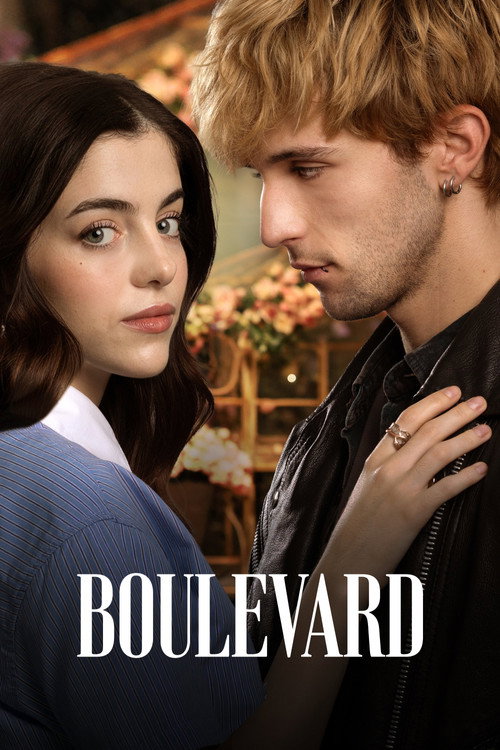
Boulevard (2026) is a Spanish romantic drama directed by Sonia Méndez, adapted by screenwriter Javier Ruescas from the enormously popular self-published Wattpad novel by Mexican author Flor M. Salvador. It follows Hasley Weigel (Eve Ryan), a teenager who arrives in a new city with her mother hoping to start over, and Luke Howland (Mikel Niso), a boy weighed down by a dark past, a difficult father and a dependence he cannot admit to.

They are, in the film's own framing, two high-school outcasts who recognise something of themselves in each other. What begins as friction and avoidance slowly turns into the kind of first love that feels like the only safe place in the world — negotiated in corridors, bedrooms, cars and above all on the stretch of road that gives the film its name. Around them orbit Hasley's mother Bonnie (Esther Acebo), trying to hold a fragile household together, and Luke's father (Luis Zahera), whose presence shadows everything his son does.

Méndez keeps the register intimate and confessional rather than melodramatic, shooting the northern Spanish landscapes of Biscay as a muted, rain-washed backdrop to adolescent interiority. The film is faithful to its source novel's structure and emotional promises, and like the book it moves steadily toward a reckoning that its young protagonists sense long before they can name it.

Core Meaning

At its heart Boulevard argues that love is not a cure. Hasley cannot heal Luke by loving him hard enough, and Luke cannot become worthy of her by willpower alone — the film's central gesture is his decision to seek help, to step away from the person he loves in order to have any chance of surviving himself. Méndez frames that choice as the most romantic act in the story, and also the most adult.

The second idea braided through it is about time and its arbitrariness. The film spends its length teaching us that adolescence feels infinite — endless afternoons, endless conversations on the same road — and then demonstrates how little of it is guaranteed. What remains is not the relationship itself but what it made possible: the words said in time, the letter written, the person one becomes because someone once looked at them without flinching.

Underneath both runs a message aimed squarely at its young audience: pain that is hidden becomes fatal, pain that is spoken becomes survivable. Addiction, grief and depression in the film are never aestheticised as romantic damage; they are things that require naming, a rehabilitation centre, a parent, a letter.

Thematic DNA

Love as recognition, not rescue 30%
Addiction, denial and the decision to ask for help 22%
Starting over and the impossibility of outrunning yourself 18%
Parents, inheritance and the households we survive 16%
Grief and the afterlife of first love 14%

Love as recognition, not rescue

Hasley and Luke are drawn together because each sees the other's damage without recoiling. The film repeatedly stages the temptation of the rescue fantasy — that Hasley's presence might be enough to pull Luke out — and just as repeatedly refuses it. Luke's real turn comes when he chooses treatment rather than her, an act the film presents as love precisely because it costs him her company.

Addiction, denial and the decision to ask for help

Luke's dependence is not a character quirk but the engine of the plot. It shapes his absences, his cruelty, his self-loathing and his silence with his father (Luis Zahera). The film tracks the long distance between knowing you are ill and saying so out loud; his letter, revealing his plan to enter a rehabilitation centre for a year, is the moment denial finally breaks.

Starting over and the impossibility of outrunning yourself

Hasley arrives in a new city precisely to begin again, and the narrative quietly dismantles the idea that geography can do that work. The new school, the new house, the new boy all become fresh surfaces for old wounds, until she is forced to build a self that does not depend on escape.

Parents, inheritance and the households we survive

Bonnie Weigel (Esther Acebo) and Luke's father embody two failures of care: one overwhelmed and well-meaning, the other harsher and more corrosive. The film suggests that both teenagers are managing adult-sized damage they did not create, and that adolescence here means learning which parts of a parent to keep and which to refuse.

Grief and the afterlife of first love

The final movement hands the film to mourning: the funeral, the empty classroom, the house that no longer needs to be tiptoed through. Grief is shown not as a single scene but as a process Hasley moves through while Luke's voice continues to speak to her, turning the boulevard from a meeting place into a memorial.

Character Analysis

Hasley Weigel

Eve Ryan

Archetype: The newcomer / reluctant heroine Key Trait: Guarded tenderness

Motivation

To start over — and, once she meets Luke, to be the one person who does not abandon him.

Character Arc

She arrives in the city as someone defined by what she is fleeing, and spends the film learning that a fresh start is something built rather than moved into. Loving Luke first gives her a reason to stay present, then forces her to confront a darkness she cannot fix; the ending leaves her holding his letter and, for the first time, a life that is hers to shape without him.

Luke Howland

Mikel Niso

Archetype: Wounded antihero Key Trait: Self-destructive honesty

Motivation

To stop hurting — and, failing that, to stop hurting Hasley.

Character Arc

Introduced as the boy with a dark past and an addiction he refuses to name, he oscillates between intimacy and self-sabotage. His arc resolves not in being saved but in choosing treatment: the letter reveals he had decided to enter a rehabilitation centre for a year, a decision he never gets to carry out.

All 4 characters and cast

Symbols & Motifs

The boulevard itself

Meaning:

A road is by definition a place of passage, not of arrival — and the film's title makes that the governing metaphor. It stands for adolescence as a stretch of time you can only walk through, and for a relationship that was always a route rather than a destination.

Context:

It is where the couple's romance takes shape and is symbolically anchored, and the place Hasley returns to afterwards to read Luke's letter. The same asphalt carries first meetings, confessions and the final catastrophe.

The rose

Meaning:

The most conventional token of romance, deliberately used at the least conventional moment: an offering of ordinary love that never reaches the hand it was meant for. On the ground it becomes an image of intention severed from outcome.

Context:

Luke crosses toward Hasley carrying a rose in the film's closing sequence; after the truck, the screen goes black and the flower is what we see lying on the road as a siren approaches.

The letter

Meaning:

Written language as the thing that outlives the body. It represents Luke's belated capacity to say what he could never speak aloud — his addiction, his plan for rehabilitation, his love — and the film's conviction that confession is the real act of courage.

Context:

Hasley reads it at the boulevard after a time jump, Luke's voice narrating over images of his funeral and her grieving at home and at school.

The new house and the new school

Meaning:

Thresholds of reinvention. They symbolise the promise that a person can be rewritten by a change of address, a promise the film tests and finds insufficient.

Context:

Hasley's arrival in the city with her mother Bonnie sets up both spaces as places where she is unknown — and therefore, briefly, free.

Rain and the Atlantic north

Meaning:

The weather externalises an emotional climate of suspension: grey, enclosed, waiting. It also grounds a story of global teen-romance archetypes in a very specific, unglamorous corner of northern Spain.

Context:

Shot in Biscay, the film uses overcast coastal light and wet streets as a near-constant backdrop, resisting the sunlit palette typical of the genre.

Philosophical Questions

Can you love someone out of their own destruction?

The film sets Hasley up as the classic redemptive beloved and then denies her that power. Luke's turn toward recovery comes from within and requires him to leave — an argument that love can motivate change but cannot perform it.

Is leaving someone ever the most loving thing you can do?

Luke's decision to enter a rehabilitation centre for a year means choosing absence over presence. The letter asks the audience to read that separation not as abandonment but as the only honest form his love could take.

What does a life mean if it ends the moment it turns toward hope?

By killing Luke immediately after his decision to get well, the film confronts the question of whether intention has moral weight independent of outcome. Hasley's grief, and the letter's survival, suggest it does.

Can you outrun the person you were somewhere else?

Hasley's move to a new city frames reinvention as a matter of distance. The narrative steadily shows that the new place only changes the audience, not the self, and that starting over requires being known rather than being anonymous.

What survives a person — and who decides?

Luke's voice narrating over his own funeral literalises the question. What persists is a text he chose to write; the film locates immortality not in memory but in the words someone was brave enough to put down before it was too late.

How It Ends

Alternative Interpretations

The tragic-fate reading. Taken literally, the ending is an accident: a truck, a boy running to push the girl he loves out of its path, a rose on the asphalt. Luke dies as a straightforward romantic martyr, and the film is a story about how arbitrarily death arrives just as someone has decided to live.

Full ending explanation

Cultural Impact

Boulevard belongs to a distinctly 2020s phenomenon: the Wattpad-to-screen pipeline. Flor M. Salvador's novel built a vast readership online and in print across Spanish-speaking territories before Sony Pictures Entertainment Iberia and Webtoon Productions brought it to cinemas — a lineage that runs through After and A través de mi ventana, where fan devotion, not critical consensus, drives the commercial case.

Its production profile is also notable within Spanish cinema: a €4 million youth romance financed with regional Basque support (Diputación Foral de Bizkaia) and national ICAA backing, shot in Biscay, with Prime Video attached. It represents an attempt to build a domestic, exportable teen-romance franchise rather than importing one — and the existence of the sequel novel Después de él keeps that possibility open.

Critically the reception was tough. Spanish outlets faulted the film for calculated aestheticism and for chemistry that felt "more constructed from intention than from truth," with one review witheringly comparing the script to Twilight watched on loop. Against roughly $3.6 million in box office on a €4 million budget, its cultural weight rests less on reviews than on the passionate, book-first audience that turned up for it.

Audience Reception

The split is sharp. Readers of Flor M. Salvador's novel largely embraced the film, praising its faithfulness to the book — for this audience the adaptation delivered the scenes, the boulevard and the ending they came for, and the emotional payoff of the letter and funeral sequence drew the strongest reactions.

Critics were considerably harder. The recurring complaints concern the central relationship and the film's surface: chemistry between the leads described as forced and "more constructed from intention than from truth"; an intimacy that reads as calculated, with compositions designed to look beautiful rather than to convey feeling; and silences and glances that register as artificial instead of profound. At least one Spanish review dismissed the script outright as derivative teen-romance formula.

Performances fared slightly better. Eve Ryan drew qualified credit for conveying adolescent insecurity, with reviewers noting that the artificiality around her worked against the performance rather than coming from it. The adult supporting presence of Luis Zahera and Esther Acebo was generally treated as an asset.

Verdict: a film whose worth depends almost entirely on whether you arrive as a reader or as a viewer. Commercially it landed around $3.6 million against a €4 million budget — solid engagement from its target audience, without the breakout crossover its backers may have hoped for.

Interesting Facts

  • The film adapts Boulevard, the self-published novel by Mexican author Flor M. Salvador, which first found its audience on Wattpad before becoming a publishing phenomenon.
  • The screenplay was written by Javier Ruescas, himself a bestselling Spanish young-adult novelist, rather than by director Sonia Méndez.
  • Despite its Mexican literary origins and English-language character names, the film was shot in Biscay, in the Spanish Basque Country.
  • Production backing came from Espotlight Media, Maitemindua Zinema, Amets Kalea AIE and Lightbox Animation Studios, in association with Sony Pictures Entertainment Iberia and Webtoon Productions.
  • Prime Video participated in the financing, alongside the Diputación Foral de Bizkaia and Spain's ICAA film institute.
  • The production budget was approximately €4 million, and the film grossed around $3.6 million theatrically.
  • It was released in Spanish cinemas in April 2026 (10 April per most listings, with some outlets citing the 16th) and distributed by Sony Pictures.
  • Flor M. Salvador wrote a sequel to the novel, Después de él, giving the property an obvious route to a follow-up film.
  • Reviewers and readers broadly agreed that the adaptation is unusually faithful to the book, a decision that pleased the novel's fanbase more than it did critics.
  • Luis Zahera, one of Spain's most acclaimed character actors, takes the supporting role of Luke's father, lending adult gravity to a teen-oriented production.

Frequently Asked Questions

Explore More About This Movie

Dive deeper into specific aspects of the movie with our detailed analysis pages

Comments (0)

Leave a comment

No comments yet. Be the first to share your thoughts!

Similar Movies