Skip to content
Buddy
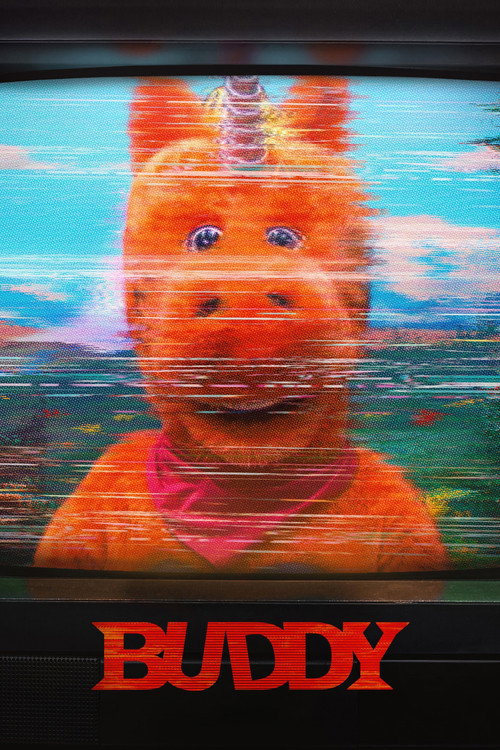
A neon-bright horror-comedy where sunshine is a cage and a smiling orange unicorn is the warden. Nostalgia curdles into dread, like a lullaby played one note too slow in an endless, painted afternoon.
Buddy

Buddy

"It's Buddy!"

27 August 2026 United States of America 96 min 7.1 (202)

Director: Casper Kelly

Cast: Delaney Quinn, Caleb Williams, Bennie Taylor, Eric Bauza, Patton Oswalt

Fantasy Comedy Horror Manufactured wholesomeness and the banality of evil Growing up and escaping nostalgia Coerced love and toxic need Memory, erasure and control Media and its unsettling afterlife
Budget: $3,000,000
Box Office: $26,848,371

Overview

Buddy (2026) is the feature directorial debut of Casper Kelly, the creator of the viral short Too Many Cooks. He co-wrote it with Jamie King. It is set inside It's Buddy!, a pastel, 1990s-style children's series hosted by a cuddly orange unicorn. The children of the show spend their days singing, dancing and learning lessons about bravery and hard work. The film was inspired by Barney & Friends but is not a copy of it.

Cracks appear when a child refuses to take part. The kid is dragged off and quietly replaced the next episode. The remaining children barely remember life before the show and cannot do basic things outside its rules. Freddy (Delaney Quinn) starts to doubt the cheerful routine, and Buddy's friendliness gets more brittle each time he is defied.

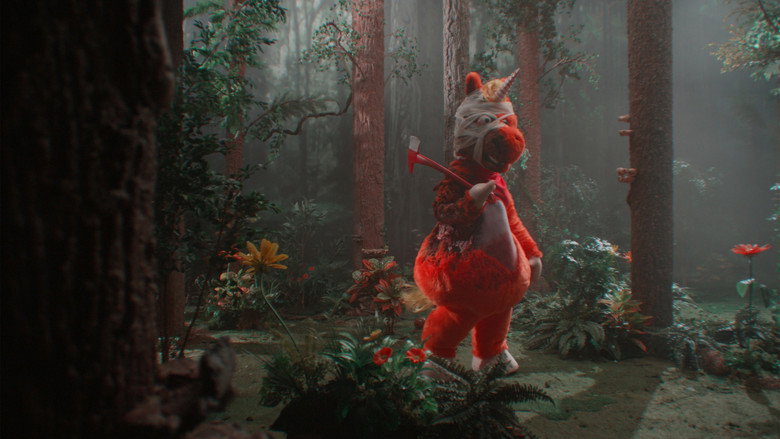
The film starts as a careful recreation of cheesy kids' TV, then slides into slasher territory. It also borrows the shape of a fairy tale, with a dangerous forest, a journey through it and a way out. It premiered in the Midnight section at Sundance in January 2026 and was released theatrically in the US on August 28, 2026. It runs about 95 minutes.
Core Meaning

The film is a satire of manufactured wholesomeness. It asks what is behind relentless cheer, mandatory love and a host who cannot tolerate being disliked. Buddy needs the children to love him, and he turns violent when they refuse. That makes him a monstrous version of every performer, parent or institution that demands affection.

It is also about growing up. As one critic noted, the lead kids are simply getting too old for this. The film treats childhood nostalgia as something both comforting and sinister: a loop that cannot be left without a fight. Reviewers described it as a hate letter made with love, and that fits. It mocks the genre while showing real affection for puppetry and 90s kids' television.

Thematic DNA

Manufactured wholesomeness and the banality of evil 30%
Growing up and escaping nostalgia 25%
Coerced love and toxic need 20%
Memory, erasure and control 15%
Media and its unsettling afterlife 10%

Manufactured wholesomeness and the banality of evil

The 'It's Buddy!' universe is bright, endless daytime with wall-to-wall music, and violence hides behind it. Buddy keeps insisting he is loving and honest while he lies, punishes and kills. A reviewer summed this up as the evil of banality.

Growing up and escaping nostalgia

Freddy and the other children are too old for the show's simple lessons. Escaping means leaving the safety of the childhood loop and entering a darker, more real world.

Coerced love and toxic need

Buddy needs to be loved. When the children refuse, his friendly mask slips. The sing-along 'You love Buddy' endings and the mocking 'I Hate Buddy' song are both about forced affection.

Memory, erasure and control

Children who rebel are removed and replaced. The kids cannot remember their lives before the show. Each episode resets the damage, so nothing is allowed to persist.

Media and its unsettling afterlife

The film asks why we hated Barney-like figures and why old children's TV looks eerie to modern eyes. Its liminal, Backrooms-like corridors and the TV portal suggest the screen is a trap that outlives its show.

Character Analysis

Freddy

Delaney Quinn

Archetype: Final Girl / reluctant hero Key Trait: Brave and perceptive

Motivation

To find the truth about the show and get herself and her friends out.

Character Arc

Freddy starts as a smiling child performer who cannot remember her life before the show. She slowly sees through Buddy's routine. She leads the surviving children toward escape and ends up the only child to survive.

Buddy

Keegan-Michael Key (voice); Sergey Zhuravsky (suit); Jonathan Yurco (Dark Buddy)

Archetype: Villain / monstrous host Key Trait: Needy and sunny, until he isn't

Motivation

To be loved by the kids and keep his show and its order going forever.

Character Arc

Buddy begins as a loving, rule-bound host. As the kids resist, he becomes more demented, and he mutates into a monstrous form when they mock him with the hate song. He finally loses his temper and is killed.

All 4 characters and cast

Symbols & Motifs

The theme songs ('It's Buddy!', 'You Love Buddy')

Meaning:

Compulsory happiness and ritual that keeps the world in order.

Context:

Every episode ends with Buddy hugging the kids and singing that they love him. Doing this heals him, repairs the set and starts a new episode.

The 'I Hate Buddy' song

Meaning:

Rebellion and the repressed hatred that the show's cheer tries to hide.

Context:

A profane parody of the closing song is what sets Buddy off. In the film, singing it triggers his transformation into the monstrous Dark Buddy.

Endless daytime and the dark forest

Meaning:

Sheltered childhood innocence versus the frightening unknown outside it.

Context:

Every episode takes place on a sunny day. When the kids run into the woods they note that it has never been dark before. Buddy claims the park is full of monsters.

The television screen

Meaning:

A portal and a prison, and media that consumes its audience.

Context:

Buddy's hand reaches out of a TV at night and pulls Grace into the show. The clip used as a lure keeps playing even after his death.

Buddy's face

Meaning:

A blank mask of friendliness onto which the audience projects horror.

Context:

Kelly rejected early puppet eyes that looked crazy. He wanted Buddy to look warm and cuddly so that viewers would read menace into the expressions once he does terrible things.

The hug

Meaning:

Affection used as control and as a reset button.

Context:

Buddy's embrace ends episodes and resets the world, so it works as a threat rather than comfort.

Memorable Quotes

I HATE YOU TOO!!!
— Buddy

Context

His furious reply when the children turn on him, and his first line as Dark Buddy.

Meaning

It is Buddy's loss of control and the moment the cheerful mask drops completely.

You murdered the nurse, Buddy.
— Wade

Context

Wade confronts Buddy after the killing of Nurse Nancy.

Meaning

Wade directly names the violence the show wants to hide.

All 5 quotes

Philosophical Questions

Can love be demanded or performed?

Buddy's insistence that the kids love him, and his rage when they will not, shows how forced affection becomes coercion.

What happens to identity when memory is controlled?

The kids can barely remember life before the show, and the show replaces those who rebel. Freddy's fragments of memory are her way out.

Is nostalgia innocent?

The film shows that comforting childhood media can mask control, fear and loss, and that growing up means facing the dark outside the playhouse.

How It Ends

Alternative Interpretations

The ending has been called Lynchian and full of existential riddles by Deadline, but incoherent hand-waving by another critic. One reading is that the show still exists after Buddy's death, so the trap persists: media nostalgia can never be fully killed. Another is that Freddy's escape is real but bittersweet, since she is the only child survivor. A third sees the film as a metaphor for growing up and leaving behind a childhood that never accepted that you would grow.

Full ending explanation

Cultural Impact

The film arrived in a wave of mascot and nostalgia horror, and critics compared it to Candle Cove and Don't Hug Me I'm Scared. Variety felt it came a bit late to the 'we hate Barney' party but praised its dream-kitsch fantasy, and called it a hate letter made with love. Deadline treated it as a gross-out satire with an existential punch. Critics praised its production design and puppetry, though some found it a one-trick pony and felt its third act ran out of jokes. Wikipedia reports generally positive reviews, and the box office was strong relative to the $3 million budget. A video game adaptation, Buddy: The Game, has been reported on fan wikis, and special sing-along screenings were promoted.

Audience Reception

Reception was generally positive. Praise went to the convincing 90s children's TV recreation, the puppetry, the production design and the cast, plus the funny, sharp satire and the darker undertone. One reviewer called it very funny with imaginative design and, most importantly, puppets.

Complaints centred on a one-note premise, a bloated, joke-light third act, a long corridor chase, plot holes (such as how Grace's lost child is forgotten by everyone but her), and an ending seen as vague or unsatisfying. Some viewers loved the ambiguity. Overall it is a fun, inventive midnight movie with some unrealized ideas.

Interesting Facts

  • Producers J. D. Lifshitz, Raphael Margules and Tracy Rosenblum approached Casper Kelly in 2025 about developing a horror film based on Barney & Friends.
  • Kelly's concept was influenced by watching kids' shows with his own children, including Barney, Pee-wee's Playhouse, Blue's Clues, Dora the Explorer and The Backyardigans.
  • Early designs for Buddy had small, askew pupils that looked crazy. Kelly insisted on a warm, friendly face so the horror would come from the audience projecting menace onto it.
  • The costumes and puppets were designed by Shawna-Nova Foley, Devon Hawkes Ludlow (who created Buddy) and Chris Brown.
  • Buddy is played by Keegan-Michael Key as voice, Sergey Zhuravsky in the suit, and Jonathan Yurco as Dark Buddy.
  • The film grossed about $27 million on a $3 million budget.
  • Kelly has said the film should have had four times the budget, and with few duplicate puppets, the shooting order had to be planned around the carnage.
  • Kelly said the child actors were about 10 or 11 because he did not want to cheat the age of the show's kids.
  • It premiered in the Midnight section of Sundance on January 22, 2026 and was released in the US by Roadside Attractions and Saban Films on August 28, 2026.
  • Kelly noticed while making the film that Barney has wall-to-wall music, which he copied to maintain the show's tone.

Easter Eggs

Marketing credits the film to producers of Friendship and Weapons and to Kelly, creator of Too Many Cooks.

It links the film to Kelly's earlier viral, nostalgia-warping work and to recent horror-comedy hits.

Variety noted a Freddy Krueger-style burn on Buddy's face and the genre mash-up that extends to Little Red Riding Hood and The Wizard of Oz.

The film mixes slasher conventions with fairy-tale structure.

Reviewers noted a Backrooms-like corridor chase.

It nods to internet liminal-space horror, along with influences such as the Candle Cove creepypasta and Don't Hug Me I'm Scared.

Frequently Asked Questions

Explore More About This Movie

Dive deeper into specific aspects of the movie with our detailed analysis pages

Comments (0)

Leave a comment

No comments yet. Be the first to share your thoughts!

Similar Movies