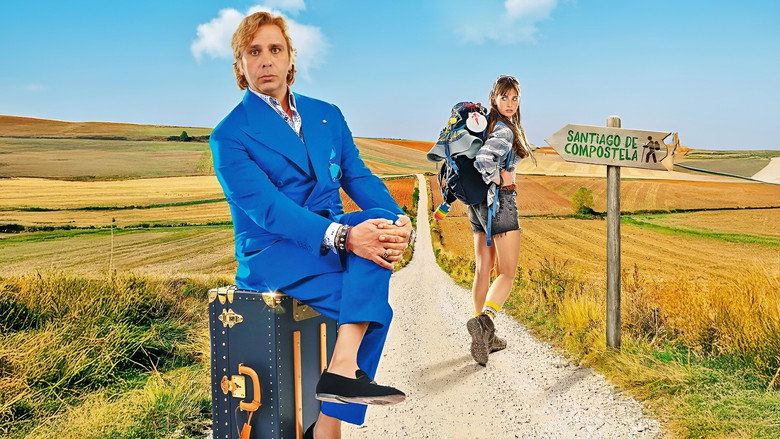
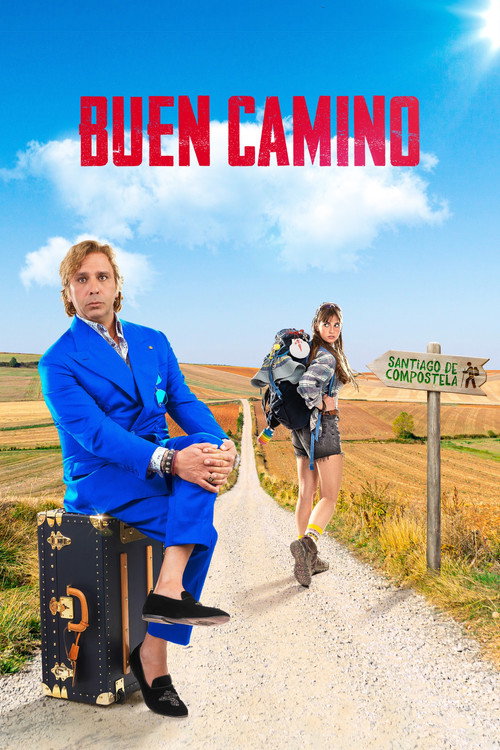
Full spoilers follow. The engine of the plot is a disappearance. Checco — a rich, vain, superficial heir living off his father's sixty years of work, engaged to a young model and days away from turning fifty — learns that his daughter Cristal has vanished. The information does not come from him knowing her: it is his ex-wife Linda, a former model now an actress without roles, and her partner Tarek, a Palestinian writer and director with an alternative lifestyle, who alert him, and it is Cristal's best friend Corina who supplies what a father should already have known — that Cristal has gone to walk the Camino de Santiago, eight hundred kilometres on foot, in search of a meaning for her life.
Checco's response is the film's defining joke and its whole thesis: he goes to collect her in a Ferrari. He treats a pilgrimage as an extraction job, and the route refuses the terms. The journey that follows crosses Italy and Spain and systematically demotes him — from driver to walker, from patron to pilgrim, from a man surrounded by people paid or impressed enough to laugh at him to a man among strangers who are not. Along the Spanish stretch he encounters Alma, who belongs to the Camino rather than to his world, and whose indifference to his status forces him to find something else to offer.
The retrieval mission inverts. What was meant to end the daughter's detour becomes the father's, and the arduous, surprise-filled trip turns into the opportunity for the two to genuinely know each other — the reconciliation the film has been walking toward. It ends where the route ends: in the historic centre of Santiago de Compostela, in the Plaza del Obradoiro before the cathedral.
What only lands in retrospect is the generational architecture. The grandfather, ill from the start, represents sixty years of labour; Checco represents its consumption; Cristal represents the refusal to consume it. The Ferrari, the Costa Smeralda and the fiftieth birthday are all versions of the same illusion — that a life can be arrived at rather than travelled. The film's quiet sting is that Checco never has to surrender the fortune. He is not redeemed by poverty but by presence, which is the warmer and, for some critics, the safer of the two endings available to it.