Skip to content
Buen Camino
A sun-bleached comic pilgrimage where a father chases his runaway daughter across Spain and loses, one blister at a time, everything he thought made him rich.
Buen Camino

Buen Camino

25 December 2025 Italy 90 min 6.3 (621)

Director: Gennaro Nunziante

Cast: Checco Zalone, Beatriz Arjona, Letizia Arnò, Martina Colombari, Hossein Taheri

Family Comedy Adventure Fatherhood as something you do, not something you are The search for meaning against inherited comfort Wealth, vanity and the comedy of status The journey as transformation Encounter with the other
Budget: $28,100,000
Box Office: $73,797,878

Overview

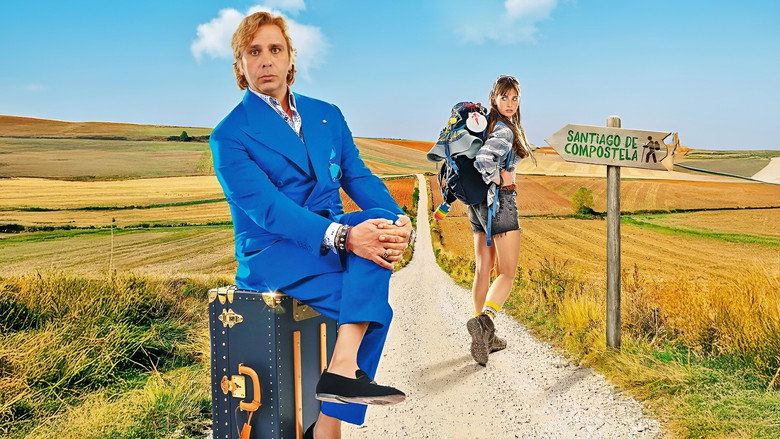
Checco is a wealthy, vain and thoroughly superficial heir, living off the fortune his father built over sixty years of work. His father is now ill, his engagement to a young model keeps his self-image polished, and his fiftieth birthday is only days away. Then his daughter Cristal vanishes — and the comfortable architecture of his life develops its first crack.

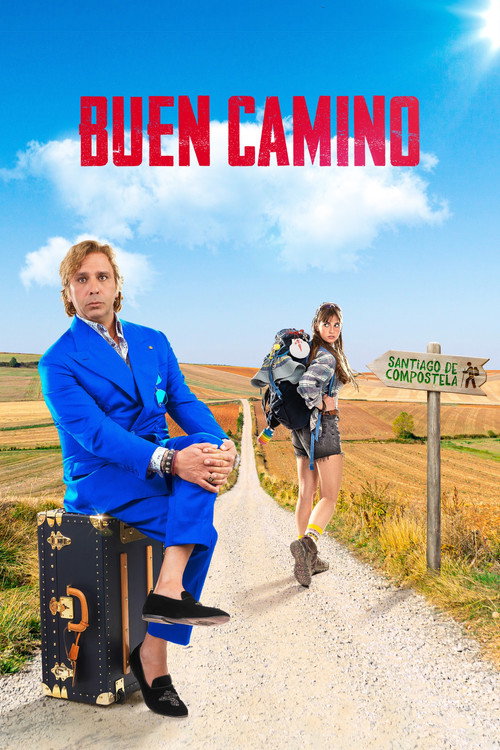
Through his ex-wife Linda, a former model now an actress without roles, her partner Tarek, a Palestinian writer and director with an alternative lifestyle, and Cristal's best friend Corina, Checco learns where the girl has gone: onto the Camino de Santiago, walking some eight hundred kilometres on foot in search of a meaning for her own life. Convinced this is a phase to be terminated as quickly as possible, Checco sets off to collect her — in a Ferrari.

What follows is an improbable, footsore journey across Italy and Spain, along the pilgrim routes that converge on Santiago de Compostela. The car becomes useless, the luxury becomes ballast, and the errand of retrieval turns into something Checco never budgeted for: a chance to actually meet his daughter, and to find out who he is when nobody is impressed by him.

Core Meaning

Gennaro Nunziante and Checco Zalone use the oldest pilgrimage route in Europe as a comic stress test for a very contemporary Italian type: the inheritor. Checco has not built anything; he has received everything, and the film quietly insists that a life you did not earn is a life you cannot explain to your child. The Camino is chosen precisely because it cannot be bought, delegated or accelerated — the only currency it accepts is footsteps.

The message is less religious than relational. Cristal walks to find meaning; Checco walks to retrieve her and ends up finding the same thing by accident. The film's argument is that fatherhood is not a status conferred by biology or funded by money but a practice — attention paid, distance covered, discomfort accepted. Its punchline is gentle rather than savage: the man who set out to bring his daughter back is the one who gets brought back.

Underneath sits a generational reckoning. Checco's own father worked sixty years and is now dying; Checco consumed those years; Cristal is refusing to consume them. The pilgrimage becomes the place where three generations of Italian ideas about what a life is for are made to walk in the same direction.

Thematic DNA

Fatherhood as something you do, not something you are 30%
The search for meaning against inherited comfort 25%
Wealth, vanity and the comedy of status 20%
The journey as transformation 15%
Encounter with the other 10%

Fatherhood as something you do, not something you are

Checco's paternity is initially a line item — school fees, gifts, a name. Cristal's disappearance exposes that he does not know his daughter well enough to guess where she would go, and must ask her friend Corina. The eight hundred kilometres function as the parenting he never did, compressed and paid in arrears, while the parallel figure of his own dying father reminds him that the debt runs in both directions.

The search for meaning against inherited comfort

Cristal walks the Camino in search of meaning for her life — the explicit motive the film gives her. She is the heir of an heir, and the pilgrimage is her refusal of a destiny that has already been paid for. Checco, approaching fifty, is forced into the same question from the opposite end: what do you do when you have everything money can buy and nothing it cannot?

Wealth, vanity and the comedy of status

The film's satire is built on collisions: the Costa Smeralda and the Ferrari on one side, the pilgrim hostel and the blister on the other. Checco's fiancée, his ex-wife Linda's stalled career, Tarek's performative alternative lifestyle — each is a different costume of self-presentation, and the Camino strips the costumes off the only character who believed his was real.

The journey as transformation

Structurally the film is a road movie that keeps demoting its own transport: from sports car to feet, from itinerary to route, from retrieval mission to pilgrimage. The geography does the dramaturgy — Italy's glamour, Spain's meseta, and finally the cathedral square — so that the change in Checco is measured in kilometres rather than announced in speeches.

Encounter with the other

The Camino is a machine for meeting strangers, and the film uses it to put Checco's provincial certainties in front of people who owe him nothing: fellow pilgrims, Spanish locals, and Alma, whose presence obliges him to be someone other than the man his money describes. Tarek, back home, serves the same function in a more abrasive register.

Character Analysis

Checco

Checco Zalone

Archetype: Antihero / reluctant pilgrim Key Trait: Ingratiating, self-satisfied provincial charm that survives every humiliation

Motivation

Initially to retrieve Cristal and restore order before his fiftieth birthday; increasingly, to be someone his daughter — and his dying father — could recognise as a man rather than an inheritance.

Character Arc

Begins as a vain, superficial heir who treats his daughter's disappearance as a logistical problem solvable with a fast car. Stripped progressively of vehicle, comfort and audience, he is forced into the humility of walking, and ends the film as a father who has finally met his own child rather than merely funded her.

Cristal

Letizia Arnò

Archetype: Seeker / catalyst Key Trait: Quiet, unbudgeable resolve

Motivation

To find a purpose she has chosen herself rather than one bought for her.

Character Arc

Vanishes from a life of guaranteed privilege to walk eight hundred kilometres in search of meaning, and spends the journey deciding whether the father who came to drag her home deserves to be let in. Her arc is the mirror of his: she has to learn that rejecting his world does not require rejecting him.

All 5 characters and cast

Symbols & Motifs

The Ferrari

Meaning:

Purchased speed, inherited status, and the illusion that any distance can be shortened by money. Its uselessness on a footpath is the film's thesis in one image.

Context:

Checco sets out to collect his daughter from the Camino by driving a Ferrari to fetch her — an absurdity the film lets play out before the road itself takes the car away from him.

The Camino de Santiago

Meaning:

A route that cannot be bought, skipped or outsourced; a centuries-old technology for turning a person into a pilgrim. It symbolises earned meaning as opposed to inherited comfort.

Context:

The eight hundred kilometres Cristal chooses to walk, and that Checco must eventually walk too, form the film's spine from Italy through Spain.

Feet and blisters

Meaning:

The body as the only honest accountant. Pain that cannot be delegated becomes the proof of presence that Checco has never offered his daughter.

Context:

The physical comedy of an unfit fifty-year-old in unsuitable shoes doubles as the film's moral bookkeeping across the walking sequences.

The fiftieth birthday

Meaning:

The midpoint where a life stops being potential and becomes a verdict. It turns the plot's urgency inward.

Context:

Cristal disappears just days before the milestone, so the search and the reckoning with his own half-century arrive as the same event.

The dying father

Meaning:

The sixty years of work that produced Checco's fortune, now visibly running out. He is the film's memento mori and its standard of a life actually spent.

Context:

Established at the outset as the source of the wealth Checco enjoys, his illness shadows the journey as the generational clock the comedy is racing.

Santiago de Compostela and the Plaza del Obradoiro

Meaning:

Arrival, and the discovery that the destination matters less than who is standing beside you in the square.

Context:

The film closes in the historic centre of Santiago, with the cathedral square and its paved streets framing the end of the walk.

Philosophical Questions

Can meaning be inherited, or must it be walked?

Cristal is born into a fortune built by a grandfather's sixty years of work and responds by covering eight hundred kilometres on foot. The film sets the two economies side by side — capital that transfers instantly and meaning that transfers only through effort — and lets the Ferrari's uselessness on a footpath answer the question visually.

What does a parent actually owe a child?

Checco has provided everything materially and nothing relationally, and the plot exposes the gap by making him unable to guess where his own daughter would go. The journey reframes the debt as time, attention and shared discomfort rather than provision.

Is it possible to change late, and does late change count?

The fiftieth birthday and the dying father set a deadline on Checco's self-examination. The film is optimistic but not naive: it shows change arriving through exhaustion rather than insight, suggesting that conversion is physical before it is moral.

Does a pilgrimage undertaken for the wrong reason still work?

Checco does not set out to seek God, meaning or himself — he sets out to retrieve a runaway and terminate an inconvenience. That the route works on him anyway raises the possibility that the form of a practice can outrun the intention behind it.

Who is the authentic one — the consumer or the idealist?

Checco's unapologetic materialism is placed opposite Tarek's principled alternative lifestyle and Linda's professional vanity, and the comedy declines to hand any of them a clean victory, suggesting that self-presentation is universal and sincerity is rare in every register.

Alternative Interpretations

A sincere conversion story. The straightforward reading takes the Camino at face value: a superficial man walks a sacred route and is genuinely changed by it, and the reconciliation with his daughter is the film's earned reward. On this view the softening that some critics regretted is the point — Zalone at fifty writing about a character at fifty.

Full ending explanation

Cultural Impact

Buen Camino arrived as the event film of the Italian Christmas 2025 season and behaved accordingly. Distributed by Medusa on 25 December 2025, it dominated the domestic box office for 28 consecutive days, passed €68 million in 24 days to become the highest-grossing film in Italy, and finished its run around €76.6 million — figures that restated Zalone's status as the last reliable mass phenomenon of Italian cinema and, in a period of chronic anxiety about theatrical attendance, functioned as proof that a homegrown comedy could still fill rooms nationwide.

Its choice of subject also gave it a second life outside cinema. By building a mainstream comedy around the Camino de Santiago, the film handed one of Europe's oldest pilgrimage routes an enormous Italian-language shop window, with coverage tracking its locations from the Costa Smeralda and Rome to the Plaza del Obradoiro. The film was recognised at the David di Donatello awards, and moved to Netflix on 29 April 2026, where its themes of inherited wealth, absentee fatherhood and the search for meaning reached a second, domestic audience.

Critically it occupies a more contested place. Part of the press read it as Zalone in a softer, more sentimental register: at least one review argued that it lacks almost entirely the provocative, iconoclastic and anarchic spirit that had made him unique in Italy — the recurring question being whether a comedian who built his reputation on discomfort can survive his own turn toward tenderness.

Audience Reception

Audience endorsement was overwhelming in the only currency that is unambiguous: attendance. The film held the top spot in Italy for 28 straight days, crossed €30 million by 29 December, €40 million by 1 January, €45 million by 2 January, €60 million by 8 January, and became the country's highest-grossing film on 18 January 2026 with over €68 million in 24 days, closing around €76.6 million. Those are numbers produced by repeat viewing and family audiences, consistent with a Christmas release pitched as comedy, family and adventure.

What clearly worked for the public was the combination viewers had come for: Zalone's comic persona reunited with Gennaro Nunziante after four previous hits, the spectacle of the Camino de Santiago and the Spanish and Italian locations, and a father-daughter emotional line broad enough to play across generations in the same room. The film's recognition at the David di Donatello added institutional confirmation to popular success.

The main line of criticism ran in the opposite direction. Reviewers who had valued Zalone as Italy's most disruptive comic voice found this outing markedly tamer — one review judged that it lacks almost entirely the provocative, iconoclastic and anarchic spirit that had made him unique — and the sentimental redemption arc became the divisive element: warmth for much of the audience, domestication for part of the press. The overall verdict is a crowd-pleasing, technically expansive and emotionally generous comedy that traded some of its author's bite for reach, and was rewarded with the biggest box office in Italian history.

Interesting Facts

  • The film reunites Checco Zalone with director Gennaro Nunziante after four previous box-office hits together; the two co-wrote the screenplay.
  • Shooting began in July 2025 and took place across Italy and Spain, following an itinerant structure along European landscapes and the Camino de Santiago.
  • Locations range from the luxury of the Costa Smeralda and the streets of Rome to the authentic stretches of the Camino in Spain.
  • The finale was shot in the historic centre of Santiago de Compostela, including the Plaza del Obradoiro and the paved streets around the cathedral.
  • Produced by Indiana Production and distributed by Medusa Film, it was released in Italian cinemas on 25 December 2025 as a Christmas release.
  • It became a box-office phenomenon: by 18 January 2026 it had passed €68 million in 24 days, becoming the highest-grossing film in Italy, and went on to take around €76.6 million.
  • The film held the number-one position at the Italian box office for 28 consecutive days before being overtaken by Marty Supreme.
  • It won an award at the David di Donatello ceremony.
  • The film arrived on Netflix on 29 April 2026 after its theatrical run.
  • Zalone unveiled the plot and the first images of the film himself in early December 2025, shortly before release.

Frequently Asked Questions

Explore More About This Movie

Dive deeper into specific aspects of the movie with our detailed analysis pages

Comments (0)

Leave a comment

No comments yet. Be the first to share your thoughts!

Similar Movies