Skip to content
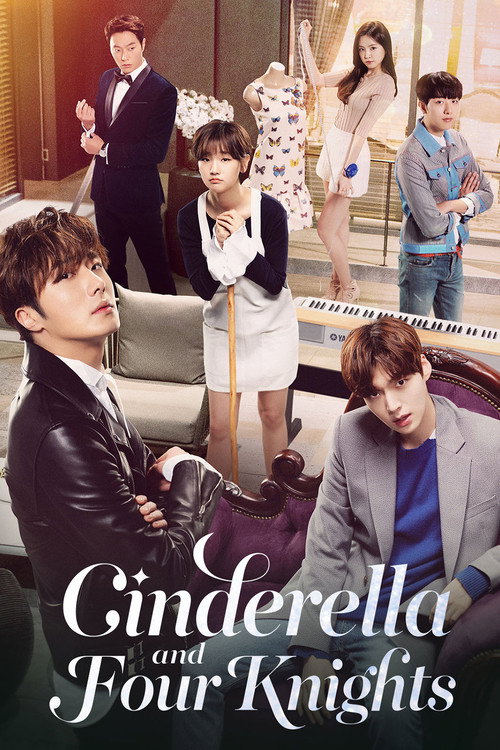
Cinderella and Four Knights
A pastel-tinted romantic fairy tale wrapped in youthful longing and bittersweet family estrangement, resembling a lone glass slipper warming on a cold marble staircase before leading forgotten hearts back home.
Cinderella and Four Knights

Cinderella and Four Knights

신데렐라와 네명의 기사

12 August 2016 — 22 October 2016 South Korea 1 season 22 episode Ended 7.4 (128)

Cast: Jung Il-woo, Park So-dam, Ahn Jae-hyun, Lee Jung-shin, Kim Hye-ri

Drama Comedy Found Family & Healing Estrangement Self-Worth vs. Material Privilege Guilt, Forgiveness & Unresolved Childhood Trauma Fate, Identity & Autonomy

Overview

Cinderella and Four Knights (신데렐라와 네 명의 기사) is a 2016 South Korean romantic comedy-drama directed by Kwon Hyuk-chan and Lee Min-woo. Based on the 2011 two-volume web novel by Baek Myo, the series was developed by Studio Dragon, produced by HB Entertainment, and aired on tvN. The television broadcast comprises 16 hour-long episodes, though select international and syndicated streaming distributions re-edited the runtime into 22 episodes.

The narrative centers on Eun Ha-won, an unyielding, high-spirited high school senior struggling under the psychological and domestic cruelty of her wicked stepmother and stepsister following the tragic death of her mother. Juggling multiple odd jobs to fund her college tuition and fulfill her dream of becoming a teacher, Ha-won's life takes a radical turn after a chance encounter with Kang Hyun-min, a wealthy playboy who hires her as a fake fiancé for his grandfather’s wedding. Ha-won's fearless conduct and martial arts-backed discipline catch the attention of Chairman Kang Jong-du, the patriarch of the mega-conglomerate Haneul Group.

Desperate to discipline and unite his three alienated, self-destructive orphaned grandsons living in the opulent Sky House mansion, Chairman Kang offers to finance Ha-won’s entire higher education on one condition: she must move into Sky House and successfully reform the rebellious trio into a functioning family. Operating under the strict mandate of "no dating allowed in the house," Ha-won finds herself surrounded by four distinct young men—rebellious mechanic Kang Ji-woon, superficial heir Kang Hyun-min, gentle idol musician Kang Seo-woo, and the Chairman's stoic martial-artist bodyguard Lee Yoon-sung. Across her mission-based residency, the mansion evolves from a lavish gilded prison into a crucible where childhood traumas, corporate treachery, and budding romances force each resident to confront their past.


Core Meaning

The overarching message of the series is that family and personal worth are defined not by pedigree, inheritance, or bloodlines, but by vulnerability, mutual forgiveness, and active compassion. By deconstructing the classical Cinderella archetype, the creators assert that a fairy-tale savior does not simply escape poverty through an arranged marriage to a wealthy prince; instead, true self-actualization comes from breaking cycles of emotional abandonment and guiding fractured souls toward healing. The series demonstrates that lavish privilege without genuine human connection fosters isolation, while resilient empathy possesses the power to dismantle generational walls.

Thematic DNA

Found Family & Healing Estrangement 40%
Self-Worth vs. Material Privilege 25%
Guilt, Forgiveness & Unresolved Childhood Trauma 20%
Fate, Identity & Autonomy 15%

Found Family & Healing Estrangement

The cousins—each bearing a different father and isolated by the Chairman's transactional parenting—view one another with bitterness. Ha-won's presence transforms Sky House from a cold boardinghouse of competitive heirs into an authentic brotherhood where communal meals, shared crises, and shared sacrifices overcome systemic distrust.

Self-Worth vs. Material Privilege

The series constantly contrasts the hollow opulence of chaebol life with Ha-won’s grounded dignity. Ha-won refuses to let money dictate her ethics or pride, inverting the traditional Cinderella dynamic by functioning not as a charity case, but as the emotional anchor for young men impoverished in spirit.

Guilt, Forgiveness & Unresolved Childhood Trauma

Hyun-min’s masked womanizing stems from survivor's guilt following a childhood tragedy; Ji-woon’s abrasive hostility conceals the trauma of maternal abandonment; and Yoon-sung grapples with filial loyalty toward a scheming mother. Healing is depicted as an agonizing but necessary process of confronting suppressed memories.

Fate, Identity & Autonomy

Through plot reveals surrounding familial rings and intertwining parental accidents, the narrative examines whether lives are bound by preordained destiny or forged through conscious choice. Ha-won and Ji-woon ultimately prioritize personal agency and authentic affection over prescribed corporate expectations.

Character Analysis

Eun Ha-won

Park So-dam

Archetype: The Resilient Hero / Untamed Cinderella Key Trait: Unyielding grit and moral tenacity.

Motivation

Initially seeks financial independence to fund her higher education; shifts to protecting and uniting the fractured Sky House family.

Character Arc

Evolves from an exploited, survival-driven stepdaughter into an emotionally empowered mediator who restores a broken dynasty before pursuing love and university life on her own terms.

Kang Ji-woon

Jung Il-woo

Archetype: The Brooding Rebel / Reluctant Prince Key Trait: Fierce loyalty hidden under abrasive cynicism.

Motivation

Seeks to guard his independence and protect childhood friend Hye-ji; evolves into securing true romantic and familial love.

Character Arc

Discovered as a chaebol heir after a lifetime in an auto repair shop, he begins as an angry outsider lash-out; through Ha-won's honesty, he drops his prickly defenses, reclaims his identity, and risks his life to save his grandfather.

All 5 characters and cast

Symbols & Motifs

The Glass Slipper / High Heels

Meaning:

Embodying the fairy-tale motif, high heels mark Ha-won’s transition into high society. Her rejection of artificial glamor in favor of grounded authenticity is emphasized when she discards them.

Context:

Featured prominently during the chaotic wedding banquet, where Ha-won casts off the painful heels and walks away barefoot into the night.

The Mother's Ring

Meaning:

Signifies unconditional love, lost identity, shared destiny, sacrifice, and the hidden ties binding the protagonists together across generations.

Context:

Ha-won wears her late mother's ring as a talisman; it is later revealed to connect directly with Ji-woon's past and an intertwined tragedy involving both of their mothers.

Sky House

Meaning:

Represents an ivory tower—a glossy, sterile cage shielding the Kang heirs from emotional reality while simultaneously imprisoning them within their alienation.

Context:

The architectural centerpiece of the series. Its cold, sunlit living areas only gain genuine warmth once Ha-won brings the residents together for communal meals.

The Motorcycle and Wrench

Meaning:

Serves as a physical manifestation of defiance against Haneul Group’s corporate machinery, signifying humble roots and a yearning for personal autonomy.

Context:

Associated with Kang Ji-woon's background as an auto repair mechanic prior to and during his reluctant transition into high society.

The Mission Envelopes

Meaning:

Initially represent transactional manipulation and artificial directives, which are later subverted into genuine emotional milestones.

Context:

Written instructions provided to Ha-won by Chairman Kang containing specific behavioral tasks she must accomplish with the cousins.

Memorable Quotes

내가 얼마면 되는데? 넌 돈만 주면 뭐든 다 하는 모양이지?
— Kang Ji-woon

Context

Episode 2; Ji-woon confronts Ha-won after the wedding reception and throws cash at her feet, misinterpreting her motives as transactional greed.

Meaning

Establishes the initial class divide and cynicism Ji-woon harbors toward chaebol social climbing.

너희들한테는 푼돈일지 몰라도, 세상에는 이 돈이 절실한 사람들도 많아.
— Eun Ha-won

Context

Episode 2; Ha-won gathers the scattered banknotes, returns them directly to Ji-woon, and pins him against the wall.

Meaning

Ha-won shatters the elite arrogance of the Kang cousins, asserting her dignity and establishing her moral authority.

All 4 quotes

Episode Highlights

The Clock Strikes Midnight

S1E1

Ha-won is introduced delivering pizzas and defending convenience store staff before Hyun-min pays her to attend Chairman Kang's wedding banquet as his fiancé.

Significance:

Lays the foundational fairy-tale setup, showcasing Ha-won’s martial arts prowess and capturing the Chairman's attention.

Entering the Citadel

S1E2

Ha-won confronts Ji-woon’s arrogance, rejects Hyun-min’s shallow theatrics, and is cast out of her home by her stepmother before Chairman Kang extends the Sky House invitation.

Significance:

Establishes the central premise, the rules of Sky House, and Ha-won's role as reformer.

The Memorial Mission

S1E6

Ha-won tasks the cousins with attending their ancestral memorial rite; despite intense resistance, her vulnerability persuades them to show up.

Significance:

Represents Ha-won's first major mission victory, cracking the cousins’ defensive shells and proving that Sky House can function as a family.

The Vacation Breakthrough

S1E8

Ha-won organizes a retreat outside the city, where alcohol and games dismantle emotional pretenses, culminating in Ji-woon and Ha-won's drunken first kiss.

Significance:

Shifts the tone from guarded rivalry to romantic awakening, transitioning Ji-woon from antagonistic protector to romantic lead.

Confessions and Realizations

S1E10

Ha-won is hospitalized with a broken foot; the cousins rally around her, prompting Hyun-min to confront his past and Ji-woon to realize his genuine feelings.

Significance:

Crystallizes the romance between Ji-woon and Ha-won while prompting Hyun-min to stop deflecting his unresolved history with Hye-ji.

The Patriarch's Collapse

S1E15

Chairman Kang collapses from liver cancer while his wife Ji Hwa-ja orchestrates a corporate boardroom takeover using Lee Yoon-sung; Ji-woon discovers he is a donor match.

Significance:

Elevates the stakes from domestic romance to life-and-death drama, forcing the family to unite against hostile takeover efforts.

Ties That Bind

S1E16

Ji-woon’s liver transplant saves Chairman Kang, the corporate coup fails, childhood memories connect Ha-won and Ji-woon’s mothers, and the family reunites in open harmony.

Significance:

Delivers resolution across all four character arcs, redefining the family legacy and securing Ha-won’s independent path to happiness.

Philosophical Questions

Can money substitute for genuine paternal affection and family structure?

The show exposes how unlimited financial resources can deepen psychological isolation when substituted for real emotional presence.

Is self-worth derived from pedigree or individual moral agency?

Ha-won's unwavering self-respect continually challenges the assumption that elite birth equates to personal superiority.

Does childhood guilt necessitate lifelong self-punishment?

Both Hyun-min and Ji-woon demonstrate how harboring unaddressed guilt distorts one's ability to engage in authentic adult relationships.

How It Ends

Alternative Interpretations

Critical readings of the series span several perspectives:

Full ending explanation

Cultural Impact

Aired in the summer of 2016, Cinderella and Four Knights arrived during a wave of pre-produced Korean dramas aimed at simultaneously securing television ratings and international streaming distribution via platforms like DramaFever and Viki. In domestic ratings, despite its late-night slot, the series maintained stable figures around 3–4% on cable tvN, performing especially well with younger female demographics.

Culturally, the series served as a bridge between the over-the-top, melodramatic chaebol romances of the 2000s and the modern, character-driven romantic comedies of the late 2010s. While domestic critics were split on its reliance on predictable storytelling, international fandom embraced it as peak "comfort cotton-candy" viewing, sustaining long-term popularity across streaming platforms in Asia and the West.

Audience Reception

Audience and critical consensus highlights several key elements:

  • Praised Elements: Park So-dam’s magnetic, grounded performance as Eun Ha-won was widely celebrated, imbuing a cliché role with charisma, physical comedic timing, and emotional depth. Ahn Jae-hyun’s charismatic turn as Kang Hyun-min, whose initial swagger gives way to genuine vulnerability, frequently stole scenes. The show also earned acclaim for its high rewatch value, vibrant production aesthetics, and catchy soundtrack.
  • Common Criticisms: Viewers noted uneven narrative pacing in the second half, with excessive melodramatic tropes (e.g., sudden illness, disputed parentage, corporate board coups) introduced late in the narrative. Son Na-eun’s character Park Hye-ji received criticism for repetitive melancholy and slow development, alongside predictable plot beats that rarely diverged from expected fairy-tale outcomes.

Overall Verdict: Regarded as an undeniably cheesy yet thoroughly entertaining and heartwarming guilty-pleasure rom-com that succeeds thanks to strong cast chemistry and an exceptionally charming female lead.

Interesting Facts

  • Unlike the traditional live-shoot system common in Korean television at the time, Cinderella and Four Knights was 100% pre-produced, wrapping all filming in May 2016 before its August premiere.
  • The drama was adapted from Baek Myo’s popular two-volume 2011 romance web novel of the same name.
  • Filmed shortly after Park So-dam received critical acclaim for The Priests (2015) and right before her breakthrough in international cinema (later starring in Bong Joon-ho's Oscar-winning Parasite), this marked her transition into mainstream romantic comedy.
  • tvN deliberately placed the show in a novel Friday–Saturday 23:00 / 23:30 KST slot to test late-night weekend viewing habits for youth-oriented programming.
  • The cast featured significant musical crossovers, with CNBLUE bassist Lee Jung-shin playing the gentle pop star and Apink vocalist Son Na-eun playing the second female lead.

Easter Eggs

Nods to Boys Over Flowers

The show openly plays with tropes from Boys Over Flowers (2009)—a tough working-class girl reforming an elite boy band of heirs—a meta-reference reinforced by the fact that co-star Ahn Jae-hyun had recently married Ku Hye-sun (the iconic Geum Jan-di of Boys Over Flowers) earlier in 2016.

Kdrama Fairy-Tale Tropes

The series knowingly checks off classic mid-2000s K-drama clichés: the stepmother's cruelty, sudden wrist grabs, secret rings, corporate boardroom takeovers, and childhood origins ("we knew each other when we were young"), leaning into them as affectionate homage.

Musical Cameo/OST Integration

Lee Jung-shin’s character Seo-woo writes songs in-universe that mirror the drama’s official soundtrack themes of unspoken devotion, mirroring his real-life role as a musician.

Frequently Asked Questions

Explore More About This Movie

Dive deeper into specific aspects of the movie with our detailed analysis pages

Comments (0)

Leave a comment

No comments yet. Be the first to share your thoughts!

Similar Movies