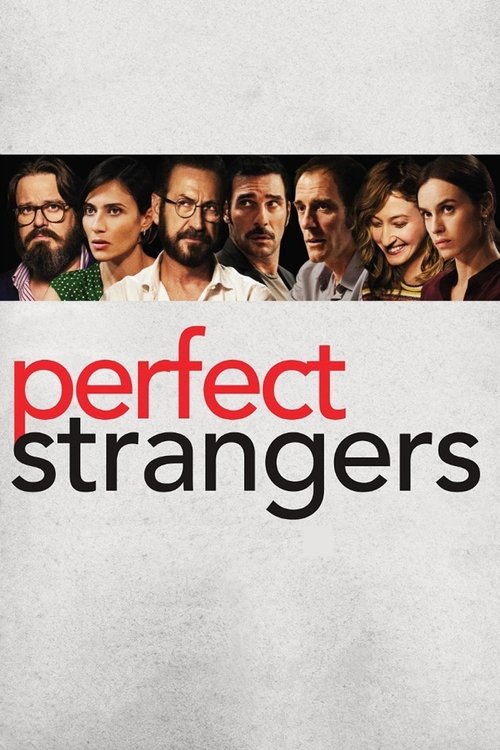
Perfect Strangers
A tense comedic-drama that spirals into emotional horror; a fragile social masquerade shattered by the harsh glow of a smartphone screen under a lunar eclipse.
Perfect Strangers

Perfect Strangers

Perfetti sconosciuti

"Everyone has three lives: A public life. A private life... and a secret life."

11 February 2016 Italy 97 min ⭐ 7.9 (4,515)
Director: Paolo Genovese
Cast: Giuseppe Battiston, Anna Foglietta, Marco Giallini, Edoardo Leo, Valerio Mastandrea
Drama Comedy
Secrecy and Deception Technology as a Revealer of Truth The Fragility of Relationships Public Persona vs. Private Self
Box Office: $32,207,491

Overview

"Perfect Strangers" (original title: "Perfetti sconosciuti") is an Italian comedy-drama that unfolds over a single evening. Seven long-time friends—three couples and one recent divorcé—gather for a dinner party hosted by Rocco, a plastic surgeon, and Eva, a therapist. During the meal, Eva proposes a dangerous game: everyone must place their mobile phones on the table and share every text, email, and phone call they receive with the entire group.

What starts as a seemingly harmless diversion to prove they have nothing to hide from one another quickly descends into chaos. As the phones begin to buzz and ring, a torrent of secrets, lies, and betrayals is unleashed, threatening to unravel their friendships and marriages. The game exposes hidden affairs, secret struggles, and identities concealed even from their closest companions, forcing each character to confront the chasm between their public personas and their private lives.

Core Meaning

The core meaning of "Perfect Strangers" is an exploration of the fragility of human relationships in the digital age and the universal nature of secrecy. Director Paolo Genovese examines the idea that our smartphones have become the "black boxes" of our lives, containing our truest, most hidden selves. The film posits that complete transparency would be destructive, suggesting that a degree of privacy and even secrecy is necessary to maintain social bonds. It raises the unnerving question: how well do we truly know the people closest to us? Ultimately, the film serves as a cautionary tale about the illusion of intimacy and the secrets we all keep, implying that perhaps some doors are better left unopened.

Thematic DNA

Secrecy and Deception 35%
Technology as a Revealer of Truth 30%
The Fragility of Relationships 20%
Public Persona vs. Private Self 15%

Secrecy and Deception

This is the central theme of the film. Every character, with the exception of Rocco, is hiding a significant secret that contradicts the image they present to their friends and partners. These deceptions range from infidelity (Cosimo and Eva's affair, Lele's online flirtations) to hidden sexual identity (Peppe being gay) and professional anxieties. The film argues that these secrets are a fundamental, albeit dangerous, part of the human condition.

Technology as a Revealer of Truth

The smartphone is positioned as the primary antagonist and truth-teller. It's described as the "black box of our lives," a repository of our uncensored thoughts and actions. The film demonstrates how technology, which allows for constant private communication, has created a new, vulnerable dimension to our lives where our deepest secrets are stored, just a notification away from being exposed.

The Fragility of Relationships

The film systematically deconstructs the seemingly stable relationships of the friend group. Marriages, long-term friendships, and romantic partnerships are all shown to be built on precarious foundations of unspoken truths and outright lies. Rocco's closing line in the hypothetical scenario, "Because we are breakable," encapsulates this theme perfectly, suggesting that human connections cannot withstand the weight of absolute honesty.

Public Persona vs. Private Self

"Perfect Strangers" masterfully illustrates the duality of modern identity. The characters at the dinner table perform versions of themselves they wish to be—the happy couple, the successful professional, the loyal friend. The game shatters these personas, revealing the messy, complex, and often contradictory private selves they conceal. This highlights a universal anxiety about being truly "seen" and judged for one's authentic, flawed self.

Character Analysis

Rocco

Marco Giallini

Archetype: The Moral Compass / The Observer
Key Trait: Wise

Motivation

To maintain peace and offer genuine support to his family, particularly his daughter. He values wisdom and acceptance over judgment and control.

Character Arc

Rocco begins as a seemingly passive husband, quietly observing the tensions between his wife Eva and their daughter. He is the only character with no devastating secrets, giving him a moral high ground. His arc is one of quiet wisdom, culminating in a powerful, non-judgmental phone call with his daughter where he offers her mature advice about her first sexual experience. In the film's hypothetical reality, he is deeply hurt by Eva's betrayal but remains a pillar of reason.

Eva

Kasia Smutniak

Archetype: The Instigator / The Hypocrite
Key Trait: Judgmental

Motivation

To assert control and expose the flaws in others, likely to deflect from her own insecurities and deceptions.

Character Arc

A therapist who preaches self-acceptance, Eva is revealed to be deeply insecure, planning breast augmentation surgery and having an affair with Cosimo, the husband of her friend Bianca. She initiates the game, perhaps subconsciously wanting secrets to be revealed. Her arc is a descent from a position of supposed intellectual and moral superiority into a hypocrite exposed by her own game.

Cosimo

Edoardo Leo

Archetype: The Philanderer
Key Trait: Deceitful

Motivation

To satisfy his own selfish desires without regard for the consequences or the feelings of his wife and friends.

Character Arc

The newlywed taxi driver who appears happy with his wife Bianca. His arc is a complete unraveling of this facade. He is revealed to be a serial cheater, having an affair not only with the host Eva but also with another woman who is now pregnant. He transforms from a jovial friend into the most duplicitous and morally bankrupt member of the group.

Peppe

Giuseppe Battiston

Archetype: The Outsider with a Secret
Key Trait: Vulnerable

Motivation

To find acceptance and live authentically, while also being protective of his partner from the judgment of his friends.

Character Arc

Peppe, a divorced teacher, arrives alone, claiming his new girlfriend is sick. His arc is about the courage to reveal his true self. He is forced to admit he is gay after swapping phones with Lele to protect his friend from a minor embarrassment. He is initially afraid of his friends' judgment, and their homophobic reactions prove his fears were justified, leading him to lament that he can never introduce his partner, Lucio, to them.

Lele

Valerio Mastandrea

Archetype: The Everyman with a Hidden Vice
Key Trait: Restless

Motivation

To escape the monotony of his marriage and to protect his friend's more significant secret out of a sense of loyalty.

Character Arc

Married to Carlotta, Lele seems to be in a mundane, strained marriage. His secret seems minor at first (receiving racy photos from a woman), but it's his agreement to swap phones with Peppe that plunges him into a deeper crisis, as he is temporarily accused of being gay. His arc reveals the simmering dissatisfaction in his marriage and his willingness to engage in reckless behavior to protect a friend, with disastrous consequences.

Symbols & Motifs

The Smartphone

Meaning:

The smartphone symbolizes the "black box" of a person's life—a digital Pandora's box containing their secrets, desires, and true identity. It represents the modern confessional and the fragile vessel in which we store the duality of our public and private lives.

Context:

The phones are the central plot device. Placed on the dinner table, they become a collective object of tension and revelation. Each ring or notification is a potential bomb that explodes the carefully constructed social harmony.

The Lunar Eclipse

Meaning:

The eclipse symbolizes the hidden side of human nature, mirroring the dark side of the moon. It represents the temporary unveiling of truths that are normally kept in darkness. The return of the light at the end of the eclipse coincides with the secrets being metaphorically hidden once more in the film's 'real' timeline.

Context:

The dinner party takes place on the evening of a total lunar eclipse. The characters mention its astrological and emotional effects, setting a mysterious and transformative tone for the night's events.

The Dinner Party

Meaning:

The dinner party itself symbolizes the facade of social harmony and civility. It is a carefully constructed performance where friends gather to reinforce their bonds, but in this case, it becomes an arena for emotional combat and the destruction of those very bonds.

Context:

The entire film, barring the opening and closing scenes, is set around the dinner table. This confined, theatrical setting traps the characters, forcing them to confront each other's revelations without escape.

Memorable Quotes

Ognuno di noi ha tre vite: una pubblica, una privata ed una segreta.

— Eva (quoting Gabriel García Márquez, though often misattributed in the context of the film)

Context:

This line is spoken early in the dinner party, setting the stage for the game and foreshadowing the revelations to come. It's part of the conversation that leads Eva to suggest they share the contents of their phones.

Meaning:

Translated as, "Each of us has three lives: a public one, a private one, and a secret one." This quote is the philosophical thesis of the entire film, establishing the central conflict between the different layers of our identity.

Siamo tutti frangibili.

— Rocco

Context:

This is said by Rocco towards the end of the film's hypothetical timeline, after the devastating game has concluded and everyone's lives have been shattered. It is his profound and melancholic conclusion about human nature.

Meaning:

Translated as, "We are all breakable." This is Rocco's justification for why the game is a terrible idea. It suggests that human relationships are too fragile to withstand the pressure of absolute, unfiltered truth and that our flaws and secrets are an intrinsic part of us that must be handled with care.

Questo è diventato la scatola nera della nostra vita.

— Eva

Context:

Spoken during the initial debate about phones and privacy, this statement solidifies the symbolic role the devices will play throughout the night.

Meaning:

Translated as, "This [the phone] has become the black box of our lives." This metaphor powerfully captures the film's view of technology. Like an airplane's black box, the phone holds all the data—the truths, the secrets, the last communications—that can explain the crash of a relationship.

Philosophical Questions

Is absolute honesty desirable or destructive in a relationship?

The film explores this by presenting a scenario where total transparency is enforced. The result is the complete implosion of every relationship. Rocco's wisdom suggests that we are "breakable" and cannot withstand such raw exposure. This challenges the modern ideal of sharing everything with a partner, proposing that some secrets and private spaces are necessary for self-preservation and the preservation of the relationship itself.

How has technology reshaped our identity and our secrets?

"Perfect Strangers" posits that smartphones have become external hard drives for our secret selves. The film demonstrates that technology doesn't create the secrets, but it makes them more tangible, concentrated, and dangerously accessible. It questions whether we can maintain a coherent identity when our "black box" contains a version of ourselves that is completely at odds with our public persona.

Do we ever truly know another person?

This is the film's central, unsettling question. By showing lifelong friends and married couples who are utterly ignorant of each other's deepest secrets (infidelity, sexual orientation, secret therapy), the movie argues that our knowledge of others is always incomplete. It suggests that we are all, to some extent, 'perfect strangers' to one another, interacting with carefully curated versions of who they are.

Alternative Interpretations

The primary point of alternative interpretation revolves around the film's ending. After a night of catastrophic revelations, the friends leave the apartment, and everything is back to normal—as if the game never happened. This leads to two main readings:

1. The "What If" Scenario: This is the most widely accepted interpretation. The dinner party guests decided not to play the game, and the entire destructive series of events we witness is a hypothetical montage of what would have happened if they had. The film shows the audience the devastating truth and then returns to the 'real' timeline where the friends continue to live in blissful ignorance, their secrets intact. This reading serves as a cautionary tale for the audience, not the characters.

2. Collective Denial / Magical Realism: A less common interpretation suggests that the game did happen, but the power of the lunar eclipse or a collective, unspoken agreement to deny the events allows the characters to 'reset' their reality. They choose to forget the painful truths to preserve their fragile relationships, effectively putting the secrets back in the box. This reading is more cynical, suggesting a conscious choice to live a lie rather than face the consequences of the truth.

Cultural Impact

The cultural impact of "Perfect Strangers" has been phenomenal and disproportionate to its humble origins. Its central premise—a dinner party game that exposes secrets via smartphones—tapped into a universal, contemporary anxiety about privacy, identity, and infidelity in the digital era. This universality is proven by its status as the most remade film in history, according to Guinness World Records. With over two dozen remakes across vastly different cultures, from South Korea ("Intimate Strangers") to Mexico ("Perfectos Desconocidos") and France ("Nothing to Hide"), the film's narrative framework has proven to be an incredibly effective and flexible template for exploring local social mores, relationship dynamics, and attitudes towards issues like homosexuality and infidelity.

The film's success lies in its 'high concept, low budget' formula. Confined to a single location with a small cast, it is inexpensive to produce, which has encouraged international filmmakers to create their own versions. It resonated with critics and audiences alike, winning Italy's top film award and sparking widespread conversation. It has become a cultural touchstone, with the term "Perfect Strangers game" entering the lexicon as shorthand for a risky, truth-telling social experiment. The movie perfectly captured the zeitgeist of a society grappling with the fact that our closest companions may also be, in the digital realm, 'perfect strangers'.

Audience Reception

Audience reception for "Perfect Strangers" has been overwhelmingly positive, contributing to its global success and cult status. Viewers widely praise the film's brilliant, simple, and universally relatable premise. Many find it to be a gripping, tense, and thought-provoking experience that is both a hilarious comedy and a devastating drama. The clever script, sharp dialogue, and strong ensemble cast are frequently highlighted as major strengths. The main point of praise is how the film taps into modern anxieties about technology and privacy, making viewers reflect on their own lives and relationships.

The primary point of criticism or debate among audiences is the ending. While many find the 'what if' scenario brilliant and thought-provoking, some viewers have expressed confusion or dissatisfaction, interpreting it as a cop-out that negates the film's dramatic impact. However, most viewers appreciate the ending's chilling message: that the characters—and by extension, many of us—choose the comfort of lies over the destructive nature of truth.

Interesting Facts

  • "Perfect Strangers" holds the Guinness World Record for the most remade film in cinema history. As of 2024, it has been remade over 24 times in countries like Spain, France, South Korea, China, and India.
  • The film was a major critical and commercial success in Italy, winning the David di Donatello (the Italian Oscar) for Best Film and grossing over $30 million on a small budget.
  • The concept is highly adaptable because it's set in a single location and explores the universal theme of secrets in the digital age, making it cheap to produce and culturally relevant worldwide.
  • Despite its many remakes, an official English-language version has yet to be produced, though one was in development with actress Issa Rae at one point.
  • Director Paolo Genovese was inspired to write the film after a friend's marriage ended when the wife discovered a secret message on her husband's phone after he was in a motorcycle accident.
  • The film's success has also led to numerous stage adaptations around the world, including in Spain, Mexico, and Argentina.

⚠️ Spoiler Analysis

Click to reveal detailed analysis with spoilers

Frequently Asked Questions

Explore More About This Movie

Dive deeper into specific aspects of the movie with our detailed analysis pages

Comments (0)

Leave a comment

No comments yet. Be the first to share your thoughts!