Nuovo Cinema Paradiso
"An enchanted village. A wonderful friendship. Star-crossed lovers. And the magic of the movies."
Cinema Paradiso - Ending Explained
⚠️ Spoiler Analysis
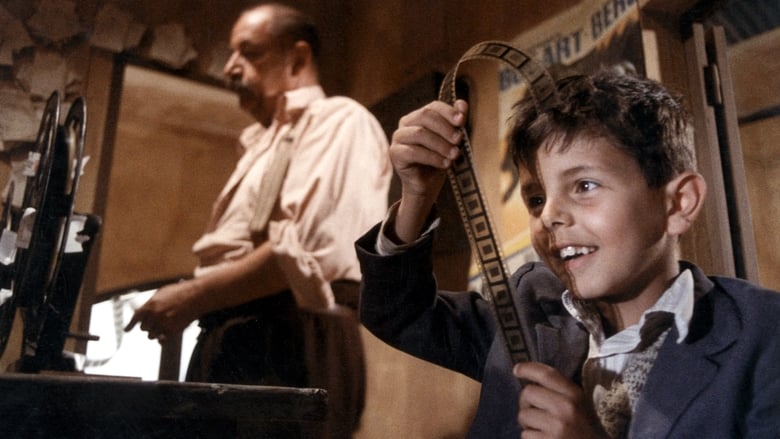
The central plot of "Cinema Paradiso" is propelled by key events and revelations. A pivotal early moment is the fire in the projection booth caused by the volatile nitrate film. Young Totò saves Alfredo's life, but the film reel explodes in Alfredo's face, leaving him permanently blind. This event solidifies Totò's role as the new projectionist, cementing his life's path.
Teenage Totò's passionate romance with Elena ends abruptly when her family moves away. He believes she simply left him, a heartbreak that follows him into adulthood. Alfredo, seeing that Totò's attachment to the village and to Elena will hold him back, commands him to leave for Rome after his military service and to never return or even communicate. He tells Totò that any success requires a complete break from the past, a painful sacrifice that Salvatore honors for thirty years.
Upon his return for Alfredo's funeral, Salvatore learns that the Cinema Paradiso is being demolished. The film's emotional climax, and its greatest revelation, is the gift Alfredo left him: a single reel of film. When Salvatore watches it in a private theater, he discovers that Alfredo had spliced together all the kissing scenes that the priest had ordered cut throughout the years. As he watches this montage of pure cinematic love, Salvatore weeps and smiles, finally understanding Alfredo's final lesson and making peace with his past. The director's cut adds another major spoiler: the reveal that Alfredo deliberately sabotaged Salvatore and Elena's relationship by hiding a note from her, believing it was for his own good, thus revealing the true depth of his intervention in Salvatore's life.
Alternative Interpretations
The most significant alternative interpretation of "Cinema Paradiso" comes from the director's cut (2002), which adds nearly an hour of footage and fundamentally changes the narrative's meaning. In the theatrical version, Alfredo is a purely benevolent mentor whose advice to Salvatore is a painful but necessary sacrifice for the boy's future. The ending is a bittersweet reconciliation with the past.
However, the director's cut reveals that Alfredo was directly responsible for Salvatore and Elena's separation. He convinced Elena to leave Salvatore, believing she would stand in the way of his destiny, and never told Salvatore she had left a note for him. This re-frames Alfredo's character as more manipulative, playing God with Salvatore's life. The reunion between the adult Salvatore and Elena, and their brief affair, demystifies the idealized romance, making the film less a story of pure nostalgia and more a tragic exploration of how one man's choices irrevocably altered the course of two lives. This version suggests that Salvatore's success came at the cost of his personal happiness, a price orchestrated by his own mentor.
Some academic readings have also interpreted the film through a postmodern lens, viewing it as a satire that ironically deconstructs national myths and cultural ideals. Another interpretation sees the film as a critique of the very nostalgia it seems to celebrate, suggesting that living in the past, or through the lens of cinema, ultimately leads to an unfulfilled life.