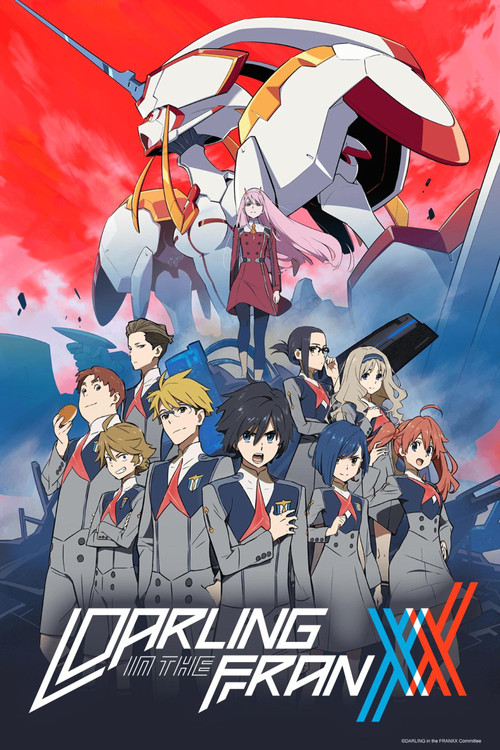
DARLING in the FRANXX
A post-apocalyptic mecha romance where the bittersweet struggle for humanity blossoms against a backdrop of sterile dystopia, like a single vibrant flower cracking through concrete.
DARLING in the FRANXX

ダーリン・イン・ザ・フランキス

13 January 2018 — 06 July 2018 Japan 1 season 24 episode Ended ⭐ 8.5 (1,839)
Cast: Yuto Uemura, Haruka Tomatsu, Kana Ichinose, Yuuichirou Umehara, Nanami Yamashita
Drama Animation Sci-Fi & Fantasy Comedy
Humanity and Dehumanization Love, Sexuality, and Partnership Freedom vs. Control Coming of Age in a Dystopian World

DARLING in the FRANXX - Ending Explained

⚠️ Spoiler Analysis

DARLING in the FRANXX's plot is built on a series of major reveals that recontextualize the entire story. The initial conflict against the Klaxosaurs is a red herring. The true history of the world is that humanity was once a thriving civilization that discovered "magma energy," which granted immortality but caused them to lose their reproductive abilities and emotions. This energy source angered the Klaxosaurs, who are not mindless monsters but a hive-mind civilization of biomechanical beings, the original sentient inhabitants of Earth, who evolved to protect the planet. The Klaxosaur Princess, Code: 001, leads them.

The true antagonists are VIRM, a parasitic alien collective led by the entity known as Papa. Millennia ago, VIRM attacked the Klaxosaurs, forcing them to retreat underground. VIRM later returned and deceived humanity, creating the APE organization and offering them immortality in exchange for their humanity, intending to eventually absorb all life on Earth into their collective consciousness. Dr. Franxx, the creator of the mecha, was manipulated by APE but harbored his own agenda, hoping the new generation of pilots (Squad 13) could pave a new future for humanity.

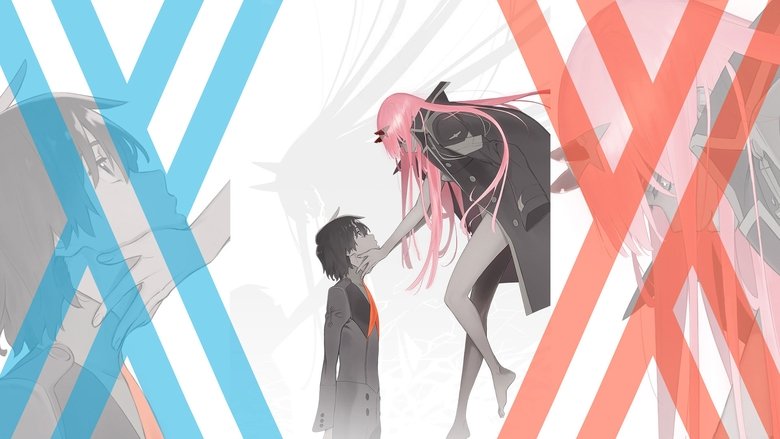
The central romance is also based on a hidden past. Hiro and Zero Two met as children in a laboratory. Hiro, a prodigy who had grown curious and defiant, freed the tormented, horned Zero Two. They tried to escape together, and during this brief time, he showed her kindness, named her, and promised to be her "darling." They were captured, and their memories were erased. Zero Two's entire motivation has been to find this boy, her destructive behavior stemming from a belief that killing Klaxosaurs would make her human enough to be with him.

In the finale, the Klaxosaur Princess joins forces with the humans to fight VIRM in space. Strelitzia merges with a massive Klaxosaur weapon, transforming into the Strelitzia True Apus, with Zero Two's consciousness forming the mecha's body and Hiro piloting from within. To destroy the VIRM homeworld and end their threat forever, they detonate the weapon, sacrificing their physical bodies. Their souls wander through space for eons before returning to Earth, where they are reincarnated as two children who meet under a cherry tree, their promise to find each other finally fulfilled.

Alternative Interpretations

The ending of DARLING in the FRANXX is the primary source of alternative interpretations. While the surface reading is a bittersweet tragedy followed by reincarnation, other perspectives exist:

  • Buddhist/Shinto Interpretation: The ending can be viewed through the lens of Japanese aesthetics and religious concepts like wabi-sabi (finding beauty in imperfection and transience) and reincarnation. Hiro and Zero Two's sacrifice and rebirth are not a cheap trope but the completion of a natural cycle. Their souls returning to Earth to meet again under a sakura tree symbolizes this renewal and the ultimate triumph of life over the sterile immortality offered by VIRM.
  • A Failed Deconstruction: Some critics interpret the show as an attempted, but ultimately failed, deconstruction of the mecha genre. It uses familiar tropes from Evangelion (psychological trauma, suggestive piloting) and Gurren Lagann (escalating stakes, cosmic battles) but, in the view of these critics, fails to synthesize them into a coherent message. The sudden shift to an alien conflict is seen not as a clever twist but as the writers losing control of the narrative and defaulting to genre clichés.
  • Tantric and Hindu Allegory: A more esoteric interpretation suggests the series is a complex allegory for Hindu nationalism and esoteric Tantrism. In this reading, the VIRM represent Western materialism and British imperialism, while the parasites' struggle for freedom and procreation symbolizes a spiritual liberation and a return to more traditional, natural ways of life. The male-female piloting system is seen as a representation of Tantric concepts of duality and creation.