DARLING in the FRANXX
ダーリン・イン・ザ・フランキス
Overview
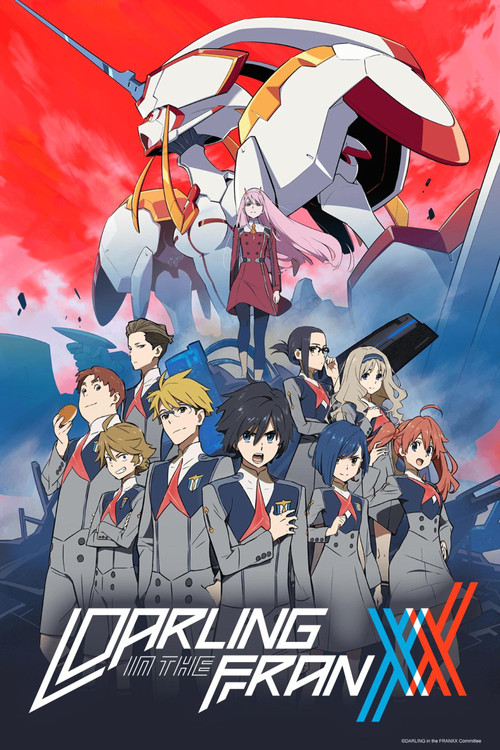
Set in a desolate, post-apocalyptic future, DARLING in the FRANXX follows a group of artificially created children known as "Parasites." Their sole purpose is to pilot giant mecha called Franxx, in male-female pairs, to defend the last remnants of humanity from monstrous creatures called Klaxosaurs. These children live in isolated environments called "Mistilteinn" or "birdcages," unaware of the true nature of the world, love, or procreation, which the ruling immortal adults have abandoned.
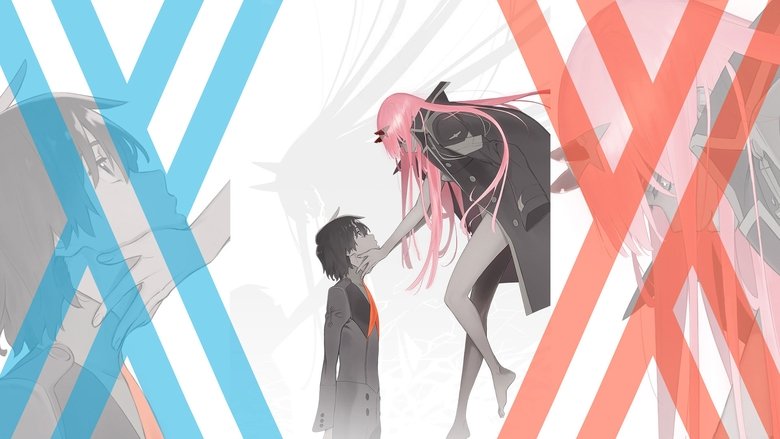
The story centers on Hiro (Code:016), a once-promising pilot who has lost the ability to synchronize with his partner. His life takes a dramatic turn when he meets Zero Two (Code:002), an enigmatic and powerful pilot with Klaxosaur blood, infamous as the "Partner Killer." Their meeting ignites a passionate and tumultuous relationship that challenges the rigid structure of their society. As Squad 13, led by Hiro and Zero Two, continues to fight, they begin to uncover the dark secrets of their world, the origins of the Klaxosaurs, and the true agenda of their god-like leaders, APE.
Core Meaning
The core meaning of DARLING in the FRANXX revolves around the exploration of humanity, identity, and the profound significance of relationships and love in a society that has suppressed them. The series posits that true humanity is defined not by immortality or technological advancement, but by the messy, emotional, and reproductive connections between people. It critiques sterile, authoritarian systems that sacrifice individuality and emotion for perceived stability. Ultimately, the creators convey a message that finding a partner—a 'darling'—with whom to share life's struggles and joys is essential to being human, and that breaking free from oppressive systems to create one's own future is a fundamental part of the human experience.
Thematic DNA
Humanity and Dehumanization
The series constantly questions what it means to be human. The immortal "adults" have shed their emotions and reproductive functions, living in a sterile stasis, while the manufactured "parasites" are treated as disposable tools of war. The children's journey is one of rediscovering emotions, sexuality, and relationships, which the show presents as the core of the human experience. Zero Two, a human-klaxosaur hybrid, desperately wishes to become fully human, believing that killing Klaxosaurs will achieve this, only to later realize that her connection with Hiro is what truly makes her feel human.
Love, Sexuality, and Partnership
The piloting of the Franxx, which requires a male "Stamen" and female "Pistil" in a suggestive cockpit arrangement, serves as a direct metaphor for sexual intimacy and partnership. The story explores various facets of love, from youthful infatuation and jealousy to deep, sacrificial bonds. The relationship between Hiro and Zero Two, symbolized by the mythical one-winged bird, the Jian, posits that individuals are incomplete and can only "fly" by finding a partner. The rediscovery of procreation by Kokoro and Mitsuru becomes an act of rebellion against the sterile society of the adults.
Freedom vs. Control
Squad 13 lives in a gilded cage (the "birdcage"), their lives completely controlled by the authoritarian APE council. They are indoctrinated and have their memories wiped when they step out of line. Their character arcs are defined by their struggle for self-determination: choosing their own names, forming genuine relationships, and ultimately fighting against their creators for the right to shape their own destiny and rebuild society on their own terms. The series champions individualism against a collectivist, emotionless dystopia.
Coming of Age in a Dystopian World
At its heart, the series is a coming-of-age story for Squad 13. They are forced to mature rapidly, confronting not only giant monsters but also complex emotional issues like love, jealousy, loss, and identity without any guidance from adults. They learn about the world through trial and error, creating their own small society and rules. Their journey from obedient "parasites" to independent individuals who rebuild civilization forms the central narrative arc of the show.
Character Analysis
Hiro (Code: 016)
Yuto Uemura
Motivation
Initially, Hiro's motivation is simply to find a place where he belongs and prove his worth by piloting a Franxx. This quickly transforms into an all-consuming desire to be with Zero Two, his "darling," whom he remembers from a traumatic childhood encounter. Ultimately, his motivation expands to protecting all of his friends in Squad 13 and ensuring a future where humanity can live freely.
Character Arc
Hiro begins as a disillusioned prodigy who has lost his purpose after failing to pilot a Franxx. His encounter with Zero Two reawakens his spirit and gives him a new reason to exist: to be her wings. Initially, he is passive and defined by his relationship with her. As the series progresses, he regains the confidence and leadership qualities he had as a child. He moves from being a co-pilot to an active agent in his own destiny, challenging the authority of APE and making the ultimate sacrifice to protect the future he and his friends have built, promising to find Zero Two again, no matter what.
Zero Two (Code: 002)
Haruka Tomatsu
Motivation
Her primary motivation is to reunite with her "darling" from her childhood (Hiro) and become human so she can be with him. This goal is based on her interpretation of a picture book, "The Beast and the Prince." This singular focus later evolves into a desire to protect the world and future that she and Hiro have fought for together, finding fulfillment not in changing her nature, but in being accepted for who she is.
Character Arc
Zero Two is introduced as a wild, dangerous, and alluring pilot who consumes the life force of her partners. Her initial arc is a desperate and destructive quest to become fully human, believing that killing Klaxosaurs will grant her wish. Through her rekindled relationship with Hiro, she learns that humanity is not something to be earned, but is found through connection and love. She transforms from a self-destructive "monster" who uses people into a loving partner who is fiercely protective of Hiro and Squad 13, ultimately sacrificing her physical form to save the world with her darling.
Ichigo (Code: 015)
Kana Ichinose
Motivation
Her main motivation is protecting Hiro, driven by her long-standing love for him. This often conflicts with her responsibility for the safety and cohesion of the entire squad. As the series progresses, her motivation shifts from possessing Hiro to genuinely wanting him to be happy, and ensuring the survival and prosperity of her found family, Squad 13.
Character Arc
Ichigo starts as the serious, by-the-book leader of Squad 13, harboring a deep, unrequited love for her childhood friend, Hiro. Her arc is defined by her struggle to reconcile her feelings for Hiro with his love for Zero Two, and her duty as a leader. Initially, her jealousy causes her to act rashly and against Zero Two. However, she matures significantly, eventually accepting Hiro's choice and supporting him. In the end, she lets go of her past love and finds happiness with Goro, becoming a crucial leader in the new human society.
Goro (Code: 056)
Yuuichirou Umehara
Motivation
Goro is motivated by a desire to protect his friends, especially Ichigo. He values the well-being and harmony of the group above his own personal desires. He acts as the emotional anchor for the squad, providing stability and perspective amidst the adolescent drama and the horrors of war. His ultimate goal is to see his friends survive and find happiness.
Character Arc
Goro is the calm, mature, and reliable co-leader of the squad, often called "Go-bro" for his supportive nature. He is deeply in love with Ichigo but selflessly supports her, even knowing her heart belongs to Hiro. His arc is less about dramatic change and more about steadfast emotional maturity. He consistently makes rational decisions for the good of the team, even at personal cost. In the end, his patience and unwavering support are rewarded as he and Ichigo build a life together, and he becomes a world-traveling explorer, helping to rebuild civilization.
Symbols & Motifs
Jian Bird (The Bird with One Wing)
The Jian is a mythical bird from Chinese folklore born with only one wing, requiring it to find a mate to fly. It is the central metaphor for the series, symbolizing the necessity of partnership and the idea that individuals are incomplete on their own.
Introduced by Zero Two in the first episode, the symbol is constantly referenced in relation to her and Hiro's bond. Their ability to pilot the Strelitzia together when Hiro can pilot with no one else reinforces this symbolism. The concept applies to all Franxx pilots, who must work in male-female pairs to function effectively.
The Franxx Mecha
The Franxx, with their distinctly feminine appearances and the intimate piloting mechanism, symbolize relationships, puberty, and sexuality. Each Franxx's name is derived from a flower, with the flower's meaning often reflecting the personality or arc of its pistil pilot.
The piloting position, with the male controlling the female's movements, is a very direct and controversial metaphor for sexual intercourse. The Franxx going into "Stampede Mode" when a pilot's emotions run wild further links the mecha to the adolescent emotional and physical turmoil the characters experience.
Horns
Zero Two's horns are a physical manifestation of her non-human, Klaxosaur side. They symbolize her otherness, her perceived monstrosity, and her alienation from the human society she wishes to join. As her connection with Hiro grows, his own body begins to develop horns, symbolizing their deepening bond and the blurring of lines between human and Klaxosaur.
Throughout the series, the length and state of Zero Two's horns often reflect her emotional state and the stability of her connection with Hiro. When she becomes more monstrous, they grow larger; when she feels more human with him, they are less prominent. Hiro accepting and even touching her horns is a key sign of his unconditional love for her.
The Picture Book: "The Beast and the Prince"
The wordless picture book that Zero Two treasures tells the story of a lonely, horned beast princess who falls in love with a human prince, but cannot be with him because of their different natures. It is a direct allegory for Zero Two and Hiro's own story, symbolizing their forbidden love and their struggle to overcome their differences to be together.
The book is revealed in Episode 13, showing that their meeting as children was the basis for their entire relationship. Zero Two modeled her entire personality and quest to become human on the characters in the book, hoping to reunite with her "darling" prince from the past. The story's tragic ending foreshadows the sacrifices they will ultimately have to make.
Memorable Quotes
If you don't have a place, you just have to make one for yourself.
— Zero Two
Context:
Zero Two says this to Hiro early in the series, encouraging him when he feels lost and purposeless after failing as a pilot. It's a foundational moment that establishes her worldview and inspires Hiro to take a chance with her.
Meaning:
This quote encapsulates Zero Two's proactive and defiant philosophy. It reflects the series' core theme of creating one's own destiny and finding belonging, rather than accepting an assigned, unfulfilling role.
We'll always be together. Until the day we die.
— Zero Two
Context:
This line is exchanged between Hiro and Zero Two during several pivotal and intimate moments, becoming their personal mantra. It is most poignantly remembered during their final sacrifice in space in Episode 24.
Meaning:
This simple vow becomes the ultimate promise between Hiro and Zero Two. It highlights the depth of their bond and foreshadows their eventual shared fate, emphasizing that their connection transcends life and death.
The Jian, a bird that possesses only one wing. Unless a male and female pair lean on each other, they cannot fly.
— Zero Two
Context:
This narration occurs at the very beginning of Episode 1, setting the thematic stage for the entire story as images of the mythical bird are shown before introducing the main characters.
Meaning:
This quote introduces the central metaphor of the entire series. It explains the necessity of partnership and mutual reliance, not just for piloting the Franxx but for navigating life itself. It frames love and relationships as essential for achieving one's full potential.
If you place your hopes in anything, they will be betrayed. Promises will go unfulfilled and faith will let you down.
— Mitsuru
Context:
Mitsuru says this in the first half of the series, showcasing his jaded personality before his character arc with Kokoro allows him to open up and learn to trust and hope again.
Meaning:
This cynical quote reflects Mitsuru's deep-seated trauma and disillusionment after feeling betrayed by Hiro's broken childhood promise. It speaks to the pain and pessimism that can arise from broken trust.
Episode Highlights
Alone and Lonesome
This episode establishes the dystopian world, the concept of the parasites, and the Franxx. It introduces the protagonist Hiro at his lowest point and brings the mysterious, captivating Zero Two crashing into his life, culminating in their first, explosive synchronization in the Strelitzia.
It sets up the central relationship and the core conflict of the series: Hiro and Zero Two's partnership against the world. It perfectly lays the thematic groundwork of finding a partner to "fly."
Your Thorn, My Badge
After their third ride together, the curse of the "Partner Killer" manifests, causing a monstrous blue tumor to grow on Hiro's chest. Despite the pain and Ichigo's desperate attempts to keep them apart, Hiro breaks through to pilot with Zero Two again, accepting the risks of being with her.
This episode solidifies Hiro's commitment to Zero Two, demonstrating that he is willing to endure the physical cost of their partnership. It's a major step in their relationship, moving it from a temporary arrangement to a deliberate choice.
The Beast and the Prince
Through a synchronized consciousness during a battle, Hiro recovers his lost childhood memories. The episode is a long flashback revealing that he met a young, tormented Zero Two, gave her a name, showed her kindness, and promised to escape with her before they were captured and their memories were wiped.
This is arguably the most important episode for the central plot. It reframes Hiro and Zero Two's entire relationship, revealing its deep, tragic origins and explaining Zero Two's obsession with her "darling." It is the emotional core of the series.
Punishment and Confession
Following the flashback, a guilt-ridden Zero Two believes she is a monster and pushes Hiro away. Ichigo, in a desperate attempt to protect Hiro, confesses her love to him and forbids Zero Two from seeing him, leading to an emotional confrontation between all three characters.
This episode brings the love triangle to its painful climax. It explores the depths of Ichigo's character and forces Hiro to make a definitive choice, ultimately leading to him fighting to reunite with a distraught Zero Two.
Jian
In the midst of a massive battle at the Grand Crevasse, Hiro fights his way to the berserk Strelitzia to save Zero Two. They have a heartfelt reunion, fully accepting each other, monster and all. Their perfect reconciliation unlocks Strelitzia's true power, turning the tide of the battle in a spectacular fashion.
This episode is the cathartic peak of Hiro and Zero Two's relationship arc and is considered by many fans to be the high point of the series. It resolves their main internal conflicts and marks a shift in the story towards the larger, external conflict with APE and VIRM.
Inhumanity
Squad 13 uncovers the truth of their world. Dr. Franxx reveals the history of humanity: how they achieved immortality by sacrificing their reproductive organs and emotions, leading to a stagnant society. The Klaxosaurs are revealed to be the original inhabitants of Earth who evolved to fight an ancient alien invader, VIRM, and Papa is revealed to be a VIRM agent.
This episode is a massive exposition dump that completely changes the context of the entire series. It shifts the primary antagonists from the Klaxosaurs to the alien VIRM and explains the dystopian setting, setting the stage for the final space-faring arc.
Never Let Me Go
In the series finale, Hiro and Zero Two sacrifice their lives in deep space to destroy the VIRM homeworld and ensure Earth's safety. On Earth, years pass, and the surviving members of Squad 13 rebuild civilization. In the distant future, the souls of Hiro and Zero Two are reincarnated, meeting again as children under a cherry blossom tree.
The controversial finale concludes the story with themes of sacrifice, rebirth, and enduring love. While their deaths were tragic, their reincarnation provides a bittersweet and hopeful ending, fulfilling their promise to be together forever.
Philosophical Questions
What defines humanity?
The series explores this by contrasting the immortal, passionless "adults" with the emotional, mortal "parasites." Is humanity defined by longevity and knowledge, or by the capacity to love, reproduce, and experience a full range of emotions? Zero Two's journey from a "monster" wanting to be human to someone who realizes her connection with Hiro is her humanity suggests the answer lies in relationships, not biology or status.
Is a life without struggle and emotion truly living?
The dystopian society offers immortality and stability at the cost of individuality, procreation, and strong emotions. The adults live in a state of stagnant apathy. The series argues that the struggles of life—pain, heartbreak, jealousy, and eventually death—are inseparable from its joys, like love and family. Squad 13 chooses a shorter, more difficult life filled with emotion over the empty eternity of the adults, suggesting that a meaningful existence requires both suffering and happiness.
Can you create your own purpose in a world that has defined it for you?
The parasites are bred for a single purpose: to pilot Franxx and die in battle. Their entire rebellion is an exercise in finding new meaning for their lives. Hiro and Zero Two find purpose in each other. Kokoro and Mitsuru find it in becoming parents. The rest of Squad 13 finds it in building a new society. The series strongly advocates for self-determination against a deterministic and oppressive system.
Alternative Interpretations
The ending of DARLING in the FRANXX is the primary source of alternative interpretations. While the surface reading is a bittersweet tragedy followed by reincarnation, other perspectives exist:
- Buddhist/Shinto Interpretation: The ending can be viewed through the lens of Japanese aesthetics and religious concepts like wabi-sabi (finding beauty in imperfection and transience) and reincarnation. Hiro and Zero Two's sacrifice and rebirth are not a cheap trope but the completion of a natural cycle. Their souls returning to Earth to meet again under a sakura tree symbolizes this renewal and the ultimate triumph of life over the sterile immortality offered by VIRM.
- A Failed Deconstruction: Some critics interpret the show as an attempted, but ultimately failed, deconstruction of the mecha genre. It uses familiar tropes from Evangelion (psychological trauma, suggestive piloting) and Gurren Lagann (escalating stakes, cosmic battles) but, in the view of these critics, fails to synthesize them into a coherent message. The sudden shift to an alien conflict is seen not as a clever twist but as the writers losing control of the narrative and defaulting to genre clichés.
- Tantric and Hindu Allegory: A more esoteric interpretation suggests the series is a complex allegory for Hindu nationalism and esoteric Tantrism. In this reading, the VIRM represent Western materialism and British imperialism, while the parasites' struggle for freedom and procreation symbolizes a spiritual liberation and a return to more traditional, natural ways of life. The male-female piloting system is seen as a representation of Tantric concepts of duality and creation.
Cultural Impact
DARLING in the FRANXX was one of the most hyped and discussed anime of 2018. It was created by director Atsushi Nishigori, bringing together staff from renowned studios Trigger and A-1 Pictures (CloverWorks), many of whom were ex-Gainax employees who had worked on influential mecha series like Neon Genesis Evangelion and Gurren Lagann. The show is often seen as a spiritual successor to these titles, borrowing thematic elements such as adolescent pilots in a dystopian world, psycho-sexual undertones in its mecha, and an escalating, high-stakes plot.
Upon release, the series garnered a massive online following. The first half was widely praised for its compelling character drama, intriguing world-building, and the powerful romance between Hiro and Zero Two. Zero Two, in particular, became an instant fan-favorite and a pop culture phenomenon, dominating fan art, cosplay, and internet memes. However, the series is also known for its controversial and divisive second half. Around episode 15, the focus shifted from interpersonal drama to a large-scale science fiction plot involving aliens (VIRM), which many viewers found rushed and poorly executed. The finale, with its space battles, ultimate sacrifice, and reincarnation, left the fanbase deeply split. Some found it to be a thematically fitting, albeit tragic, conclusion, while others criticized it as a nonsensical departure from the show's core strengths. Despite the criticism, the series' legacy endures through its iconic characters and its bold, if flawed, exploration of themes of love, humanity, and rebellion.
Audience Reception
Audience reception for DARLING in the FRANXX was intensely polarized and can be split into two distinct phases. The first half of the series (approximately episodes 1-15) was met with widespread acclaim and enthusiasm. Viewers praised the compelling mystery of the world, the stylish animation co-produced by Trigger and CloverWorks, and especially the poignant and powerful romance between Hiro and Zero Two. Zero Two became an breakout character of the year, and the emotional climax of Episode 15 was hailed as a masterpiece by many fans.
However, the reception took a sharp downturn in the series' second half. Many viewers felt the shift in focus from the character-driven drama to a grand-scale sci-fi plot involving an alien entity named VIRM was abrupt and poorly handled. Criticisms were leveled at the rushed pacing, the sudden introduction of new antagonists, and the sidelining of the compelling interpersonal conflicts that had defined the first half. The finale was particularly divisive; while some appreciated the bittersweet, thematic conclusion of sacrifice and reincarnation, a significant portion of the audience found it nonsensical, unsatisfying, and a disappointing end for beloved characters, especially compared to the manga's more straightforwardly happy ending.
Interesting Facts
- The series was a joint production between Studio Trigger and A-1 Pictures (specifically, its subsidiary CloverWorks), a collaboration born from director Atsushi Nishigori's desire to work with his old colleagues from Gainax who had since moved to Trigger.
- Zero Two's character design took the longest to finalize. Director Atsushi Nishigori wanted her to be the iconic 'face' of the series, so they kept adding distinctive features like pink hair, horns, and prominent eyeshadow until she stood out.
- The names of the main pilots are Japanese number puns based on their code numbers. For example, 'Ichigo' (015) can be read as 'ichi' (1) and 'go' (5), and 'Hiro' (016) as 'hi' (1, an alternate reading) and 'ro' (6, from 'roku').
- The opening theme song, "Kiss of Death," was produced by the famous Japanese rock musician Hyde and performed by Mika Nakashima, lending significant star power to the project.
- The manga adaptation, illustrated by Kentaro Yabuki (known for *To Love Ru*), began serialization shortly after the anime premiered. From chapter 37 onwards, the manga diverges significantly from the anime's plot, offering an alternative storyline and a different, happier ending where Hiro and Zero Two survive.
- The show was temporarily banned in China for being too risqué and having allegedly inappropriate content, highlighting the controversial nature of its themes and visual metaphors.
⚠️ Spoiler Analysis
Click to reveal detailed analysis with spoilers
Frequently Asked Questions
Explore More About This Movie
Dive deeper into specific aspects of the movie with our detailed analysis pages
Comments (0)
No comments yet. Be the first to share your thoughts!