Skip to content
Dead of Winter
A frostbitten survival thriller where grief hardens into grit: one widow, one buried scream in a snowbound cabin, and a white wilderness that swallows every cry for help.
Dead of Winter

Dead of Winter

"Wrong place. Wrong crime."

23 September 2025 Germany 98 min 6.4 (448)

Director: Brian Kirk

Cast: Emma Thompson, Judy Greer, Marc Menchaca, Laurel Marsden, Gaia Wise

Action Thriller Grief as fuel The unlikely hero and invisible women Nature as the true antagonist Desperation and moral collapse Obligation to a stranger
Box Office: $1,030,111

Overview

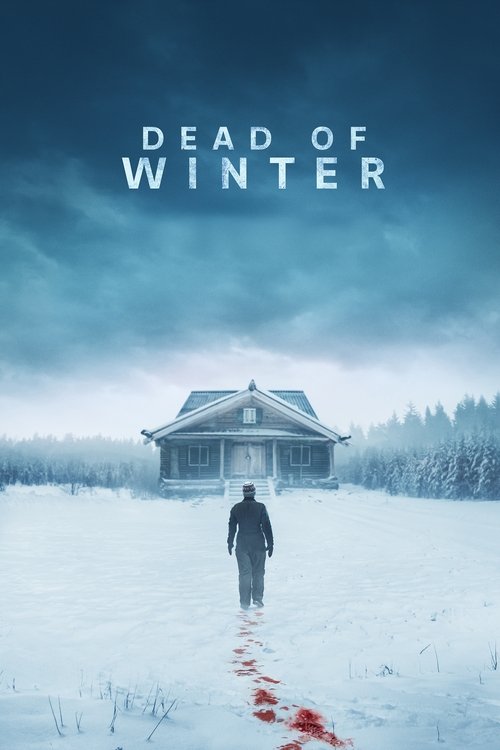
Dead of Winter is a 2025 action thriller directed by Brian Kirk from a screenplay by Nicholas Jacobson-Larson and Dalton Leeb. Emma Thompson stars as Barb, a recently widowed woman driving north through the frozen backroads of Minnesota toward Lake Hilda, carrying the ashes of her late husband, Karl, to scatter them at a place that mattered to them both. It is a private pilgrimage, undertaken alone, in weather that punishes anyone foolish enough to stop moving.

Lost among unmarked roads, Barb pulls up at a remote cabin hoping for directions. What she finds instead is a young woman, Leah, held captive by a couple who are armed, unstable and fully prepared to kill. With no cell service, no backup and miles of white nothing between her and the nearest town, this grieving, unremarkable woman understands that she is the only rescue Leah is going to get.

Premiered at the 78th Locarno Film Festival on 8 August 2025 and released theatrically on 26 September 2025, the film builds its tension out of cold, distance and silence rather than spectacle — a lean cat-and-mouse chase across ice, staged by Kirk and cinematographer Christopher Ross in the vast, desolate glare of the upper Midwest winter.

Core Meaning

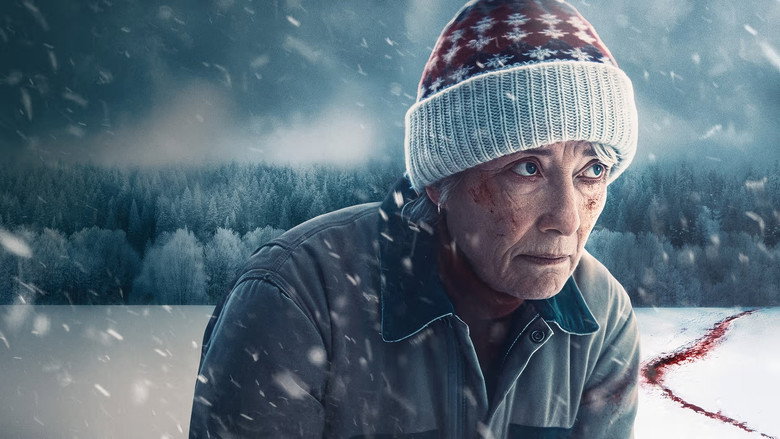
At its heart, Dead of Winter argues that heroism is not a physique or a skill set but a decision made by someone with nothing left to lose. Barb is not a trained operative; she is a woman in the winter of her own life, hollowed out by loss, who chooses to spend what remains of herself on a stranger.

Kirk uses the thriller frame to ask a quieter question: what is a life worth once the person you organised it around is gone? The film's answer is that grief can be converted — not healed, not resolved, but converted into action, into use. Barb's mourning ritual is interrupted by a chance to save someone, and the interruption becomes the point. The mission to lay Karl to rest and the mission to keep Leah alive fuse into a single act.

There is also a pointedly unglamorous thesis about who gets to be an action hero. By casting a 66-year-old Emma Thompson as the woman who walks into the cabin, the film insists that competence, stubbornness and moral clarity outlast youth — and that the world's habit of looking past older women is exactly what makes Barb dangerous.

Thematic DNA

Grief as fuel 28%
The unlikely hero and invisible women 24%
Nature as the true antagonist 20%
Desperation and moral collapse 16%
Obligation to a stranger 12%

Grief as fuel

Barb's journey begins as a funeral rite — a drive north to scatter Karl's ashes — and the film never lets her put that grief down. It is the reason she is out on empty roads alone, the reason she has no one waiting for her, and ultimately the reason she is willing to risk everything. Mourning does not soften her; it strips away her fear of consequence. The box of ashes travels with her through the entire ordeal, a literal weight she refuses to set aside.

The unlikely hero and invisible women

The film's central provocation is its protagonist: an ordinary older woman in a parka who is dismissed by her captors as harmless. That underestimation is her weapon. Dead of Winter deliberately withholds the usual action-hero grammar — no training montage, no special past — and instead earns each victory through improvisation, endurance and local knowledge. Emma Thompson has said the role was unlike anything she had played, and the film treats her ordinariness as its thesis rather than its handicap.

Nature as the true antagonist

The kidnappers are dangerous, but the cold is impartial and inexhaustible. Snow erases tracks, silence swallows screams, distance neutralises phones, and ice becomes both escape route and death trap. Kirk and cinematographer Christopher Ross frame the frozen upper Midwest as a vast, indifferent arena in which human cruelty is just one more hazard. Survival here is a negotiation with the landscape first and with the villains second.

Desperation and moral collapse

Judy Greer's and Marc Menchaca's couple are not masterminds but people who have made an irreversible decision and are now improvising their way deeper into it. Greer plays her as a woman who has, as one critic put it, essentially lost her mind — a folksy neighbour with a rot underneath. The film contrasts two kinds of ordinary people under pressure: one who becomes monstrous, and one who becomes brave.

Obligation to a stranger

Nothing binds Barb to Leah. She could drive away, and the film pauses long enough for the audience to feel that option. The refusal to leave is the moral spine of the movie: an argument that community is not something you're owed but something you perform, alone, in the cold, for someone whose name you barely know.

Character Analysis

Barb

Emma Thompson

Archetype: Reluctant hero / grieving pilgrim Key Trait: Unassuming stubbornness

Motivation

Initially to honour Karl and finish saying goodbye. Then, and overwhelmingly, to get Leah out alive — a purpose that fills the vacuum her husband's death left behind.

Character Arc

Begins as a widow on a solitary errand — driving to Lake Hilda to scatter her husband Karl's ashes — defined entirely by absence. Stumbling onto Leah's captivity, she moves from confusion to calculation to a ferocity she clearly did not know she had. Her arc ends not in survival but in sacrifice, choosing to take her enemy down with her rather than let the danger continue.

The "Purple Lady"

Judy Greer

Archetype: Antagonist / fallen neighbour Key Trait: Homespun menace

Motivation

Protecting a crime that has already spiralled beyond her control; keeping her captive and her plan contained at any cost.

Character Arc

Introduced as one half of a rural couple whose folksy ordinariness curdles as the situation escalates. Critics described her as a Minnesota bumpkin who has essentially lost her mind, and the performance charts an unravelling rather than a reveal — she is already past the point of return when Barb arrives, and the film watches her push further.

All 4 characters and cast

Symbols & Motifs

Karl's ashes in the metal box

Meaning:

The physical form of Barb's grief and of her marriage — a life compressed into something she can carry. The metal of the box matters: it is hard, cold and unyielding, like the resolve grief has given her.

Context:

The box motivates the entire journey to Lake Hilda and stays with Barb throughout the ordeal. In the final moments, sinking beneath the ice, she releases it — completing the burial she set out to perform and joining it in the same water.

Snow and the whiteout

Meaning:

Erasure and moral blankness. Snow covers tracks, bodies and history equally; it is a landscape with no memory, where anything can be hidden and nothing can be proved.

Context:

Used throughout as both texture and plot mechanism — the reason Barb gets lost, the reason the cabin can exist unwitnessed, and the reason pursuit becomes a matter of reading marks in the ground.

The frozen lake

Meaning:

The thin membrane between life and death. Ice looks like solid ground and is not — a perfect image for a story about ordinary surfaces concealing lethal depths.

Context:

Lake Hilda is Barb's destination as a memorial site and becomes the stage for the climax, where the surface finally gives way and the film's two central women go under together.

The basement

Meaning:

What a home hides. A domestic space inverted into a cell, symbolising the buried violence beneath the friendly surface of rural neighbourliness.

Context:

Leah is held in the basement of the couple's cabin — the discovery that transforms Barb's request for directions into a hostage situation.

The purple coat

Meaning:

The single spot of saturated colour in a monochrome world. It marks Greer's character as an aberration — visible, garish, impossible to lose in the snow — and turned her into the film's most recognisable image.

Context:

Judy Greer's captor wears a puffy purple jacket so distinctive that audiences nicknamed her the "Purple Lady." In pursuit sequences the coat functions as a target, the one thing the whiteout cannot swallow.

Dead cell service

Meaning:

The severing of the modern safety net. Without a signal, contemporary life's assumption that help is always one call away collapses, throwing the story back onto individual courage.

Context:

Established early and sustained: Barb is miles from town with no way to summon anyone, which is precisely what makes her the only available rescue.

Philosophical Questions

What is a life worth once the person it was built around is gone?

Barb enters the film carrying her husband's ashes and no plan for afterwards. The story tests whether meaning can be found rather than restored — and answers, ambiguously, that she finds a use for her life at the exact moment she decides to end it.

Do we owe anything to strangers?

Nothing obliges Barb to intervene; leaving would be reasonable and survivable. The film treats her refusal to drive away as a moral axiom rather than a plot necessity, quietly asking the viewer what they would have done on that road with no signal and no witnesses.

Is heroism a trait or a decision?

By denying Barb any special training or history, the film locates courage entirely in choice under pressure. Each of her victories comes from improvisation and endurance, arguing that the capacity was always latent and only circumstance was missing.

When does ordinary desperation become evil?

The captor couple are not criminal masterminds but people compounding one irreversible decision with the next. Judy Greer's unravelling neighbour gives the film its most uncomfortable proposition: that monstrousness is usually just fear with nowhere left to go.

Can a self-destructive act be a moral one?

The climax deliberately fuses rescue and suicide — Barb's final move saves a life and takes her own. The film refuses to disentangle the two motives, leaving the audience to decide whether they witnessed an act of love, of despair, or of both at once.

Alternative Interpretations

The ending as sacrifice. The most straightforward reading of the climax — Barb handcuffing herself to her adversary and dragging them both beneath the ice — is heroic self-expenditure: a woman who has already lost her reason to live spending her last act on ensuring a young stranger's survival. Under this reading, releasing Karl's ashes as she sinks is a completed mission, not a defeat.

Full ending explanation

Cultural Impact

Dead of Winter arrived in a moment when the \"unexpected older action hero\" had become a recognisable current in genre cinema, and it was received largely on those terms: outlets framed Emma Thompson's Barb as one of the most unlikely action protagonists of the year, and the novelty of a double Oscar winner known for literate comedy and drama trudging through blood and snow drove much of the film's coverage.

Critically it landed on the positive side of the ledger — a 76% Tomatometer from 87 reviews on Rotten Tomatoes, with a critics' consensus holding that the film \"succeeds more in execution than in innovation,\" distinguishing itself through performances, atmosphere and a willingness to embrace tonal unpredictability rather than through originality. Audience scores tracked closely, at 78% on the Popcornmeter from over 250 verified ratings, with an IMDb user average around 6.1.

Its most persistent cultural reference point is the Coen brothers' Fargo: nearly every review measured the film's snow-bound Minnesota grotesquerie against that benchmark, some finding the homage affectionate and others finding it a comparison the film could not survive. Its premiere at the 78th Locarno Film Festival positioned it as a genre picture with festival credibility, and Thompson's accompanying interviews — about the Finnish shoot, the -29°C cold, and the scarcity of good roles for women past 60 — gave the release a secondary life as a conversation about ageing and casting.

Audience Reception

Overall verdict: broadly favourable. The film holds a 78% Popcornmeter score on Rotten Tomatoes from more than 250 verified audience ratings, closely mirroring its 76% critics' score, with an IMDb user average of roughly 6.1 — the profile of a solid, well-liked genre picture rather than a breakout.

Most praised: Emma Thompson, almost universally. Viewers responded to seeing her in a role unlike anything in her filmography, and the sheer incongruity of a genteel two-time Oscar winner as a snowbound survivalist was widely cited as the film's pleasure. Judy Greer drew nearly equal praise as a formidable, unhinged foil, and the cinematography — Christopher Ross's frozen, vast, desolate Midwest — was a consistent highlight even among lukewarm reviews.

Main criticisms: familiarity. The critics' consensus itself concedes the film succeeds more in execution than innovation and does not break new ground in the thriller genre. The recurring complaint is the Fargo problem: reviewers noted the film reaches for Coen-brothers snowbound irony \"down to the accents\" without quite landing that sinisterly satirical register. Some also found the plotting mechanical, leaning on contrivances such as the convenient absence of cell service.

Divisive elements: the tonal unpredictability that the critics' consensus counts as a strength struck some viewers as tonal whiplash, with the film shifting between grim survival drama and near-black comedy. Thompson's Minnesotan accent — which she prepared by meeting actual Minnesotans despite shooting in Finland — was a talking point in its own right, defended by many and picked at by regional viewers. And the ending, which denies audiences a clean triumphant escape, split viewers between those who found it devastatingly earned and those who felt cheated of a survival-thriller payoff.

Interesting Facts

  • Although set in northern Minnesota, the film was shot primarily in Finland.
  • Emma Thompson has said that when she arrived in Finland the temperature was around -29°C (roughly -20°F), and that the cold was the production's defining challenge.
  • Thompson praised the Finnish crew's efficiency and craftsmanship while working in extreme winter conditions.
  • To build Barb's Minnesotan accent, Thompson met with real Minnesotans as preparation, even though none of the shoot took place there.
  • Thompson was 66 years old while making the film, and has spoken publicly about finding better roles at that age.
  • Thompson served as an executive producer on the film in addition to starring.
  • Despite the physical demands of the role, Thompson has insisted the film is not the beginning of an action-movie career for her.
  • The screenplay was written by Nicholas Jacobson-Larson and Dalton Leeb.
  • The film had its world premiere at the 78th Locarno Film Festival on 8 August 2025, ahead of a theatrical release on 26 September 2025.
  • Cinematographer Christopher Ross shot the film's frozen landscapes, widely singled out in reviews for capturing the vast desolation of the upper Midwest winter.

Easter Eggs

The Fargo inheritance

Reviewers repeatedly compared the film to Fargo — the snowbound Minnesota setting, the flat regional accents, the collision of politeness and brutality. Some critics felt it openly courts the comparison "down to the accents" without matching the Coen brothers' satirical bite, making the resemblance the film's most discussed intertextual feature.

Judy Greer's purple puffer jacket

The costume choice became a fan shorthand: viewers took to calling Greer's character the "Purple Lady" because the film's monochrome palette makes the coat the one unmissable object on screen — an accidental piece of iconography born from production design.

Frequently Asked Questions

Explore More About This Movie

Dive deeper into specific aspects of the movie with our detailed analysis pages

Comments (0)

Leave a comment

No comments yet. Be the first to share your thoughts!

Similar Movies