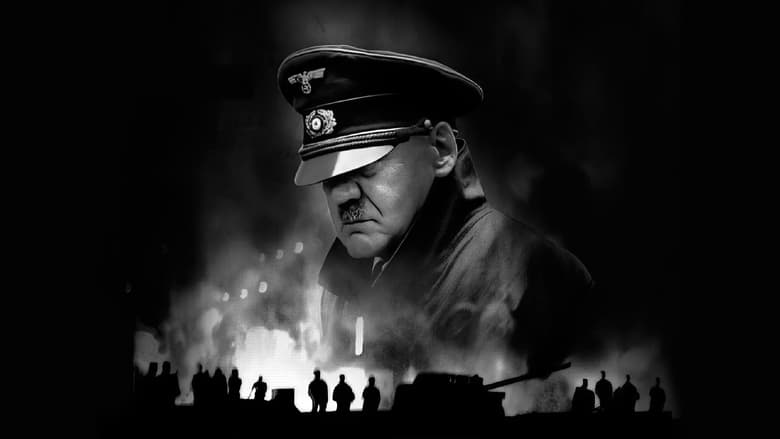
Der Untergang
"April 1945, a nation awaits its... Downfall"
Director: Oliver Hirschbiegel
Cast: Bruno Ganz, Alexandra Maria Lara, Corinna Harfouch, Ulrich Matthes, Juliane Köhler
Downfall — Characters & Cast
Character Analysis
Adolf Hitler
Bruno Ganz
Motivation
His primary motivation is the preservation of his power and his warped vision of a dominant Germany at any cost. When victory becomes impossible, his motivation shifts to a nihilistic desire for a grand, Wagnerian self-destruction, intending to drag the entire German nation down with him. He is driven by a narcissistic belief in his own destiny and an absolute refusal to accept failure.
Character Arc
Hitler's arc is one of rapid and total disintegration. The film begins with him already on the verge of defeat, but he maintains a facade of authority. As the narrative progresses, this facade crumbles completely. He devolves from a charismatic, albeit terrifying, leader into a paranoid, delusional, and physically frail old man, consumed by rage and self-pity. His journey is not one of redemption or growth, but of a descent into utter nihilism, culminating in his suicide and his final, contemptuous condemnation of the German people for failing him.
Traudl Junge
Alexandra Maria Lara
Motivation
Initially, her motivation is a youthful desire for an exciting and important job. She is driven by a sense of duty and a genuine, if naive, admiration for Hitler. As the end nears, her motivation shifts to pure survival and the need to escape the suffocating horror of the bunker.
Character Arc
Traudl Junge begins as a young, apolitical woman who is initially captivated by Hitler's charm and the prestige of her position. Her arc is one of dawning horror and disillusionment. Through her eyes, the audience witnesses the inner workings of the bunker and the gradual unraveling of the man she saw as a respectable employer. By the end, her innocence is shattered, and she is forced to confront the monstrous reality of the regime she served. Her escape from the bunker and Berlin symbolizes a desperate flight from the darkness she was a part of, leading to a lifetime of grappling with her complicity, as expressed by the real-life Junge in the film's closing interview footage.
Joseph Goebbels
Ulrich Matthes
Motivation
His sole motivation is his fanatical devotion to Hitler and the National Socialist ideology. He sees no value in a world without Hitler's Germany. This belief is so absolute that it overrides any paternal instinct, leading him to believe that his children are better off dead than living in a post-Nazi world.
Character Arc
Goebbels' character does not have a traditional arc of change; instead, he represents the unwavering, terrifying endpoint of Nazi ideology. He remains a true believer until the very end, his fanaticism never wavering. His 'arc' is a straight line into oblivion. He embraces the regime's downfall with a chilling resolve, seeing it as a logical conclusion to their 'all or nothing' philosophy. His final act of participating in the murder of his children and his own suicide is the ultimate expression of his absolute and horrifying devotion.
Magda Goebbels
Corinna Harfouch
Motivation
Her motivation is a twisted form of maternal protection rooted in fanatical ideology. She genuinely believes that death is a better fate for her children than a life without National Socialism. Her actions are driven by the conviction that the world after the fall of the Third Reich will not be worth living in.
Character Arc
Similar to her husband, Magda Goebbels' arc is one of unwavering, horrific conviction. Her journey in the film is a descent into a cold, premeditated darkness. Initially seen as a devoted mother, her fanaticism is gradually revealed to be her defining trait. Her arc culminates in one of the most disturbing scenes in cinema, where she systematically murders her six children. This act is the terrifying apotheosis of her belief, demonstrating the complete destruction of her humanity by ideology.
Cast
Explore More About This Movie
Dive deeper into specific aspects of the movie with our detailed analysis pages