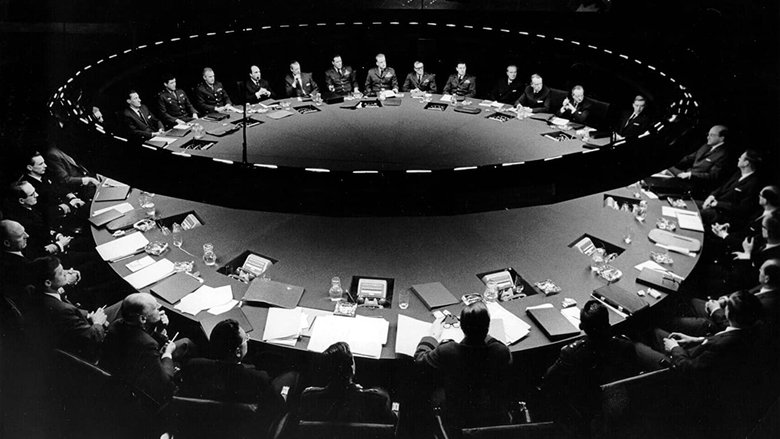
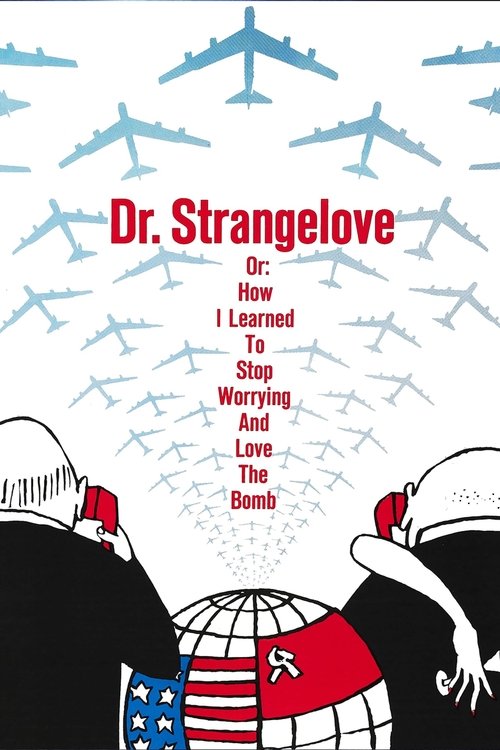
"The hot-line suspense comedy."
Director: Stanley Kubrick
Cast: Peter Sellers, George C. Scott, Sterling Hayden, Keenan Wynn, Slim Pickens
Dr. Strangelove or: How I Learned to Stop Worrying and Love the Bomb — Characters & Cast
Character Analysis
Dr. Strangelove
Peter Sellers
Motivation
His primary motivation is the detached, scientific pursuit of strategic advantage, regardless of the human cost. He is fascinated by the possibilities of nuclear war and post-apocalyptic survival, viewing it as a grand experiment. He is driven by a belief in a master race and the opportunity to rebuild society according to his own eugenic principles.
Character Arc
Dr. Strangelove is a former Nazi scientist and now a key nuclear advisor to the President. He is confined to a wheelchair and struggles to control his rogue right arm, which instinctively gives the Nazi salute. His character remains largely static, representing the cold, amoral logic of science in service of destruction. His arc culminates in a chilling moment of physical and ideological reawakening as the world ends, where he triumphantly stands and exclaims, 'Mein Führer, I can walk!' symbolizing the resurgence of his Nazi past in the face of global annihilation.
General 'Buck' Turgidson
George C. Scott
Motivation
Turgidson is motivated by a fervent anti-communist ideology and a belief in the necessity of military superiority. He is driven by a desire to 'win' the Cold War, even if it means risking global destruction. His actions are also guided by a sense of self-preservation and the protection of the military's reputation.
Character Arc
General Turgidson is the jingoistic and perpetually energized Chairman of the Joint Chiefs of Staff. He does not undergo significant development, consistently advocating for aggressive military action. He initially sees the accidental attack as a potential strategic advantage over the Soviets. Even as the situation spirals out of control, his primary concern is maintaining a 'mineshaft gap' with the Russians. His character serves as a constant satirical representation of military machismo and strategic insanity.
President Merkin Muffley
Peter Sellers
Motivation
Muffley is motivated by a sincere desire to prevent nuclear war and save humanity. He acts as the voice of reason in a room full of chaos and aggression, constantly trying to find a peaceful and logical solution to an insane problem.
Character Arc
President Muffley is the calm, rational, but ultimately powerless leader of the United States. He spends the entire film attempting to de-escalate the crisis through diplomacy and reason. His character arc is one of increasing desperation as he realizes that the systems and people he is supposed to command are beyond his control. He is a tragic figure whose sanity and good intentions are completely ineffective in the face of madness and automated destruction.
General Jack D. Ripper
Sterling Hayden
Motivation
Ripper is driven by a paranoid delusion that the communists are using water fluoridation to poison Americans. His actions are a desperate attempt to protect the nation's (and his own) perceived purity and essence from this imagined threat, which is heavily implied to be a projection of his own sexual impotence.
Character Arc
General Ripper is the catalyst for the film's events. He is a deeply paranoid and delusional Air Force general who initiates the nuclear attack. His character does not develop; he remains steadfast in his bizarre beliefs about a communist conspiracy to contaminate American's 'precious bodily fluids.' His arc concludes with his suicide, taking the only recall code with him and sealing the world's fate.
Group Captain Lionel Mandrake
Peter Sellers
Motivation
Mandrake is motivated by a clear and simple goal: to stop the nuclear attack and prevent the end of the world. He uses logic, persuasion, and eventually desperate measures to try and avert the catastrophe initiated by his commanding officer.
Character Arc
Captain Mandrake is a British Royal Air Force exchange officer trapped with the insane General Ripper. He represents the audience's perspective of bewildered sanity in the face of madness. His arc is a frustrating and ultimately futile attempt to extract the recall code from Ripper and communicate it to the outside world, thwarted at every turn by military protocol and absurd obstacles, like a Coca-Cola machine.
Cast
Explore More About This Movie
Dive deeper into specific aspects of the movie with our detailed analysis pages