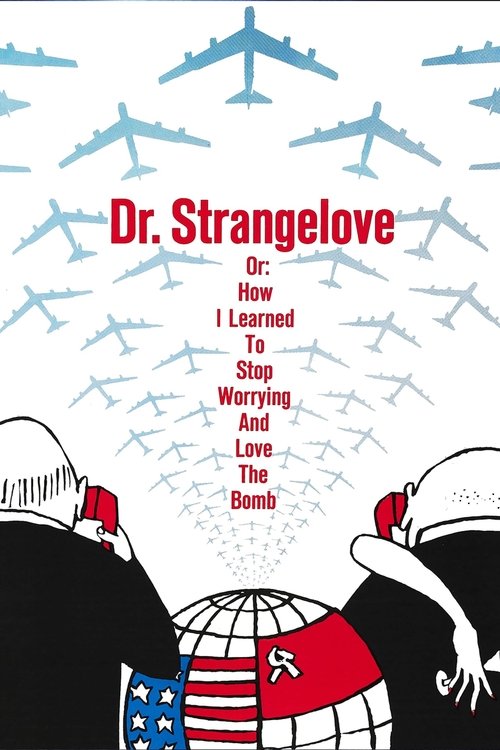
Dr. Strangelove or: How I Learned to Stop Worrying and Love the Bomb
A darkly comedic ballet of mutually assured destruction, where Cold War paranoia waltzes with absurd incompetence towards a blinding, inevitable atomic finale.
Dr. Strangelove or: How I Learned to Stop Worrying and Love the Bomb

Dr. Strangelove or: How I Learned to Stop Worrying and Love the Bomb

"The hot-line suspense comedy."

29 January 1964 United Kingdom 95 min ⭐ 8.1 (5,899)
Director: Stanley Kubrick
Cast: Peter Sellers, George C. Scott, Sterling Hayden, Keenan Wynn, Slim Pickens
War Comedy
The Absurdity of War and Deterrence Human Fallibility and Technological Overreach Sex and Death Critique of the Military-Industrial Complex
Budget: $1,800,000
Box Office: $9,500,000

Overview

"Dr. Strangelove or: How I Learned to Stop Worrying and Love the Bomb" is a satirical black comedy that escalates the Cold War into a nuclear apocalypse. The film begins when a paranoid and unhinged U.S. Air Force General, Jack D. Ripper, orders a preemptive nuclear strike on the Soviet Union, convinced that the communists are poisoning the "precious bodily fluids" of Americans. He seals his base from outside communication, leaving the President and his top advisors in the War Room struggling to avert a global catastrophe.

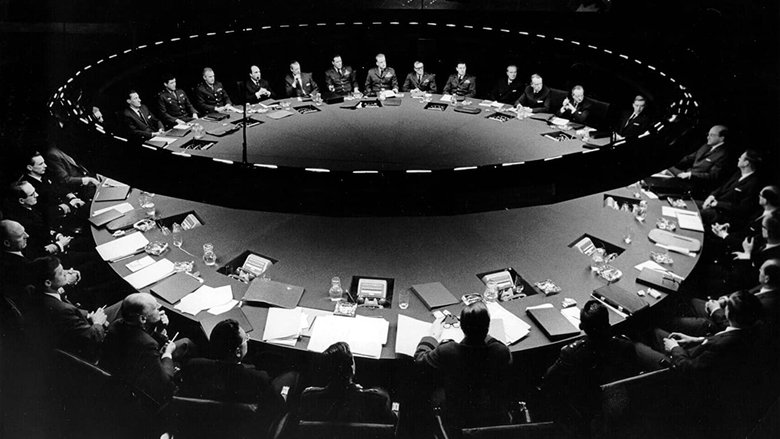
The narrative unfolds in three key locations: Burpelson Air Force Base, where RAF Captain Mandrake attempts to reason with the delusional General Ripper; the B-52 bomber, where Major "King" Kong and his crew patriotically fly towards their target, oblivious to the diplomatic chaos; and the Pentagon's War Room, where President Merkin Muffley, the hawkish General "Buck" Turgidson, and the eccentric ex-Nazi scientist Dr. Strangelove frantically try to recall the bombers. Their efforts are complicated by military protocols and the revelation of a Soviet "Doomsday Machine," an automated system that will trigger the end of all life if the USSR is attacked.
Core Meaning

Stanley Kubrick's "Dr. Strangelove" is a powerful and scathing satire of the Cold War and the concept of mutually assured destruction (MAD). The film's core message is a stark warning about the dangers of nuclear proliferation and the absurdity of a political and military doctrine that relies on the threat of total annihilation for deterrence. Kubrick argues that when humanity creates the means for its own destruction, the combination of human fallibility, technological automation, and political incompetence makes catastrophe not just possible, but inevitable. The film exposes the inherent insanity of a world where a few individuals, driven by paranoia, ego, or misguided patriotism, can trigger a global holocaust. It suggests that in the nuclear age, the line between strategic planning and collective suicide is terrifyingly thin.

Thematic DNA

The Absurdity of War and Deterrence 35%
Human Fallibility and Technological Overreach 30%
Sex and Death 20%
Critique of the Military-Industrial Complex 15%

The Absurdity of War and Deterrence

The central theme is the critique of the logic of nuclear deterrence, specifically the idea of Mutually Assured Destruction (MAD). The film portrays the architects of this strategy as incompetent, irrational, and disconnected from the horrifying consequences of their plans. The very concept of a "Doomsday Machine," which the Soviets built in secret, highlights the ultimate absurdity: a deterrent is useless if the enemy doesn't know it exists. The humor arises from the stark contrast between the gravity of the situation (global annihilation) and the petty, bureaucratic, and often childish behavior of the men in charge.

Human Fallibility and Technological Overreach

"Dr. Strangelove" explores how human flaws like paranoia, ego, and miscommunication can lead to catastrophic failure when combined with powerful, automated systems. General Ripper's delusion about "precious bodily fluids" directly triggers the crisis. The film critiques the over-reliance on technology that is designed to be independent of human control, as exemplified by the Doomsday Machine, which cannot be stopped once activated. This theme serves as a cautionary tale about creating systems so complex and powerful that they escape our ability to manage them wisely.

Sex and Death

Throughout the film, there is a recurring linkage between sexuality, masculinity, and the drive for destruction. This is evident from the opening sequence of a B-52 bomber being refueled mid-air, which resembles copulation. General Ripper's paranoia is rooted in his sexual impotence, which he projects onto a vast communist conspiracy. The characters' names (e.g., Strangelove, Turgidson, Muffley) carry sexual connotations. The film satirizes the military's machismo, suggesting that the obsession with powerful weaponry is a phallic substitute and that the ultimate expression of this toxic masculinity is global annihilation.

Critique of the Military-Industrial Complex

The film satirizes the close relationship between the military and the political establishment, suggesting a self-perpetuating cycle of paranoia and armament. General Turgidson is more concerned with the strategic advantages of a first strike than with preventing a holocaust. Dr. Strangelove, a former Nazi scientist, is now a key advisor to the US President, symbolizing how the architects of past atrocities can be integrated into the machinery of future ones. The characters in the War Room discuss post-apocalyptic survival in terms of a "mineshaft gap," reducing the end of the world to another Cold War competition.

Character Analysis

Dr. Strangelove

Peter Sellers

Archetype: The Mad Scientist
Key Trait: Amoral Scientific Zealotry

Motivation

His primary motivation is the detached, scientific pursuit of strategic advantage, regardless of the human cost. He is fascinated by the possibilities of nuclear war and post-apocalyptic survival, viewing it as a grand experiment. He is driven by a belief in a master race and the opportunity to rebuild society according to his own eugenic principles.

Character Arc

Dr. Strangelove is a former Nazi scientist and now a key nuclear advisor to the President. He is confined to a wheelchair and struggles to control his rogue right arm, which instinctively gives the Nazi salute. His character remains largely static, representing the cold, amoral logic of science in service of destruction. His arc culminates in a chilling moment of physical and ideological reawakening as the world ends, where he triumphantly stands and exclaims, 'Mein Führer, I can walk!' symbolizing the resurgence of his Nazi past in the face of global annihilation.

General 'Buck' Turgidson

George C. Scott

Archetype: The Hawkish General
Key Trait: Gung-ho Militarism

Motivation

Turgidson is motivated by a fervent anti-communist ideology and a belief in the necessity of military superiority. He is driven by a desire to 'win' the Cold War, even if it means risking global destruction. His actions are also guided by a sense of self-preservation and the protection of the military's reputation.

Character Arc

General Turgidson is the jingoistic and perpetually energized Chairman of the Joint Chiefs of Staff. He does not undergo significant development, consistently advocating for aggressive military action. He initially sees the accidental attack as a potential strategic advantage over the Soviets. Even as the situation spirals out of control, his primary concern is maintaining a 'mineshaft gap' with the Russians. His character serves as a constant satirical representation of military machismo and strategic insanity.

President Merkin Muffley

Peter Sellers

Archetype: The Ineffectual Peacemaker
Key Trait: Reasoned Impotence

Motivation

Muffley is motivated by a sincere desire to prevent nuclear war and save humanity. He acts as the voice of reason in a room full of chaos and aggression, constantly trying to find a peaceful and logical solution to an insane problem.

Character Arc

President Muffley is the calm, rational, but ultimately powerless leader of the United States. He spends the entire film attempting to de-escalate the crisis through diplomacy and reason. His character arc is one of increasing desperation as he realizes that the systems and people he is supposed to command are beyond his control. He is a tragic figure whose sanity and good intentions are completely ineffective in the face of madness and automated destruction.

General Jack D. Ripper

Sterling Hayden

Archetype: The Paranoid Zealot
Key Trait: Delusional Paranoia

Motivation

Ripper is driven by a paranoid delusion that the communists are using water fluoridation to poison Americans. His actions are a desperate attempt to protect the nation's (and his own) perceived purity and essence from this imagined threat, which is heavily implied to be a projection of his own sexual impotence.

Character Arc

General Ripper is the catalyst for the film's events. He is a deeply paranoid and delusional Air Force general who initiates the nuclear attack. His character does not develop; he remains steadfast in his bizarre beliefs about a communist conspiracy to contaminate American's 'precious bodily fluids.' His arc concludes with his suicide, taking the only recall code with him and sealing the world's fate.

Group Captain Lionel Mandrake

Peter Sellers

Archetype: The Voice of Sanity
Key Trait: Frustrated Rationality

Motivation

Mandrake is motivated by a clear and simple goal: to stop the nuclear attack and prevent the end of the world. He uses logic, persuasion, and eventually desperate measures to try and avert the catastrophe initiated by his commanding officer.

Character Arc

Captain Mandrake is a British Royal Air Force exchange officer trapped with the insane General Ripper. He represents the audience's perspective of bewildered sanity in the face of madness. His arc is a frustrating and ultimately futile attempt to extract the recall code from Ripper and communicate it to the outside world, thwarted at every turn by military protocol and absurd obstacles, like a Coca-Cola machine.

Symbols & Motifs

The Doomsday Machine

Meaning:

The Doomsday Machine symbolizes the ultimate and absurd endpoint of the logic of nuclear deterrence. It represents a technology of mutually assured destruction that operates beyond human control, highlighting the inherent madness of a strategy that relies on the threat of total annihilation.

Context:

The Soviet Ambassador reveals its existence in the War Room. Its key feature is that it is fully automated and cannot be stopped once triggered, which happens when Major Kong's B-52 successfully drops its bomb on a Soviet target. The fact that the Soviets kept it a secret negates its purpose as a deterrent, further emphasizing the film's theme of absurdity.

Bodily Fluids

Meaning:

General Ripper's obsession with the purity of his "precious bodily fluids" symbolizes the irrational paranoia and anxieties that fueled the Cold War. It's a stand-in for fears of communist infiltration and ideological contamination, reduced to a bizarre and deeply personal delusion about sexual and physical purity.

Context:

General Ripper explains his theory to Captain Mandrake, linking the fluoridation of water to a communist plot to "sap and impurify" the fluids of Americans. This paranoid belief is the sole motivation for him launching the unauthorized nuclear attack.

The B-52 Bomber

Meaning:

The B-52 bomber, particularly the iconic image of Major Kong riding the atomic bomb, symbolizes the fusion of American patriotism, masculinity, and the destructive power of nuclear technology. It is a phallic symbol representing a climactic, orgasmic release of destructive energy.

Context:

The opening credits feature a B-52 being refueled in mid-air in a manner suggestive of sexual intercourse. The climax of the B-52's journey sees Major Kong straddling the bomb as it falls, whooping like a cowboy, directly linking the act of nuclear annihilation with a moment of perverse, triumphant ecstasy.

Dr. Strangelove's Arm

Meaning:

Dr. Strangelove's uncontrollable, black-gloved prosthetic arm, which often defaults to a Nazi salute, symbolizes the irrepressible nature of humanity's destructive and fascistic impulses. It suggests that despite attempts to control and civilize these urges, they remain just beneath the surface, ready to emerge at critical moments.

Context:

Throughout his scenes in the War Room, Dr. Strangelove struggles to control his arm, which at one point tries to strangle him. His final, triumphant exclamation of "Mein Führer, I can walk!" as he rises from his wheelchair, suggests that the apocalypse has somehow revitalized these dark forces within him.

Memorable Quotes

Gentlemen, you can't fight in here! This is the War Room!

— President Merkin Muffley

Context:

Spoken by President Muffley when he breaks up a physical fight between General Turgidson and the Soviet Ambassador in the Pentagon's War Room, a place designed for the highest level of strategic military planning.

Meaning:

This line is a perfect example of the film's satirical humor, highlighting the absurd disconnect between the supposed solemnity of the location and the childish, violent behavior of the world's leaders. It underscores the theme that the people in charge of humanity's fate are not as rational or in control as they should be.

Mein Führer, I can walk!

— Dr. Strangelove

Context:

After laying out his plan for post-apocalyptic survival, which involves a select group of humans breeding in mineshafts, Dr. Strangelove spontaneously rises from his wheelchair. This happens just before the film cuts to a montage of nuclear explosions, ending the world.

Meaning:

This is the film's final line, and it is deeply unsettling. Dr. Strangelove, a former Nazi, is miraculously 'healed' by the prospect of a new world order born from nuclear apocalypse. It symbolizes the re-emergence of fascistic and destructive ideologies at the moment of humanity's self-destruction.

I can no longer sit back and allow Communist infiltration, Communist indoctrination, Communist subversion and the international Communist conspiracy to sap and impurify all of our precious bodily fluids.

— General Jack D. Ripper

Context:

General Ripper says this to Captain Mandrake as his justification for launching a nuclear attack on the Soviet Union without authorization.

Meaning:

This quote encapsulates the irrational paranoia that triggers the film's central crisis. It satirizes the extreme anti-communist rhetoric of the Cold War by linking it to a bizarre, pseudo-scientific, and deeply personal delusion, showing how madness can be cloaked in the language of patriotism.

Well, boys, I reckon this is it - nuclear combat toe to toe with the Roosskies.

— Major T. J. 'King' Kong

Context:

Spoken by Major Kong to his B-52 crew after they receive the order to commence their attack on the Soviet Union. He delivers the line with a sense of duty and excitement, completely unaware that the order is the result of a single general's insanity.

Meaning:

This line captures the disturbingly cheerful and patriotic attitude of the bomber crew as they head towards unleashing nuclear annihilation. It highlights the disconnect between the soldiers carrying out the orders and the catastrophic reality of their mission, treating the apocalypse like a sporting event.

Philosophical Questions

Can humanity be trusted with the technology it creates?

The film explores this question by presenting a scenario where the very systems designed to ensure security (nuclear deterrents, failsafe protocols) become the instruments of destruction. The 'Doomsday Machine' is the ultimate example of this – a technological creation that removes human agency from the most critical decision in history. The film suggests a deep pessimism about humanity's ability to wisely manage its own creations, arguing that our emotional and psychological flaws make us unfit custodians of apocalyptic power.

What is the nature of sanity in an insane world?

"Dr. Strangelove" presents a world where the official doctrines of global superpowers are inherently irrational. In this context, who is truly insane? Is it General Ripper, with his bizarre personal delusions, or the strategists in the War Room who calmly discuss 'acceptable' losses in the tens of millions? The characters who appear most sane, like President Muffley and Captain Mandrake, are rendered completely ineffective. The film suggests that in a world built on the logic of mutually assured destruction, sanity itself becomes a form of powerlessness.

Alternative Interpretations

While the film's primary interpretation is a straightforward satire of Cold War politics, some alternative readings exist. One perspective views the film as a darker allegory about the inherent self-destructive nature of humanity, with the nuclear holocaust serving as a metaphor for a species-wide death drive. Dr. Strangelove's final, triumphant cry of "Mein Führer, I can walk!" can be interpreted not just as a resurgence of Nazism, but as the ultimate victory of humanity's most destructive and irrational impulses over reason and survival.

Another interpretation focuses on the film as a critique of masculinity. The male characters are almost all driven by ego, sexual anxiety (Ripper's impotence), and a phallic obsession with weaponry. From this viewpoint, the end of the world is the ultimate, tragic outcome of a patriarchal system that equates power with destructive capability. The proposed post-apocalyptic breeding program, with a 10:1 female-to-male ratio, is the final, absurd expression of this toxic masculinity, reducing women to a mere tool for repopulation in a world destroyed by men.

Cultural Impact

Released at the height of the Cold War, just over a year after the Cuban Missile Crisis, "Dr. Strangelove" had a profound and lasting cultural impact. It was one of the first major films to satirize the deeply ingrained fears of nuclear annihilation, using black comedy to question the sanity of the political and military doctrines of the time. Critics and audiences were initially divided, with some finding its humorously bleak take on global destruction to be in poor taste, while others hailed it as a groundbreaking and courageous piece of political satire.

The film is credited with helping to shape a more skeptical public attitude towards the Cold War and the arms race. Its portrayal of military leaders and politicians as incompetent, paranoid, and absurdly detached from the consequences of their actions entered the popular consciousness. The image of Major Kong riding the bomb and the concept of the "War Room" have become iconic cultural touchstones, frequently referenced in other films, television shows, and political cartoons. The film's daring humor and cynical worldview influenced a generation of filmmakers and helped to establish political satire as a potent genre in American cinema. In 1989, it was selected for preservation in the United States National Film Registry by the Library of Congress for being "culturally, historically, or aesthetically significant."

Audience Reception

Upon its release, "Dr. Strangelove" was met with a mix of acclaim and controversy. Many critics praised its bold, audacious humor and its sharp satirical critique of Cold War politics, with some calling it the most important film of its time. However, others were unsettled by its dark subject matter and cynical tone, finding it to be a "sick joke" that made light of a terrifying reality. The film was a commercial success, resonating with a public grappling with the anxieties of the nuclear age. Over time, its reputation has solidified, and it is now almost universally regarded as a masterpiece of political satire and one of the greatest comedies ever made. Audiences consistently praise the brilliant performances, particularly Peter Sellers' triple role, the witty and endlessly quotable dialogue, and the film's chillingly plausible depiction of how easily a nuclear war could start.

Interesting Facts

  • The film was originally intended to be a serious thriller based on the novel "Red Alert" by Peter George, but director Stanley Kubrick found the subject matter so absurd he decided to make it a black comedy instead.
  • Peter Sellers' salary of $1 million accounted for 55% of the film's total budget.
  • The character of Dr. Strangelove was not in the original novel; he was created by Kubrick and co-writer Terry Southern for the film.
  • The famous War Room set, designed by Ken Adam, was a massive construction that Kubrick insisted have a green felt-covered table so the actors would feel like they were in a high-stakes poker game for the fate of the world.
  • The film's release was delayed from December 1964 to January 1964 following the assassination of President John F. Kennedy.
  • A line of dialogue by Major Kong was dubbed over to change "Dallas" to "Vegas" to avoid a direct reference to the site of Kennedy's assassination.
  • The film originally ended with a massive pie fight in the War Room, but Kubrick cut the scene, feeling it was too farcical and inconsistent with the film's satirical tone.
  • George C. Scott was reportedly tricked by Kubrick into giving an over-the-top performance as General Turgidson. Kubrick told Scott the exaggerated takes were just for rehearsal, but then used them in the final film.
  • Slim Pickens, who played Major Kong, was not told the film was a comedy and was instructed to play his role completely straight.
  • The realistic interior of the B-52 bomber was created by the production designer based on a single photo from a book, and it was so convincing that the US Air Force allegedly investigated how the filmmakers obtained such accurate details.

Easter Eggs

The CRM 114 Discriminator, the radio device on the B-52 that prevents them from receiving the recall code, is a recurring element in Kubrick's films.

The alphanumeric code 'CRM-114' appears in other Stanley Kubrick films. For instance, in '2001: A Space Odyssey,' it is the name of a key component of the Jupiter spacecraft, and in 'A Clockwork Orange,' it's the name of a serum. This serves as a subtle signature from the director across his filmography.

The centerfold in the Playboy magazine that Major Kong is reading features actress Tracy Reed, who plays General Turgidson's secretary, Miss Scott.

This is a subtle inside joke that connects the world of the bomber crew with the high-level officials in the Pentagon, reinforcing the film's theme of the pervasive and often distracting influence of sexuality even in the face of nuclear war.

Many of the characters' names are sexually suggestive or have hidden meanings.

For example, 'Mandrake' is a root once thought to promote male fertility, 'Jack D. Ripper' is a clear reference to a famous killer, 'Buck Turgidson' suggests a virile and swollen persona, and 'Merkin Muffley' refers to a pubic wig. This naming convention reinforces the film's subtext about the link between sexual anxieties and military aggression.

⚠️ Spoiler Analysis

Click to reveal detailed analysis with spoilers

Frequently Asked Questions

Explore More About This Movie

Dive deeper into specific aspects of the movie with our detailed analysis pages

Comments (0)

Leave a comment

No comments yet. Be the first to share your thoughts!