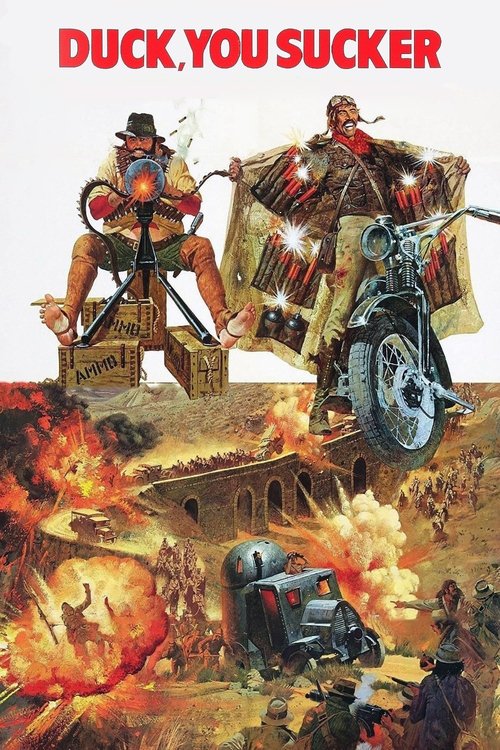
Duck, You Sucker
A Zapata Western elegy where dynamite blasts expose the hollowness of political myths. Amidst the dust of the Mexican Revolution, an unlikely friendship blooms between a peasant bandit and an Irish terrorist, painting a cynical yet poignant portrait of war.
Duck, You Sucker
Duck, You Sucker

Giù la testa

"Two daredevils battle for a fortune in gold, and it will take an army to stop them!"

29 October 1971 Spain 157 min ⭐ 7.7 (1,149)
Director: Sergio Leone
Cast: Rod Steiger, James Coburn, Romolo Valli, Maria Monti, Rik Battaglia
Western
The Cynicism of Revolution Friendship and Male Bonding Betrayal and Guilt The Myth of the West vs. Modernity

Duck, You Sucker - Ending Explained

⚠️ Spoiler Analysis

The film's turning point reveals that John is not just a revolutionary but a man running from the guilt of killing his best friend, Nolan, in Ireland. Nolan had informed on John under torture, and John executed him in retaliation. In Mexico, John encounters Dr. Villega, who similarly betrays the revolution under torture. Instead of killing Villega, John sees Nolan in him and offers him a chance to redeem himself by dying with dignity in a suicide attack on the Colonel's train.

The ending sees the complete destruction of Juan's world: his sons are massacred by the army, and his 'friendship' with John ends when John, mortally wounded, detonates himself to destroy the final obstacle. Juan is left alive, a 'hero' of a revolution he hates, completely alone, asking the universe 'What about me?'—a powerful indictment of the personal cost of political upheaval.

Alternative Interpretations

The Love Triangle: Some analyses of the flashbacks suggest a romantic rivalry between John, his friend Nolan, and the woman they both loved. This adds a layer of sexual jealousy to the political betrayal, complicating John's guilt—did he kill Nolan solely for the cause, or was there personal malice?

The Dream Theory: A minority interpretation suggests the entire revolutionary adventure is Juan's dying dream or hallucination, contrasting his grim reality with a fantasy where he becomes a 'great hero,' though the film's gritty realism largely contradicts this.