Skip to content
Duty After School
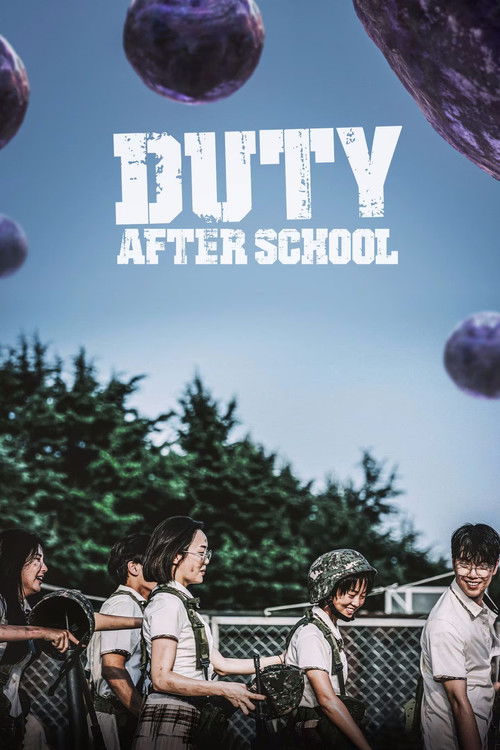
Under a bruised sky heavy with hovering extraterrestrial spheres, blood-stained military uniforms and shattered adolescence collide in a harrowing cinematic nightmare of weaponized youth, lost innocence, and visceral survival.
Duty After School
Duty After School

방과 후 전쟁활동

31 March 2023 — 21 April 2023 South Korea 1 season 10 episode Ended 8.2 (105)

Cast: Kim Ki-hae, Shin Myung-sung, Shin Hyun-soo, Lim Se-mi, Ahn Do-gyu

Drama Sci-Fi & Fantasy Action & Adventure The Toxic Weight of Academic and Societal Pressure Loss of Innocence and Weaponized Adolescence Camaraderie, Solidarity, and Found Family Human Nature, Moral Decay, and Paranoia Adult Betrayal and Institutional Failure

Duty After School — Ending Explained

⚠️ Spoiler Analysis

The narrative contains major twists across both parts:

In Part 1, Homeroom Teacher Park Eun-young dies early in Episode 2 while protecting Class 3-2. In Episode 6, Lieutenant Lee Choon-ho lures hundreds of spheres into the main school building, locks himself inside, and detonates heavy explosives, sacrificing his life to save his students.

In Part 2, military command collapses and abandons the students. Fixated on extra CSAT points, Kook Young-soo descends into madness; when Kwon Il-ha discovers him sabotaging operations, Young-soo shoots Il-ha dead. In Episode 10, when the class votes to abandon the war, Young-soo panics, sexually assaults Cha So-yeon, and opens fire on his sleeping classmates. Almost the entire cast—including Wang Tae-man, Yeon Bo-ra, Jo Jang-soo, and Cha So-yeon—is slaughtered.

No Ae-seol shoots Young-soo to end the spree. Only Kim Chi-yeol, Lee Na-ra, and No Ae-seol survive. In the flash-forward, the spheres are cleared by the military and CSAT exams resume, leaving Chi-yeol traumatized in a quiet room reflecting on his dead classmates.

Alternative Interpretations

The series can be analyzed through multiple analytical lenses:

  • The Educational System Critique: The finale where Kook Young-soo massacres his friends to secure college admission represents the extreme, murderous end-point of South Korea's hyper-competitive education system—where students view peers as rivals to be eliminated.
  • The PTSD & War Trauma Allegory: Part 2's decay into internal horror demonstrates that surviving combat physical threats is meaningless if psychological trauma remains unaddressed.
  • Failure of Generational Responsibility: The spheres and war represent adult failures inherited by children; the horrific ending underlines how older generations destroy the future of youth through neglect and exploitation.

Explore More About This Movie

Dive deeper into specific aspects of the movie with our detailed analysis pages

Similar Movies