
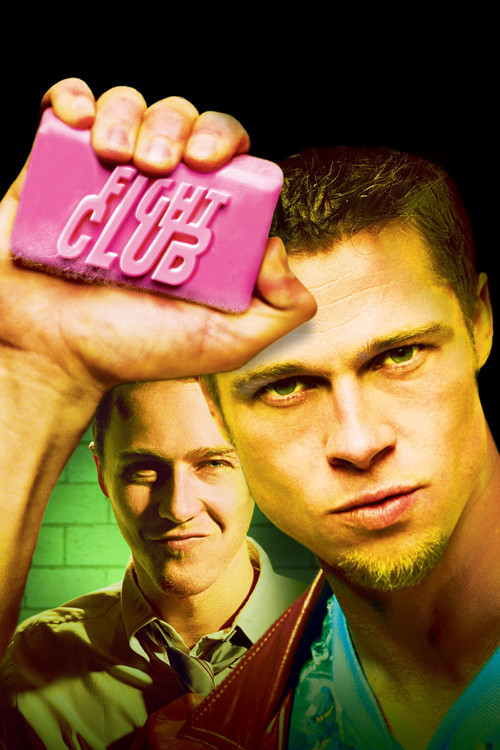
"Mischief. Mayhem. Soap."
Director: David Fincher
Cast: Edward Norton, Brad Pitt, Helena Bonham Carter, Meat Loaf, Jared Leto
Fight Club — Movie Quotes
Memorable Quotes
The first rule of Fight Club is: you do not talk about Fight Club. The second rule of Fight Club is: you do not talk about Fight Club.
Context
Tyler recites the rules to the men crowded into the bar basement, formalising what had been two friends brawling in a parking lot.
Meaning
The film's most quoted line and its neatest self-own: a movement founded on freedom immediately invents commandments, and secrecy becomes the most effective advertising ever devised. It also became a piece of pop-culture liturgy, endlessly parodied in the decades since.
The things you own end up owning you.
Context
Delivered to the narrator in the bar after the loss of his catalogue-perfect condo, as Tyler reframes catastrophe as emancipation.
Meaning
The thesis of the film's anti-consumerist satire in seven words — property inverted into possession, with the buyer as the thing purchased.
It's only after we've lost everything that we're free to do anything.
Context
Part of Tyler's late-night sermons to the narrator as fight club begins mutating into something with objectives.
Meaning
Tyler's gospel of liberation through annihilation. Seductive on first hearing, it is the exact logic the film follows to its terrifying conclusion, where 'anything' includes things no one should be free to do.
Man, I see in fight club the strongest and smartest men who've ever lived. I see all this potential, and I see squandering. God damn it, an entire generation pumping gas, waiting tables; slaves with white collars.
Context
Tyler addresses the assembled members, the moment the basement stops being a release valve and becomes a recruiting ground.
Meaning
The film's central diagnosis of thwarted masculinity and economic disillusion — the grievance that made Fight Club a lightning rod, quoted sincerely by the very men its satire is aimed at.
I haven't been fucked like that since grade school.
Context
Marla's morning-after 'pillow talk' in the Paper Street house, delivered with cheerful obscenity to the narrator's horror.
Meaning
A line born from a studio fight: Fincher agreed to replace Marla's original 'I want to have your abortion' only on the condition that the replacement could never be cut. When executives found the new version even more objectionable and asked for the original back, he refused — a small monument to the film's antagonistic relationship with its own studio.
Explore More About This Movie
Dive deeper into specific aspects of the movie with our detailed analysis pages