
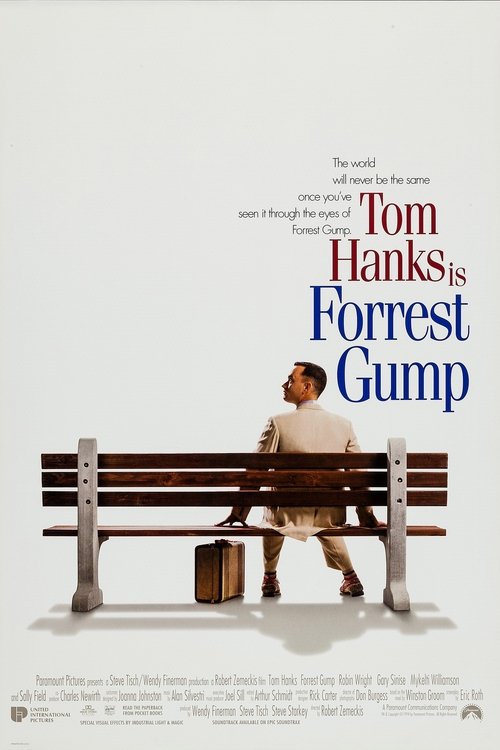
Forrest Gump
A heartfelt and sweeping drama that feels like a feather drifting through pivotal moments of American history, evoking a profound sense of innocent wonder.
Forrest Gump
Forrest Gump

"The world will never be the same once you've seen it through the eyes of Forrest Gump."

23 June 1994 United States of America 142 min ⭐ 8.5 (28,687)
Director: Robert Zemeckis
Cast: Tom Hanks, Robin Wright, Gary Sinise, Sally Field, Mykelti Williamson
Drama Comedy Romance
Destiny vs. Chance Loss of Innocence Love and Friendship Perseverance
Budget: $55,000,000
Box Office: $677,387,716

Forrest Gump - Ending Explained

⚠️ Spoiler Analysis

The narrative of "Forrest Gump" culminates in a series of poignant revelations and resolutions. After his three-year run, Forrest receives a letter from Jenny, who asks him to visit her in Savannah. It is here that the film's major twist is revealed: Jenny has a son, also named Forrest, and Forrest is the father. This revelation redefines Forrest's journey, giving him a new purpose beyond his past achievements and his pining for Jenny.

The second major revelation is that Jenny is sick with an "unknown virus," which is implied to be HIV/AIDS, a reflection of the burgeoning health crisis of the 1980s. This tragic turn forces a final reconciliation between the two. They return to Greenbow, Alabama, and get married, enjoying a brief period of family life before Jenny dies. Forrest is left to raise their son. The ending sees Forrest sending Forrest Jr. off to his first day of school, bringing Forrest's own life full circle. The feather, which appeared at the beginning, floats away from Forrest's feet into the sky, symbolizing that while Forrest's journey has found a new, stable chapter as a father, the unpredictable journey of life continues with the next generation.

Alternative Interpretations

While largely received as a heartwarming tale of an underdog's triumph, "Forrest Gump" has been subject to more critical interpretations. One significant alternative reading sees the film as a conservative critique of the 1960s counter-culture. In this view, Forrest, who embodies traditional values of loyalty, patriotism, and simplicity, is consistently rewarded with success. In contrast, Jenny, who embraces the counter-culture, anti-war movements, and a bohemian lifestyle, endures a life of trauma, abuse, and ultimately, an early death. This has led some critics to argue that the film implicitly suggests that ignorance and conformity are preferable to protest and intellectualism.

Another interpretation views Forrest not as a simpleton, but as an allegorical representation of America itself during the latter half of the 20th century: fundamentally good-hearted and well-intentioned, but also somewhat naive and bumbling through major world events with unforeseen consequences. His journey through decades of social and political upheaval mirrors the nation's own identity crisis and search for meaning during the same period.