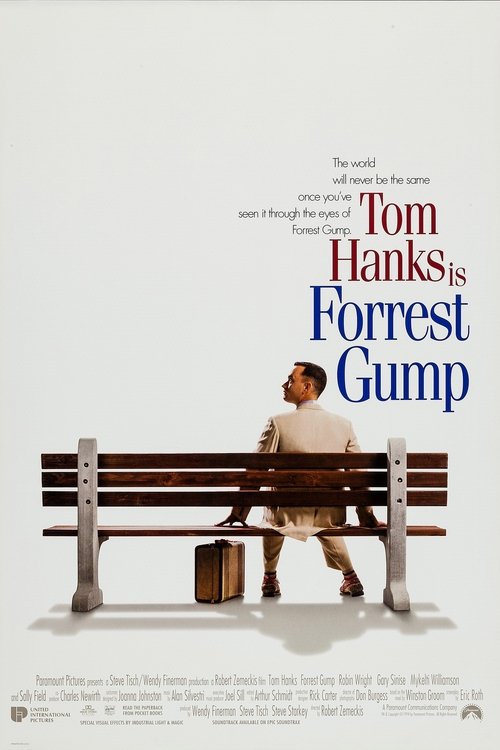
Forrest Gump
A heartfelt and sweeping drama that feels like a feather drifting through pivotal moments of American history, evoking a profound sense of innocent wonder.
Forrest Gump

Forrest Gump

"The world will never be the same once you've seen it through the eyes of Forrest Gump."

23 June 1994 United States of America 142 min ⭐ 8.5 (28,687)
Director: Robert Zemeckis
Cast: Tom Hanks, Robin Wright, Gary Sinise, Sally Field, Mykelti Williamson
Drama Comedy Romance
Destiny vs. Chance Loss of Innocence Love and Friendship Perseverance
Budget: $55,000,000
Box Office: $677,387,716

Overview

"Forrest Gump" tells the extraordinary story of a simple man with a low IQ who unwittingly finds himself at the center of some of the most significant events of the 20th century. From becoming a college football star and a decorated Vietnam War hero to a champion ping-pong player and a shrimping magnate, Forrest's life is a series of improbable and incredible adventures. His journey is framed by him recounting his life story to various strangers while waiting at a bus stop.

Despite his remarkable achievements and the historical figures he encounters, Forrest's heart belongs to one person: his childhood friend, Jenny Curran. Their relationship is the emotional core of the film, as Forrest's unwavering love for her persists through her troubled life, which stands in stark contrast to his own innocent journey. The narrative explores themes of destiny, innocence, and the unpredictable nature of life, all through the eyes of its uniquely guileless protagonist.
Core Meaning

The core meaning of "Forrest Gump" revolves around the idea that a person's worth is not defined by their intelligence, but by their kindness, loyalty, and integrity. Director Robert Zemeckis presents a narrative where a man with a below-average IQ can lead a more fulfilling and impactful life than those who are considered more intelligent. The film suggests that life is a combination of destiny and chance, famously articulated by Forrest's reflection: "I don't know if we each have a destiny, or if we're all just floatin' around accidental-like on a breeze. But I, I think maybe it's both." Ultimately, the movie carries a message of hope, perseverance, and the importance of simple human decency in a complex and often cynical world.

Thematic DNA

Destiny vs. Chance 35%
Loss of Innocence 30%
Love and Friendship 25%
Perseverance 10%

Destiny vs. Chance

The film constantly questions whether life is predetermined or a series of random events. This is symbolized by the feather that opens and closes the film, floating unpredictably on the wind. Forrest himself ponders this, concluding that perhaps it's a bit of both. Lieutenant Dan initially believes in a predetermined destiny for himself to die in battle, a belief that is shattered when Forrest saves him, leading to a profound spiritual crisis and eventual acceptance of his new life path.

Loss of Innocence

Forrest Gump is portrayed as a perpetually innocent character, navigating a world filled with turmoil and cynicism without being corrupted by it. In contrast, Jenny's life is a tragic journey through the dark side of the counter-culture, including drug abuse and sexual exploitation, representing a loss of innocence on both a personal and national level. The film juxtaposes Forrest's simple worldview with the complex and often harsh realities of American history, from the Vietnam War to the AIDS crisis.

Love and Friendship

The film explores deep bonds of loyalty and affection. Forrest's unwavering love for Jenny is the central emotional thread, persisting despite their different paths and her personal struggles. His friendships with Bubba and Lieutenant Dan are also pivotal. He is fiercely loyal to his promise to Bubba to start a shrimping business, and his compassion helps Lieutenant Dan find a new purpose in life after his traumatic war injuries.

Perseverance

Forrest embodies the idea of overcoming adversity through sheer persistence. From breaking free of his leg braces as a child to his relentless cross-country run, he demonstrates an incredible capacity to keep moving forward. His mother's advice, "You have to do the best with what God gave you," serves as a guiding principle for his life. The film suggests that success is not necessarily born from brilliance but from determination and a refusal to give up.

Character Analysis

Forrest Gump

Tom Hanks

Archetype: The Innocent Hero
Key Trait: Unwavering loyalty

Motivation

Forrest is primarily motivated by his love for Jenny and his desire to keep his promises to his friends and family. He lives his life according to the simple, profound wisdom imparted by his mother, such as "Stupid is as stupid does," which means one is defined by their actions, not their perceived intelligence.

Character Arc

Forrest's journey is less of a traditional character arc and more of a steadfast progression through a changing world. Despite his low IQ, he remains consistently kind, loyal, and optimistic from childhood to adulthood. His 'development' comes from the vast experiences he accumulates and the wisdom he gains, culminating in his understanding of life's dual nature of chance and destiny and his role as a loving father. He finds peace and contentment by the film's end.

Jenny Curran

Robin Wright

Archetype: The Lost Soul
Key Trait: Restless

Motivation

Jenny is motivated by a deep-seated desire to escape her traumatic past. Her actions are often a cry for help and a search for an identity separate from the pain of her childhood. She constantly seeks love but struggles to accept the pure, unconditional love that Forrest offers her until the end of her life.

Character Arc

Jenny's arc is a tragic and tumultuous one. Scarred by childhood abuse, she spends most of her life running from her past, seeking freedom through the counter-culture, drugs, and a series of abusive relationships. Her journey is one of self-destruction and a desperate search for love and peace. She finally finds a semblance of peace and returns to Forrest, but it is cut short by her illness. Her arc concludes with her apologizing to Forrest and finding a brief period of happiness with him and their son.

Lieutenant Dan Taylor

Gary Sinise

Archetype: The Wounded Warrior
Key Trait: Resilient

Motivation

Initially, his motivation is to fulfill what he perceives as his family's military destiny. After his injury, his motivation becomes a nihilistic self-destruction fueled by rage against Forrest and God. His motivation shifts towards recovery and finding new meaning after he joins Forrest in the shrimping business and survives a hurricane at sea, which serves as a spiritual turning point.

Character Arc

Lieutenant Dan begins as a proud, career military man who believes it is his destiny to die in battle, like his ancestors. When Forrest saves him, leaving him a double amputee, he is consumed by bitterness, anger, and a sense of purposelessness. His journey is about coming to terms with his new reality, finding a new will to live, and ultimately making peace with God and with Forrest. He transforms from a broken man into a successful and content individual with "magic legs" and a fiancée.

Mrs. Gump

Sally Field

Archetype: The Mentor/The Devoted Mother
Key Trait: Unconditional love

Motivation

Her sole motivation is to ensure that Forrest has the same opportunities as everyone else and to instill in him a sense of self-worth. She provides him with simple, memorable aphorisms to navigate a complicated world, believing that he is "no different" from anyone else.

Character Arc

Mrs. Gump is a constant source of strength and wisdom in Forrest's life. She is a fiercely protective mother who refuses to let society's judgments define her son's potential. Her arc is fulfilled through Forrest's successes, which are a direct result of her unwavering belief in him. She faces her own death with grace, imparting final words of wisdom to her son.

Symbols & Motifs

The Feather

Meaning:

The feather symbolizes the central theme of destiny versus chance. Its unpredictable path on the wind mirrors Forrest's own view that life might be a combination of random events and a predetermined path. It represents the beauty and randomness of life's journey.

Context:

A feather appears at the very beginning of the film, floating down to Forrest's feet at the bus stop. It reappears at the end, flying away from Forrest and his son, suggesting the continuation of life's journey and its inherent uncertainty.

Box of Chocolates

Meaning:

This symbolizes the unpredictability and variety of life's experiences. As Forrest's mother says, "Life was like a box of chocolates. You never know what you're gonna get." It reflects Forrest's simple, accepting approach to whatever comes his way.

Context:

Forrest offers chocolates to the people he sits with at the bus stop while recounting his life story. The quote itself is one of the most famous lines from the film and encapsulates its core philosophy.

Running

Meaning:

Running is a recurring motif that represents freedom, escape, and a way for Forrest to process his emotions. For Jenny, it's a means of escaping her abusive childhood. For Forrest, it begins as an escape from bullies and evolves into a form of meditation and a journey of self-discovery.

Context:

Jenny's cry of "Run, Forrest, run!" is a recurring line. Forrest runs from bullies, runs across the football field, runs through Vietnam, and embarks on a three-year cross-country run after Jenny leaves him, becoming a national phenomenon.

Birds

Meaning:

Birds symbolize freedom and escape, particularly for Jenny. Having been abused by her father, she prays to become a bird so she can fly far away.

Context:

As a child, Jenny prays in a cornfield, "Dear God, make me a bird. So I could fly far. Far far away from here." At the end of the film, after Forrest visits Jenny's grave, a flock of birds suddenly takes flight from the tree above, suggesting her spirit is finally free.

Memorable Quotes

My mama always said life was like a box of chocolates. You never know what you're gonna get.

— Forrest Gump

Context:

Forrest says this to a woman sitting next to him on the park bench at the bus stop as he begins to narrate his life story.

Meaning:

This quote encapsulates the film's central theme about the unpredictability of life. It reflects a worldview of acceptance and openness to whatever experiences may come, which is the guiding principle of Forrest's life.

Run, Forrest, run!

— Jenny Curran

Context:

Jenny first shouts this when Forrest is a child, being chased by bullies on bikes. The phrase is repeated at various points in his life, including when she urges him to be safe in Vietnam.

Meaning:

Initially a literal instruction to escape danger, this phrase becomes a recurring motif representing escape, freedom, and Forrest's incredible ability to persevere through any obstacle by simply moving forward.

Stupid is as stupid does.

— Forrest Gump (quoting his mother)

Context:

Forrest repeats this line several times throughout the film, often in response to people who underestimate him or call him stupid.

Meaning:

This piece of wisdom from Mrs. Gump asserts that a person's intelligence is defined by their actions, not by a label or an IQ score. It's a defense of Forrest's character, suggesting that his kind and successful actions prove he is anything but stupid.

I don't know if we each have a destiny, or if we're all just floatin' around accidental-like on a breeze. But I, I think maybe it's both.

— Forrest Gump

Context:

Forrest speaks these words aloud while visiting Jenny's grave, reflecting on the meaning of their lives and the world at large.

Meaning:

This line, delivered at the end of the film, represents the culmination of Forrest's philosophical journey. He reconciles the two opposing views of life presented in the film—predestination and random chance—arriving at a nuanced and wise conclusion.

Philosophical Questions

Are our lives governed by destiny or by chance?

The film explores this question through its central characters and recurring symbols. Lieutenant Dan believes in a fixed destiny, while the floating feather suggests randomness. Forrest ultimately concludes that both forces are at play simultaneously, suggesting a complex interplay between fate and free will. His own life seems to be a series of accidental encounters that lead to extraordinary outcomes, leaving the audience to ponder the nature of their own paths.

What is the true measure of a person's worth?

"Forrest Gump" challenges the conventional valuation of intelligence. Despite his low IQ, Forrest's unwavering kindness, loyalty, and integrity allow him to achieve great success and positively impact those around him. The film posits that character, not intellect, is the ultimate measure of a human being, using the mantra "Stupid is as stupid does" to emphasize that actions define a person.

Can one remain innocent in a cynical world?

Forrest navigates some of the most turbulent and divisive moments in modern history—from the Vietnam War to political assassinations—with his core innocence intact. He observes events without judgment, taking them at face value. This contrasts sharply with Jenny, who is consumed and damaged by the same historical forces. The film uses Forrest as a lens to question whether it's possible, or even desirable, to maintain a simple, uncorrupted worldview in the face of widespread social upheaval and cynicism.

Alternative Interpretations

While largely received as a heartwarming tale of an underdog's triumph, "Forrest Gump" has been subject to more critical interpretations. One significant alternative reading sees the film as a conservative critique of the 1960s counter-culture. In this view, Forrest, who embodies traditional values of loyalty, patriotism, and simplicity, is consistently rewarded with success. In contrast, Jenny, who embraces the counter-culture, anti-war movements, and a bohemian lifestyle, endures a life of trauma, abuse, and ultimately, an early death. This has led some critics to argue that the film implicitly suggests that ignorance and conformity are preferable to protest and intellectualism.

Another interpretation views Forrest not as a simpleton, but as an allegorical representation of America itself during the latter half of the 20th century: fundamentally good-hearted and well-intentioned, but also somewhat naive and bumbling through major world events with unforeseen consequences. His journey through decades of social and political upheaval mirrors the nation's own identity crisis and search for meaning during the same period.

Cultural Impact

"Forrest Gump" was a massive commercial and critical success upon its release in 1994, becoming a cultural phenomenon that left a lasting imprint on American cinema and pop culture. The film's innovative use of visual effects to seamlessly insert Tom Hanks into historical archive footage was groundbreaking, setting a new standard for filmmaking and influencing numerous subsequent films. It revolutionized storytelling by blending a fictional personal narrative with real historical events, making history feel more accessible and personal to a wide audience.

The film generated a plethora of iconic quotes that have become part of the popular lexicon, such as "Life is like a box of chocolates..." and "Run, Forrest, run!" It also sparked the creation of the real-life Bubba Gump Shrimp Co. restaurant chain. The movie's soundtrack, a compilation of hits from the 1950s to the 1980s, was immensely popular and served as a musical time capsule for different generations. Despite its popularity, the film also generated debate among critics regarding its perceived political conservatism and its romanticized, some would say sanitized, view of American history, particularly the counter-culture movement. Nevertheless, "Forrest Gump" remains a powerful piece of cultural memory, shaping how a generation perceived pivotal moments of the American 20th century.

Audience Reception

Audiences overwhelmingly embraced "Forrest Gump," making it a box office blockbuster and a beloved classic. Viewers were drawn to its heartwarming story, the endearing lead performance by Tom Hanks, and its emotional depth. The film's blend of comedy, drama, and romance, set against the backdrop of significant historical events, resonated deeply with a broad audience. Many praised its themes of hope, perseverance, and the triumph of the human spirit. However, the film was not without its critics. Some viewers and critics found its portrayal of the 1960s counter-culture to be simplistic and condescending, and its overall political tone to be conservative and sentimental. The character of Jenny, in particular, has been a point of contention, with some seeing her as a tragic figure while others criticize her treatment in the narrative as a punishment for her non-conformist lifestyle.

Interesting Facts

  • Tom Hanks was not paid his usual salary for the film. Instead, he opted for a percentage of the film's gross, which earned him over $40 million.
  • Bill Murray, John Travolta, and Chevy Chase all turned down the role of Forrest Gump.
  • The ping-pong balls in the film were not real; they were computer-generated to appear as if Forrest was a world-class player.
  • Tom Hanks' younger brother, Jim Hanks, served as his running double for many of the wide shots in the cross-country running sequences.
  • The iconic park bench where Forrest tells his story was a prop placed in Chippewa Square in Savannah, Georgia, for filming. It is now housed in the Savannah History Museum.
  • The line, "My name is Forrest Gump. People call me Forrest Gump," was ad-libbed by Tom Hanks.
  • In every photo of Forrest shown in the film, his eyes are closed.
  • Kurt Russell, who had previously played Elvis Presley, provided the uncredited voice for Elvis in the film.
  • The Bubba Gump Shrimp Company, created for the film, became a real-life chain of seafood restaurants.

Easter Eggs

Forrest Gump's Speech at the Washington D.C. Rally

When Forrest speaks at the anti-war rally, his microphone is disconnected, and the audience cannot hear what he says. According to Tom Hanks, the line he delivered was: "Sometimes when people go to Vietnam, they go home to their mommas without any legs. Sometimes they don't go home at all. That's a bad thing. That's all I have to say about that."

The Blue Plaid Shirt

With every transition to a new age in Forrest's life, the first time we see him, he is wearing a blue plaid shirt. This visual motif provides a subtle continuity throughout his life's journey.

Zemeckis Family Cameos

The first boy on the school bus who refuses to let Forrest sit next to him is Alexander Zemeckis, the son of director Robert Zemeckis.

Hanks Family Cameos

Tom Hanks's daughter, Elizabeth Hanks, appears as one of the children on the school bus who won't let Forrest sit with her.

⚠️ Spoiler Analysis

Click to reveal detailed analysis with spoilers

Frequently Asked Questions

Explore More About This Movie

Dive deeper into specific aspects of the movie with our detailed analysis pages

Comments (0)

Leave a comment

No comments yet. Be the first to share your thoughts!