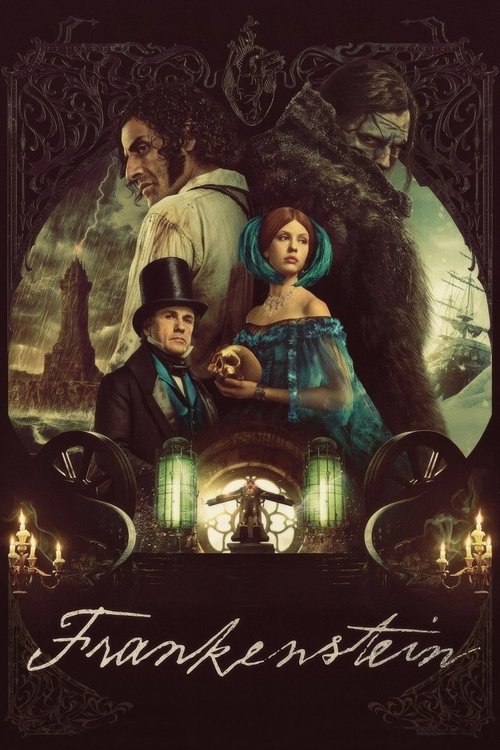
Frankenstein
A gothic melodrama of inherited trauma, where a creator's haunted ambition births a tragic, beautiful creation, mirroring a lineage of cruel fathers and mistreated sons.
Frankenstein
Frankenstein

"Only monsters play God."

17 October 2025 United States of America 150 min ⭐ 7.9 (904)
Director: Guillermo del Toro
Cast: Oscar Isaac, Jacob Elordi, Christoph Waltz, Mia Goth, Felix Kammerer
Drama Fantasy Horror
Fathers and Sons (The Cycle of Abuse) The Nature of Monstrosity Creation and Responsibility Loneliness and the Need for Connection
Budget: $120,000,000
Box Office: $144,496

Frankenstein - Ending Explained

⚠️ Spoiler Analysis

The narrative of Frankenstein is framed by Victor Frankenstein telling his story to Captain Anderson on a ship trapped in the Arctic. The film then hinges on a crucial structural shift: halfway through, the Creature boards the ship and takes over the narration, presenting his own version of events. This reveals Victor to be an unreliable and self-serving narrator. We learn the Creature's violence was not random; for example, the death of Victor's brother William (Felix Kammerer) was accidental, a result of William attacking the Creature in fear.

A major plot point involves Victor's benefactor, Henrich Harlander (Christoph Waltz), who reveals he is dying of syphilis and funded the experiment with the selfish intention of having his own brain transplanted into the new, perfect body. Victor refuses. The film's most significant departure from the novel is its ending. Elizabeth is not killed by the Creature; she is shot and killed accidentally by Victor, who is trying to shoot the Creature. In the Arctic, Victor doesn't die consumed by hatred. Instead, he and the Creature achieve a form of reconciliation. Victor, finally understanding the depth of his failure, apologizes for his abuse and abandonment. The Creature, in turn, forgives his creator just before Victor succumbs to his injuries. Unlike the novel, where the Creature plans his own suicidal immolation, this version establishes that the Creature is immortal and cannot die. The film ends not in tragedy and death, but with a bittersweet image of hope: the immortal Creature, alone but free from the cycle of vengeance, choosing to live on as the sun rises, embodying the final quote from Lord Byron: "The heart will break and yet brokenly live on."

Alternative Interpretations

While the film's primary reading is a drama about paternal failure, some interpretations focus on a queer subtext. The intense, fraught relationship between Victor and his beautiful, male creation can be read as a tragic and destructive romance. The act of creation is intimate, and Victor's initial joy upon seeing the beautiful Creature, followed by violent rejection, mirrors patterns of internalized shame and attraction. The Creature's subsequent demand for a companion becomes not just a plea against loneliness, but a desire for a partner that Victor, in his jealousy and self-loathing, refuses to grant. This reading is supported by del Toro's admiration for Christopher Isherwood's script for Frankenstein: The True Story (1973), which was imbued with gay themes of beauty and decay.

Another interpretation views the film through a theological and existentialist lens. Del Toro himself draws parallels between the Creature and religious figures like Jesus and Job, framing the story as a wrestle with a cruel or absent God (represented by Victor). The Creature's immortality and suffering pose existential questions. The film's ending, where the immortal Creature chooses to 'brokenly live on' after forgiving his creator, can be seen as a deeply existentialist statement. It rejects a tragic, romantic end in favor of a more challenging message: that one must find a way to welcome the sun and continue living, even with imperfections and eternal pain, in a world without ultimate answers.