The core meaning of "Fullmetal Alchemist: Brotherhood" revolves around the idea that humanity's strength lies in its imperfections, connections, and the acceptance of loss. The series repeatedly explores the concept of "Equivalent Exchange," initially as a rigid law of alchemy, but ultimately reveals its deeper, more philosophical meaning: one cannot gain anything without first giving something in return, and the value of what is given and received is often intangible. The story posits that striving for perfection or godhood, as the antagonist does, leads to ruin because it requires severing the very human connections that give life meaning. Ultimately, the series champions the idea that true strength is found not in absolute power, but in love, friendship, resilience in the face of suffering, and the courage to move forward despite being 'small, insignificant humans.'
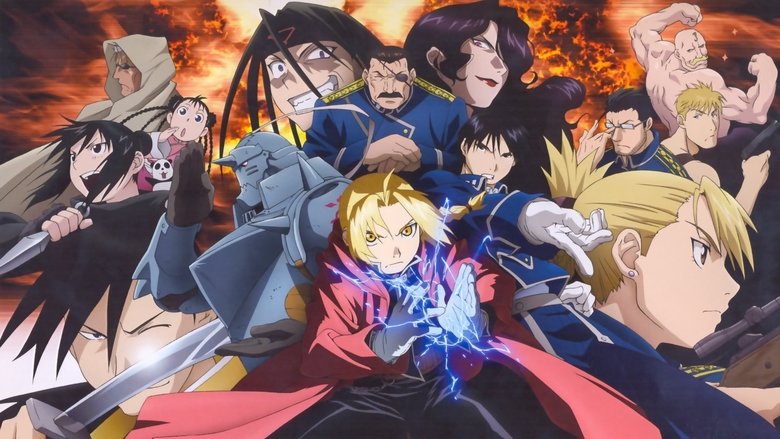
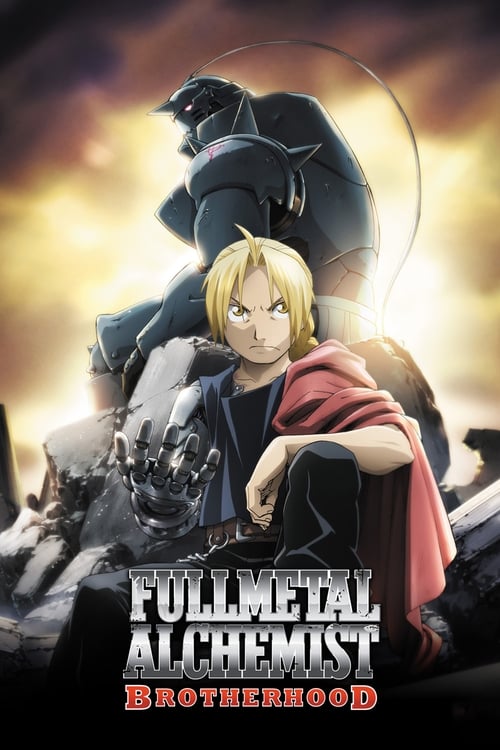
鋼の錬金術師 FULLMETAL ALCHEMIST
Cast: Rie Kugimiya, Romi Park, Shin-ichiro Miki, Fumiko Orikasa, Megumi Takamoto
Fullmetal Alchemist: Brotherhood — Symbolism & Philosophy
Symbols & Motifs
Ouroboros
The Ouroboros, a snake eating its own tail, symbolizes the endless cycle of life, death, and rebirth. For the Homunculi who bear this tattoo, it represents their cyclical regeneration and their false sense of immortality. It also signifies their self-contained, unnatural existence, as they are unable to truly grow or change beyond the sin they embody.
Each of the seven Homunculi has the Ouroboros tattoo somewhere on their body. Its placement often corresponds to where their Philosopher's Stone is housed. The symbol is a constant visual reminder of their non-human nature and their connection to their creator, Father.
The Gate of Truth
The Gate is a metaphysical portal that represents the universe's total knowledge and the ultimate source of alchemical power. It is also a reflection of the individual alchemist's own soul and understanding of the world. To see The Gate is to learn a profound, often painful, 'Truth' about oneself and the world, and it exacts a physical and mental toll as payment for that knowledge.
The Gate appears whenever an alchemist performs the taboo of human transmutation. Edward, Alphonse, Izumi Curtis, and Roy Mustang all see The Gate and lose something in return for the knowledge they gain. The final antagonist, Father, seeks to absorb the entity within The Gate to become a perfect being.
Flamel's Cross
This symbol, worn by Edward on his coat and tattooed on his teacher Izumi, is a cross with a crowned snake wrapped around it and wings at the top. It is based on the symbol of Nicolas Flamel, a real-world alchemist. It alludes to the Rod of Asclepius, representing healing and medicine, which aligns with the Elrics' goal to heal their bodies. The crucified snake can also symbolize fixing the volatile, or overcoming a deadly poison, reflecting the brothers' quest to overcome their past mistakes.
Edward wears the symbol prominently on the back of his red coat throughout the series. It serves as a visual identifier for the Fullmetal Alchemist and a constant reminder of his and his master's shared philosophy and goals.
Automail
The prosthetic automail limbs that Edward and others use symbolize both loss and resilience. They are a constant, physical reminder of a past sacrifice or trauma. However, they also represent the ability to overcome that loss, to stand up again, and to continue moving forward. They are a fusion of technology and humanity, blurring the lines of what it means to be whole.
Edward's right arm and left leg are automail, a constant presence in his life and fights. His childhood friend, Winry Rockbell, is his mechanic, making his automail a symbol of their deep bond. The maintenance and repair of the limbs provide key moments for character interaction and reflection on their journey.
Philosophical Questions
What is the true meaning of 'Equivalent Exchange'?
The series begins with a rigid, scientific definition of Equivalent Exchange: "to obtain, something of equal value must be lost." This is the law of alchemy. However, as the Elric brothers journey, they discover this law is insufficient to explain human experience. The pain of losing their mother is not equivalent to the components of a human body. The series explores this question by showing that the most important exchanges are not alchemical but emotional and moral. In the end, Edward redefines the principle. When proposing to Winry, he offers half his life for half of hers, but she rejects the premise, offering her whole life. The final, and truest, 'exchange' is Edward sacrificing his alchemy—his power—for his brother's soul, proving that the value of human connection transcends any quantifiable exchange.
What does it mean to be human?
This question is central to the series, explored through multiple characters. Alphonse is a human soul without a body, constantly questioning his own existence. The Homunculi are artificial beings with human forms and emotions but no soul, driven by singular sins. Chimeras like Nina Tucker are fusions of human and animal, trapped between identities. The series suggests that humanity is not defined by a physical body, but by the capacity for love, sacrifice, growth, and the acceptance of mortality. Father, who seeks to become a 'perfect being' by shedding his human limitations, is ultimately defeated because he cannot understand the strength found in these very 'flaws'.
Can one be redeemed from past sins?
Many characters in the series are haunted by their past actions. Roy Mustang and Riza Hawkeye grapple with their roles as 'human weapons' in the Ishvalan genocide. Scar begins as a vengeful killer, driven by the murder of his people. The Elric brothers' entire journey is a quest for redemption for their taboo act. The series suggests that redemption is possible, but not through simple atonement. It requires acknowledging one's sins, taking responsibility, and actively working to create a better future. Scar finds redemption by helping to rebuild Ishval, and Mustang seeks to lead the country towards peace. Redemption is portrayed as a difficult, ongoing process of changing oneself for the better.
Core Meaning
Explore More About This Movie
Dive deeper into specific aspects of the movie with our detailed analysis pages