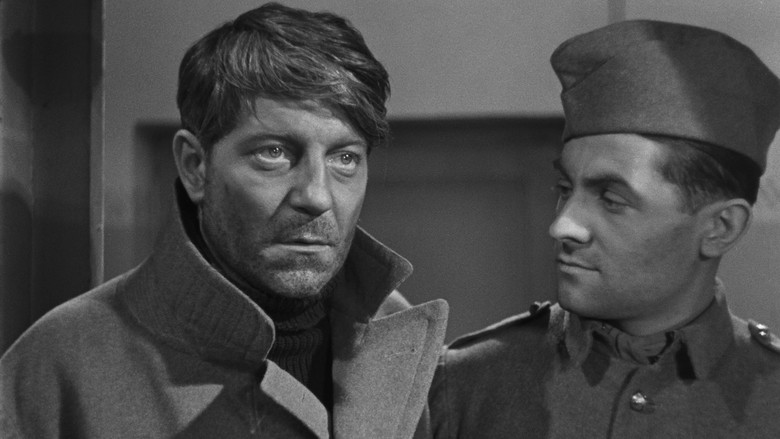
Grand Illusion
A poignant wartime drama where the fragile bonds of humanity transcend the artificial lines of class and nation, captured in the somber elegance of a prisoner-of-war camp.
Grand Illusion
Grand Illusion

La Grande Illusion

"A Great Drama of Human Emotions"

04 June 1937 France 114 min ⭐ 7.9 (745)
Director: Jean Renoir
Cast: Jean Gabin, Pierre Fresnay, Erich von Stroheim, Marcel Dalio, Dita Parlo
Drama War History
The Illusion of Borders and Nationalism Class Solidarity vs. National Allegiance Humanity and Pacifism The End of an Era
Box Office: $172,885

Grand Illusion - Ending Explained

⚠️ Spoiler Analysis

The plot of "Grand Illusion" culminates in the fortress prison of Wintersborn, where the final escape plan is set in motion. The central twist is the nature of Captain de Boeldieu's sacrifice. He deliberately creates a diversion, knowing it will likely cost him his life, so that Maréchal and Rosenthal can escape. The hidden meaning here is twofold. First, it is the ultimate act of class solidarity in reverse: the aristocrat gives his life so the common men—the future of France—can live. Second, it is a form of noble suicide; de Boeldieu admits to von Rauffenstein that their class is obsolete and that dying in the war is a "good solution."

The film's ending is deliberately ambiguous. Maréchal and Rosenthal successfully cross the border into Switzerland, with the German patrol ceasing fire once they are on neutral ground, visually demonstrating the arbitrary nature of frontiers. Maréchal has promised the German widow Elsa that he will return to her after the war. However, the film ends there, with the two men disappearing into the vast, snowy landscape. The audience is left to wonder if they will survive the rest of the war, and if Maréchal's promise can truly be kept. This open ending underscores the film's central theme: the bonds of humanity are real, but their survival in a world defined by artificial borders and conflict is the ultimate uncertainty.

Alternative Interpretations

While overwhelmingly viewed as a pacifist film, the political meaning of "Grand Illusion" is not entirely straightforward. Some interpretations challenge the simple anti-war reading. The film's plot, after all, revolves around the protagonists' relentless efforts to escape and rejoin the fighting. Renoir never suggests this duty is wrong; Maréchal explicitly worries about others "getting knocked off" while he is on the sidelines. This suggests a more complex view where the duty of a soldier and the absurdity of the war he fights exist in a state of tension.

Another interpretation focuses on the film's ending. While Maréchal promises to return to Elsa, the film offers no guarantee. An earlier version of the script reportedly ended with Maréchal and Rosenthal meeting after the war at Maxim's, but with two empty chairs at their table, implying they had either died or drifted back into their separate social worlds. The current, more hopeful ending can be seen as Renoir's choice for optimism, but the bleak alternative suggests a more cynical reading is possible: that the bonds formed under duress are temporary and that the "grand illusion" might also be the hope that these connections can survive the return to peacetime society.

Furthermore, while the film critiques nationalism, it also contains moments of intense patriotic fervor, most notably the prisoners' defiant singing of "La Marseillaise." This scene can be read not just as an act of rebellion, but as a genuine expression of national solidarity, complicating a purely anti-nationalist interpretation.