Grand Illusion
La Grande Illusion
"A Great Drama of Human Emotions"
Overview
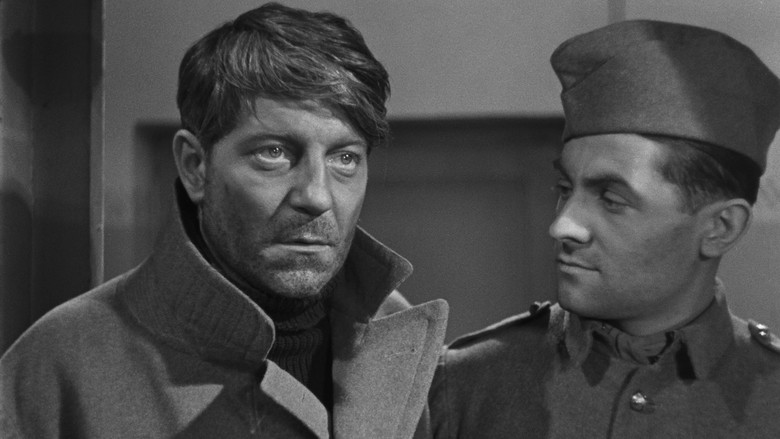
"Grand Illusion" (1937), directed by Jean Renoir, is a profound anti-war film set during World War I. It follows two French aviators, the working-class Lieutenant Maréchal (Jean Gabin) and the aristocratic Captain de Boeldieu (Pierre Fresnay), after they are shot down and captured by the German Captain von Rauffenstein (Erich von Stroheim), himself an aristocrat. The film explores the lives of these officers and their fellow prisoners in various German POW camps.
Instead of focusing on battles, the narrative delves into the relationships and class dynamics among the captured soldiers. They plan escapes, share food parcels, and find common ground that transcends national enmity. The bond between the two aristocrats, de Boeldieu and von Rauffenstein, highlights the film's theme that class allegiances can be stronger than national ones. Their shared background and values create a mutual respect that contrasts with the broader conflict.
The prisoners are eventually moved to a supposedly inescapable fortress prison, Wintersborn, commanded by a now-injured von Rauffenstein. Here, a final escape attempt is planned, leading to a climactic and tragic confrontation that underscores the film's central message about the futility of war and the end of an era.
Core Meaning
Jean Renoir's "Grand Illusion" posits that the divisions of nationality and the very concept of war are artificial constructs—the titular "grand illusion." The director intended to tell a story about human relationships and the common humanity that binds people, regardless of the vertical frontiers of nations. The film argues that horizontal divisions, such as social class, often create more profound connections or separations than national identity.
The central message is a powerful statement against war, not by depicting its violence, but by highlighting its absurdity and the shared humanity of the supposed enemies. Renoir uses the prisoner-of-war camp as a microcosm of society to explore how men from different backgrounds interact when stripped of their usual context. The film suggests that the old aristocratic order is dying, and its codes of honor are ill-suited for the modern world, while a new hope lies in the solidarity of the common man, represented by characters like Maréchal and Rosenthal.
Thematic DNA
The Illusion of Borders and Nationalism
The film's title refers to the idea that war and national boundaries are futile and artificial. This is most explicitly stated by Rosenthal, who, as he and Maréchal cross into Switzerland, remarks, "Frontiers are an invention of men. Nature doesn't give a hoot." The final scene, where German soldiers cease firing as the escapees cross an invisible line in the snow, visually reinforces this idea. The film consistently shows characters finding more in common with their enemies than their own countrymen of different social strata, thereby undermining the very basis of nationalist conflict.
Class Solidarity vs. National Allegiance
"Grand Illusion" examines how class structures transcend national lines. The aristocratic French Captain de Boeldieu and the German Captain von Rauffenstein share a profound bond based on their shared education, social codes, and language. They understand each other better than they do the working-class men in their own armies. This connection contrasts with the more practical, yet equally strong, camaraderie that develops between the working-class Maréchal and the wealthy bourgeois Rosenthal. De Boeldieu's ultimate sacrifice is for his countrymen, but it also signals his recognition that his aristocratic class has become obsolete.
Humanity and Pacifism
Renoir's film is a powerful anti-war statement that avoids depicting combat. Instead, it focuses on the shared humanity of the soldiers on both sides. The German soldiers are portrayed as polite and humane, not as monstrous enemies. From the opening scene where von Rauffenstein treats his captives as guests to Maréchal's romance with the German widow Elsa, the film repeatedly emphasizes personal connections over political conflict. Renoir stated his goal was to explore human relationships and express the "common humanity of men."
The End of an Era
The film serves as a eulogy for the European aristocracy, which World War I effectively dismantled. Von Rauffenstein and de Boeldieu are relics of a bygone era of chivalry and honor. De Boeldieu tells von Rauffenstein that for men like them, dying in the war is a "good solution" to their obsolescence. Von Rauffenstein's physical confinement in a neck brace and his posting away from the front lines symbolize the aristocracy's decay and inability to function in the modern world. His mournful cutting of his geranium after de Boeldieu's death is a poignant gesture for the end of their class.
Character Analysis
Captain de Boeldieu
Pierre Fresnay
Motivation
His primary motivation is adherence to a strict code of aristocratic honor and duty. He believes it is an officer's duty to escape. Ultimately, he is motivated by the realization that his world is vanishing and that his final, meaningful act is to aid the survival of those who will inherit the future.
Character Arc
De Boeldieu begins as a reserved, formal aristocrat who maintains a strict social distance from the lower-class Maréchal, whom he insists on addressing with the formal "vous". He finds his true peer in the German commander von Rauffenstein. Over time, he recognizes the futility of his class's position in the modern world. His final act is one of deliberate sacrifice; he orchestrates his own death to allow Maréchal and Rosenthal, the representatives of the future, to escape, thus bridging the class divide he once upheld.
Lieutenant Maréchal
Jean Gabin
Motivation
His motivation is simple and direct: survival and freedom. He feels a duty to escape and rejoin the fight, driven by a sense of patriotism and loyalty to his fellow soldiers.
Character Arc
Maréchal is a working-class mechanic, pragmatic and down-to-earth. Initially, he is frustrated by de Boeldieu's formality. Throughout his imprisonment and multiple escape attempts, he develops a deeper understanding of solidarity. His journey from a cynical soldier to a man capable of love (with the German widow Elsa) and deep friendship (with Rosenthal) represents the hope for a future based on common humanity rather than class or nationality. His character was inspired by the real-life WWI pilot Armand Pinsard.
Captain von Rauffenstein
Erich von Stroheim
Motivation
He is motivated by a rigid adherence to duty and the aristocratic code of honor he shares with de Boeldieu. He must prevent escapes, yet he does so with a sense of regret and tragic necessity, understanding that in fulfilling his duty, he is destroying the very world he values.
Character Arc
Von Rauffenstein is a proud, aristocratic German officer who feels a greater kinship with his French counterpart, de Boeldieu, than with his own common soldiers. After being severely injured in battle, he is relegated to commanding a prison, a role he finds distasteful. His body, held together by a metal brace, mirrors the decay of his social class. He is forced to kill the man he respects most, an act that leaves him heartbroken and alone, a living symbol of a dead world.
Lieutenant Rosenthal
Marcel Dalio
Motivation
Like the others, he is motivated by the desire to escape and rejoin the fight. He is also driven by a deep sense of camaraderie and generosity, using his wealth and resources to help his fellow soldiers.
Character Arc
Rosenthal is a generous son of a wealthy Jewish banking family. He represents a different kind of elite—the nouveau riche. He generously shares his lavish food parcels with his fellow prisoners, breaking down social barriers through shared meals. As an escape partner with Maréchal, he forms a deep bond based on mutual reliance, overcoming prejudice. His character's positive portrayal was a deliberate statement against the rising anti-Semitism in Europe at the time.
Symbols & Motifs
The Geranium
The single geranium is the only touch of life and beauty in the sterile, stone fortress of Wintersborn. It symbolizes the fragile code of honor and humanity that von Rauffenstein clings to. It may also represent the dying aristocracy itself—a delicate thing out of place in a harsh, modern world.
The geranium is kept by Captain von Rauffenstein in his room at Wintersborn. After he is forced to shoot de Boeldieu, he mournfully cuts the single flower—the only one that has bloomed. This gesture serves as a final, poignant tribute to his fallen friend and the class they both represent.
Borders and Frontiers
Borders—whether national, social, or linguistic—are presented as artificial and meaningless human constructs that nature ignores. They are the source of the central "illusion" that the film deconstructs.
The theme of borders is constant, from the linguistic barriers between prisoners to the rigid social divide between officers like de Boeldieu and Maréchal. The final scene provides the most powerful illustration: Maréchal and Rosenthal escape into Switzerland by crossing an unmarked border in the snow, a line that exists only on a map and in the minds of the soldiers who stop their pursuit.
The Tin Flute
The small tin flute symbolizes de Boeldieu's aristocratic detachment and his final, heroic act of defiance. It is an instrument of folk and common soldiers, yet he uses it to create a diversion based on a gentleman's code of honor, bridging the class divide in his final moments.
During the escape from Wintersborn, Captain de Boeldieu creates a distraction by playing the flute atop the castle ramparts. His seemingly frivolous act draws the attention of the German guards, allowing Maréchal and Rosenthal to escape. It is this act that leads to him being shot by a reluctant von Rauffenstein.
White Gloves
The white gloves represent the formal, ritualistic, and ultimately anachronistic code of the aristocracy. They are a symbol of a class more concerned with propriety and appearance than with the brutal reality of the world changing around them.
Captain de Boeldieu maintains his impeccable appearance throughout his imprisonment, notably wearing white gloves. He puts on a fresh pair just before he sacrifices himself, signifying his adherence to his aristocratic code even in death. Von Rauffenstein also remarks upon them, recognizing them as a symbol of their shared identity.
Memorable Quotes
Frontiers are an invention of men. Nature doesn't give a hoot.
— Lieutenant Rosenthal
Context:
Spoken near the end of the film as Maréchal and Rosenthal trudge through the deep snow towards Switzerland. Maréchal expresses doubt about their location, and Rosenthal delivers this line, pointing out the ultimate "grand illusion" of nationalism.
Meaning:
This line encapsulates the film's central theme. It dismisses the concept of national borders as artificial human constructs that have no basis in the natural world, highlighting the absurdity of wars fought over such lines.
For a commoner, dying in a war is a tragedy. But for you and me, it's a good way out.
— Captain de Boeldieu
Context:
Said by a dying de Boeldieu to a grieving von Rauffenstein after being shot during the escape attempt at Wintersborn. It is a moment of profound understanding between the two men about their shared fate.
Meaning:
This quote, spoken to von Rauffenstein, reveals de Boeldieu's fatalistic understanding that the aristocracy is a dying class. He sees death in battle not as a tragedy, but as a fitting and dignified end for a class that no longer has a place in the world.
Whatever the outcome, it will mean the end of the Rauffensteins and the Boeldieus.
— Captain von Rauffenstein
Context:
This line is spoken to de Boeldieu at the fortress of Wintersborn, as the two men reflect on their shared past and the changing world that has rendered them obsolete.
Meaning:
Von Rauffenstein expresses the same sentiment as de Boeldieu: that regardless of which nation wins the war, their shared aristocratic way of life is doomed. It shows that his allegiance is more to his class than his country.
Philosophical Questions
Are the boundaries that divide us (nation, class, language) real or illusory?
The film relentlessly explores this question by showing how these "vertical frontiers" are constantly undermined by "horizontal" connections. The aristocrats de Boeldieu and von Rauffenstein connect across enemy lines due to their shared class, while the working-class Maréchal bonds with Rosenthal and falls in love with a German woman. Language is shown as both a barrier and a bridge. The film's conclusion, with the escape across an invisible border, powerfully suggests that these divisions are ultimately man-made illusions that nature does not recognize.
What is the nature of duty in a seemingly meaningless conflict?
The characters are all bound by different codes of duty. De Boeldieu and von Rauffenstein adhere to an aristocratic code of honor, which dictates their actions even when it leads to tragic outcomes. Maréchal and the other officers are driven by a soldier's duty to escape and fight for their country. The film questions the value of these duties within the context of a war it portrays as absurd. De Boeldieu's sacrifice is the ultimate fulfillment of his duty, yet it is also an admission that his code is obsolete. The film leaves open the question of whether fulfilling one's duty in a flawed system is heroic or tragic.
Can our shared humanity overcome the systems designed to divide us?
This is the central, hopeful question of the film. Renoir answers with a qualified 'yes'. Throughout the narrative, acts of kindness, respect, and love flourish across enemy lines. The French prisoners share food and work together, Maréchal and Elsa fall in love despite being enemies, and von Rauffenstein mourns de Boeldieu's death. However, the film is not naive. It acknowledges prejudice, as when Maréchal makes an anti-Semitic remark to Rosenthal. The ending is hopeful but ambiguous, leaving the audience to ponder whether the human connections forged in the crucible of war can truly last in the world outside the prison camp.
Alternative Interpretations
While overwhelmingly viewed as a pacifist film, the political meaning of "Grand Illusion" is not entirely straightforward. Some interpretations challenge the simple anti-war reading. The film's plot, after all, revolves around the protagonists' relentless efforts to escape and rejoin the fighting. Renoir never suggests this duty is wrong; Maréchal explicitly worries about others "getting knocked off" while he is on the sidelines. This suggests a more complex view where the duty of a soldier and the absurdity of the war he fights exist in a state of tension.
Another interpretation focuses on the film's ending. While Maréchal promises to return to Elsa, the film offers no guarantee. An earlier version of the script reportedly ended with Maréchal and Rosenthal meeting after the war at Maxim's, but with two empty chairs at their table, implying they had either died or drifted back into their separate social worlds. The current, more hopeful ending can be seen as Renoir's choice for optimism, but the bleak alternative suggests a more cynical reading is possible: that the bonds formed under duress are temporary and that the "grand illusion" might also be the hope that these connections can survive the return to peacetime society.
Furthermore, while the film critiques nationalism, it also contains moments of intense patriotic fervor, most notably the prisoners' defiant singing of "La Marseillaise." This scene can be read not just as an act of rebellion, but as a genuine expression of national solidarity, complicating a purely anti-nationalist interpretation.
Cultural Impact
"Grand Illusion" was released in 1937, on the cusp of another devastating world war, and served as a powerful, pacifist plea for peace. Its humanistic message resonated deeply in a Europe facing the rise of fascism. The film was an immediate critical and commercial success internationally, winning awards at the Venice Film Festival and from New York critics. However, its anti-war and anti-nationalist stance led to it being banned in Nazi Germany, Fascist Italy, and even, for a time, in France itself for fear of damaging morale.
Its influence on cinema is immense. It is considered a cornerstone of French Poetic Realism and one of the greatest films ever made. Orson Welles famously stated that if he could save only two films "on the ark," "Grand Illusion" would be one of them. The film's narrative structure and themes have influenced countless subsequent prisoner-of-war and escape films, such as "Stalag 17" and "The Great Escape," and its iconic scene of prisoners singing "La Marseillaise" was echoed in "Casablanca". The film's deep-focus photography and long takes, which keep characters grounded in their environment, were hallmarks of Renoir's style and influenced future generations of filmmakers.
The film's central philosophical argument—that common humanity transcends artificial divisions—remains profoundly relevant. It continues to be studied for its sophisticated critique of class, nationalism, and the absurdity of war, making it a timeless work of art that speaks to audiences across generations.
Audience Reception
Upon its release in 1937, "Grand Illusion" was a massive critical and popular success, both in its native France and internationally. In France, it sold twelve million tickets. It was praised by figures like Franklin D. Roosevelt and won numerous awards, becoming the first foreign-language film to be nominated for the Best Picture Oscar. Audiences and critics were moved by its profound humanism, its subtle anti-war message, and its powerful performances, particularly by Jean Gabin and Erich von Stroheim.
However, the reception was not universally positive. Its pacifist message was seen as dangerous by authoritarian regimes; it was banned by the Nazis in Germany and Fascists in Italy. Even in France, it was later banned during World War II for fear it would weaken the will to fight. After the war, its reception among French critics was more mixed, with some finding its message of class solidarity dated, though audiences continued to love it. Today, it is overwhelmingly regarded by audiences and critics as one of the greatest films ever made, praised for its timeless message of peace and shared humanity.
Interesting Facts
- The film was declared "Cinematic Public Enemy No. 1" by Nazi propaganda minister Joseph Goebbels, who ordered all prints to be confiscated and destroyed.
- "Grand Illusion" was the first foreign-language film ever to be nominated for the Academy Award for Best Picture.
- The story was inspired by the real-life wartime experiences of director Jean Renoir, who served as a reconnaissance pilot, and his friend Armand Pinsard, who was shot down and escaped from POW camps seven times.
- Actor Erich von Stroheim, an Austrian-American, reportedly struggled with speaking his German lines, having been away from Europe for so long. It was also his idea for the character von Rauffenstein to wear a neck and back brace, making his physical and social rigidity visible.
- President Franklin D. Roosevelt was a huge proponent of the film, allegedly saying, "Everyone who believes in democracy should see this film." It was screened at the White House.
- The film's title is derived from the 1909 book "The Great Illusion" by Norman Angell, which argued that war in Europe was futile due to the nations' common economic interests.
- The original negative of the film was long thought to be lost after being seized by the Nazis. It was rediscovered in the 1950s, having been saved by a German officer. Renoir himself supervised the reconstruction.
- Jean Gabin wears Jean Renoir's actual World War I uniform in the film.
⚠️ Spoiler Analysis
Click to reveal detailed analysis with spoilers
Frequently Asked Questions
Explore More About This Movie
Dive deeper into specific aspects of the movie with our detailed analysis pages
Comments (0)
No comments yet. Be the first to share your thoughts!