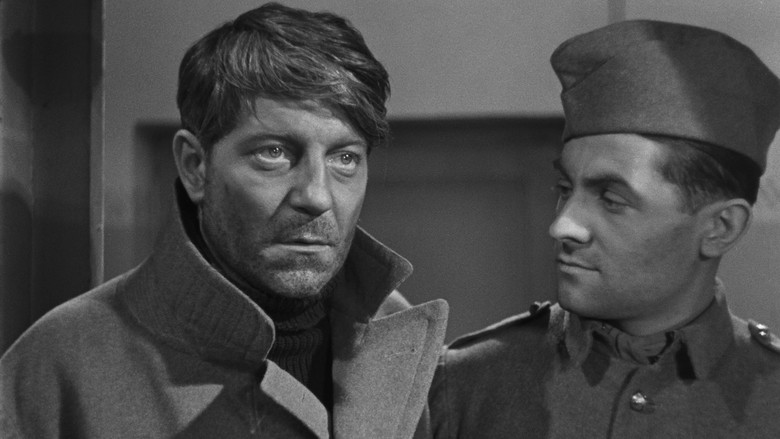

La Grande Illusion
"A Great Drama of Human Emotions"
Grand Illusion - Symbolism & Philosophy
Symbols & Motifs
The Geranium
The single geranium is the only touch of life and beauty in the sterile, stone fortress of Wintersborn. It symbolizes the fragile code of honor and humanity that von Rauffenstein clings to. It may also represent the dying aristocracy itself—a delicate thing out of place in a harsh, modern world.
The geranium is kept by Captain von Rauffenstein in his room at Wintersborn. After he is forced to shoot de Boeldieu, he mournfully cuts the single flower—the only one that has bloomed. This gesture serves as a final, poignant tribute to his fallen friend and the class they both represent.
Borders and Frontiers
Borders—whether national, social, or linguistic—are presented as artificial and meaningless human constructs that nature ignores. They are the source of the central "illusion" that the film deconstructs.
The theme of borders is constant, from the linguistic barriers between prisoners to the rigid social divide between officers like de Boeldieu and Maréchal. The final scene provides the most powerful illustration: Maréchal and Rosenthal escape into Switzerland by crossing an unmarked border in the snow, a line that exists only on a map and in the minds of the soldiers who stop their pursuit.
The Tin Flute
The small tin flute symbolizes de Boeldieu's aristocratic detachment and his final, heroic act of defiance. It is an instrument of folk and common soldiers, yet he uses it to create a diversion based on a gentleman's code of honor, bridging the class divide in his final moments.
During the escape from Wintersborn, Captain de Boeldieu creates a distraction by playing the flute atop the castle ramparts. His seemingly frivolous act draws the attention of the German guards, allowing Maréchal and Rosenthal to escape. It is this act that leads to him being shot by a reluctant von Rauffenstein.
White Gloves
The white gloves represent the formal, ritualistic, and ultimately anachronistic code of the aristocracy. They are a symbol of a class more concerned with propriety and appearance than with the brutal reality of the world changing around them.
Captain de Boeldieu maintains his impeccable appearance throughout his imprisonment, notably wearing white gloves. He puts on a fresh pair just before he sacrifices himself, signifying his adherence to his aristocratic code even in death. Von Rauffenstein also remarks upon them, recognizing them as a symbol of their shared identity.
Philosophical Questions
Are the boundaries that divide us (nation, class, language) real or illusory?
The film relentlessly explores this question by showing how these "vertical frontiers" are constantly undermined by "horizontal" connections. The aristocrats de Boeldieu and von Rauffenstein connect across enemy lines due to their shared class, while the working-class Maréchal bonds with Rosenthal and falls in love with a German woman. Language is shown as both a barrier and a bridge. The film's conclusion, with the escape across an invisible border, powerfully suggests that these divisions are ultimately man-made illusions that nature does not recognize.
What is the nature of duty in a seemingly meaningless conflict?
The characters are all bound by different codes of duty. De Boeldieu and von Rauffenstein adhere to an aristocratic code of honor, which dictates their actions even when it leads to tragic outcomes. Maréchal and the other officers are driven by a soldier's duty to escape and fight for their country. The film questions the value of these duties within the context of a war it portrays as absurd. De Boeldieu's sacrifice is the ultimate fulfillment of his duty, yet it is also an admission that his code is obsolete. The film leaves open the question of whether fulfilling one's duty in a flawed system is heroic or tragic.
Can our shared humanity overcome the systems designed to divide us?
This is the central, hopeful question of the film. Renoir answers with a qualified 'yes'. Throughout the narrative, acts of kindness, respect, and love flourish across enemy lines. The French prisoners share food and work together, Maréchal and Elsa fall in love despite being enemies, and von Rauffenstein mourns de Boeldieu's death. However, the film is not naive. It acknowledges prejudice, as when Maréchal makes an anti-Semitic remark to Rosenthal. The ending is hopeful but ambiguous, leaving the audience to ponder whether the human connections forged in the crucible of war can truly last in the world outside the prison camp.
Core Meaning
Jean Renoir's "Grand Illusion" posits that the divisions of nationality and the very concept of war are artificial constructs—the titular "grand illusion." The director intended to tell a story about human relationships and the common humanity that binds people, regardless of the vertical frontiers of nations. The film argues that horizontal divisions, such as social class, often create more profound connections or separations than national identity.
The central message is a powerful statement against war, not by depicting its violence, but by highlighting its absurdity and the shared humanity of the supposed enemies. Renoir uses the prisoner-of-war camp as a microcosm of society to explore how men from different backgrounds interact when stripped of their usual context. The film suggests that the old aristocratic order is dying, and its codes of honor are ill-suited for the modern world, while a new hope lies in the solidarity of the common man, represented by characters like Maréchal and Rosenthal.