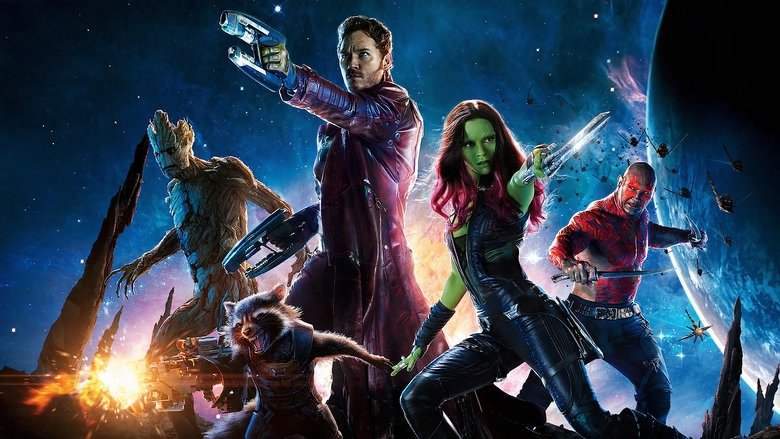
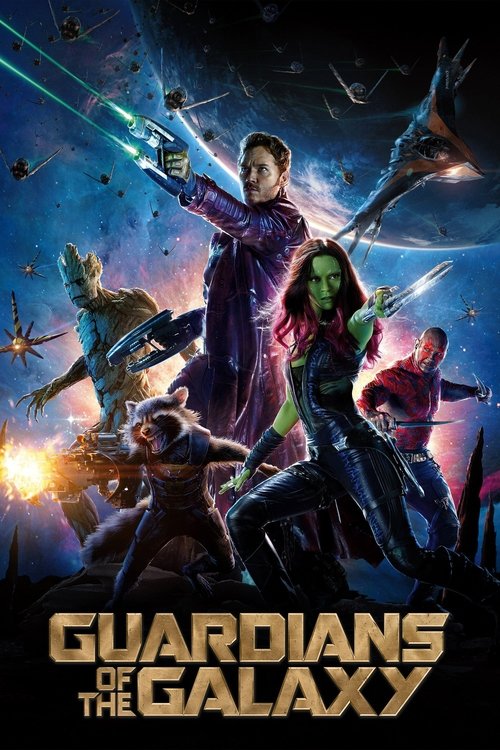
Full spoilers follow. The prologue establishes the wound the entire film is built around: a young Peter Quill refuses to hold his dying mother's hand, flees the hospital, and is abducted from Earth by Yondu's Ravagers, taking with him a Walkman, a cassette labeled Awesome Mix Vol. 1, and an unopened present.
Decades later Quill steals a mysterious Orb on Morag, triggering a bounty that collides him with Gamora (sent by Ronan to retrieve it, but secretly planning to betray him) and with Rocket and Groot, who want the price on Quill's head. Arrested and thrown into the Kyln, they meet Drax, who wants Gamora dead because she served Ronan, the Kree fanatic who murdered his wife and daughter. They escape together and take the Orb to the Collector on Knowhere — a mining colony built inside the severed head of a Celestial — where the reveal lands: the Orb contains an Infinity Stone, the Power Stone, capable of destroying entire planets and of annihilating anyone who touches it directly. The Collector's assistant demonstrates by seizing it and being obliterated.
Drax, drunk on revenge, summons Ronan to Knowhere. In the chaos Ronan takes the Orb, and on discovering it holds an Infinity Stone he renounces Thanos entirely — embedding the Stone in his war hammer and declaring he will purify Xandar alone. This is the moment the film quietly redefines its own scale: Thanos, presented as the galaxy's ultimate power, is revealed as a patron whose servants can outgrow him, seeding the MCU's larger Infinity Stone arc.
The Guardians choose to defend Xandar rather than run — the turn from criminals to heroes — allying with the Nova Corps and Yondu's Ravagers. In the assault on Ronan's ship, the Dark Aster, Nebula abandons her sister and escapes; Ronan, wielding the Stone, is briefly unstoppable because the Stone's destructive effect on its bearer is slow rather than instant, giving him time to be a god. As the crashing Dark Aster is about to kill them all, Groot extends his body into a protective cocoon around the others, and to Rocket's protest answers with the film's only variation on his single line: 'We are Groot.' He is shattered in the impact.
On the ground, Ronan survives and prepares to destroy the planet. Quill's response is the film's most famous absurdity: he challenges Ronan to a dance-off, and the sheer incomprehensibility of the gesture stalls the fanatic long enough for Drax and Rocket to destroy the hammer. Quill catches the loose Stone and is being burned alive by it when Gamora, then Drax, then Rocket take hold of him — the Stone becomes survivable only when shared, which is the thematic argument of the whole film rendered as visual effect. They turn it on Ronan and disintegrate him.
The coda resolves the prologue's unfinished business. Quill finally opens his mother's gift: Awesome Mix Vol. 2. The Stone is entrusted to the Nova Corps, and the Xandarian government absolves the Guardians of their prior crimes and honors them — an official recognition that these people are now something other than what they were. Rocket plants a surviving twig of Groot, which sprouts into a sapling that dances to music the moment Rocket's back is turned, in the mid-credits scene where Drax tries to catch him. A second stinger finds Howard the Duck drinking with the Collector amid the ruins of his museum.
What becomes clear only in retrospect: the Orb was never the object of the story — it was the excuse to force five people who trust no one into proximity long enough to become a family. Quill's refusal to take his mother's hand in the opening scene is answered exactly when he takes his crew's hands in the finale, and the entire film can be read as the distance between those two gestures.